
You’ve probably encountered it. That unmistakable flatness in AI-generated content. The kind of writing that feels like it was assembled from a thousand generic articles, all pressed together with perfect grammar but zero personality. It reads like a robot wrote it because, well, a robot did.
The problem? Your audience can tell. Google’s algorithms are getting better at detecting it. Your readers bounce away. And worst of all, your brand voice disappears.
But here’s what most people get wrong: AI writing doesn’t have to sound like a machine. The difference between robotic AI content and human-quality AI writing isn’t luck. It’s a skill you can learn and master. In this guide, I’ll show you exactly how to use AI as a powerful writing tool while keeping your content authentic, engaging, and search-friendly.
Quick Reference: What You’ll Learn
The Core Problem: AI defaults to predictable patterns, generic language, and formal tone because it’s trained on the average. Breaking these patterns requires intentional editing and human input.
The Solution: Better prompts + strategic editing + personal voice = content that ranks and resonates.
Best Workflow: Research → Refined Prompts → AI Draft → Human Edit → SEO Optimization → Fact-Check → Publish
Key Tools You’ll Need: ChatGPT or Claude for drafts, Grammarly for flow, Hemingway Editor for readability, Surfer SEO for optimization
Common Killer Mistakes: Publishing first drafts, using vague prompts, skipping fact-checking, and ignoring your brand voice
Why AI Writing Often Falls Flat (And How to Fix It)
Let me show you what robotic AI writing actually looks like:
Robotic Version: “Artificial intelligence has become increasingly important in today’s digital landscape. Many businesses are leveraging AI technology to streamline their operations and enhance productivity. The benefits of artificial intelligence are numerous and can significantly impact business outcomes.”
See the problem? “Increasingly important,” “leveraging,” “numerous benefits” – these are placeholder phrases that appear in thousands of generic articles. There’s no specificity. No voice. No reason to keep reading.
Human-Edited Version: “Your competitor is probably using AI right now. Not to replace their team, but to eliminate busywork so their best people can focus on strategy. If you’re still manually writing reports or organizing customer data at 2 PM on a Tuesday, you’re already falling behind.”
Same topic. Completely different impact.
Here’s what makes AI writing sound robotic:
Predictable sentence patterns: AI gravitates toward similar structures. Subject-verb-object. One sentence states a fact, the next adds supporting information. This creates a monotonous rhythm.
Generic vocabulary: Words like “innovative,” “streamline,” “leverage,” and “enhance” appear in AI content because they appear in millions of training documents. They’re safe defaults.
Overly formal tone: Most training data skews professional and academic, so AI defaults to formal language even when conversational tone would be more engaging.
Missing personal perspective: AI can’t draw from lived experience. It can’t say “I’ve seen this fail three times” because it hasn’t lived through anything.
No emotional intelligence: Humans write with awareness of reader emotions. We anticipate frustration and validate it. AI can mimic this structure but rarely with authenticity.
Start With Better Prompts (Your First Real Lever)
Most people write terrible prompts and then blame the AI.
Bad Prompt: “Write an article about AI writing tools”
This gives AI zero guidance. It will produce something generic because it has no constraints, no perspective, no target audience.
Better Prompt: “I’m a freelance writer who’s skeptical of AI. Write a 300-word section explaining how ChatGPT can actually speed up my workflow without replacing my voice. Use specific examples of tasks it handles well (research, outlining, first drafts) and be honest about where it falls short. Write in a conversational tone, like I’m talking to a colleague at a coffee shop. Avoid corporate jargon. Include one concrete example of a workflow improvement.”
Notice the difference?
The second prompt includes:
- A specific persona (freelance writer, skeptical)
- Tone guidance (conversational, colleague-to-colleague)
- Structure hints (specific examples, honest limitations)
- Content boundaries (what to include, what to avoid)
- Length specification
Here’s a real-world example from a client project. A SaaS company needed blog content about their project management tool.
First attempt: “Write about project management tools” AI produced: “Project management tools are essential for modern teams. They help teams collaborate, stay organized, and improve productivity.”
Useless.
Refined prompt: “Write like you’re a busy product manager who just switched from spreadsheets to our tool. Explain the moment you realized spreadsheets were slowing you down – maybe when you couldn’t find a deadline because it was hidden in a comment. Then show how the tool solved it. Use casual language. Include specific frustrations (lost emails, multiple versions of files, last-minute surprises). Write 400 words. Make it funny where possible.”
Result? AI produced: “You know that moment when you realize you’ve been checking the same three emails all week looking for that deadline Karen mentioned in the thread? Yeah. Spreadsheets don’t have a search function. Or notifications. Or any way to track who actually read your update.”
It was usable. Needed editing, but it had direction and personality.
Prompt engineering formula that works:
Give AI a role. (“You’re a data analyst explaining this to your manager”) Define the audience. (“For busy founders with no technical background”) Set the tone. (“Casual, slightly irreverent, no corporate speak”) Provide examples. (“Like how Netflix personalizes recommendations”) Specify length and structure. (“500 words, start with a surprising stat, then give three actionable tips”)
Add the Human Touch: Where Editing Becomes Art
Here’s a section of AI-generated content I actually received from Claude:
“The implementation of machine learning algorithms requires careful consideration of data quality parameters. Organizations must ensure training datasets are comprehensive and representative of real-world scenarios to achieve optimal model performance.”
Technically correct. Utterly lifeless.
I rewrote it:
“You could have the smartest algorithm in the world, but if your training data is garbage, your results will be garbage too. It’s like trying to teach someone to cook with expired ingredients. A restaurant that builds its menu on bad produce will never get repeat customers.”
Same information. One tells. One shows. One sells.
Real editing workflow from a recent project:
I was writing about email management tools for a marketing agency. The AI draft said: “Email management tools help professionals organize their inboxes more efficiently.”
My edit: “Your team probably wastes 45 minutes a day digging through email. Not checking email. Digging. Looking for that client feedback from last week. Re-reading the same conversation thread because no one assigned it to anyone. Finding out about a meeting change from a reply-all chain. Email management tools don’t make digging faster. They remove the need to dig.”
The transformation required:
- Removing generic language (“help professionals organize”)
- Adding specific pain (45 minutes, specific frustrations)
- Using analogies (remove need vs. make faster)
- Writing from reader perspective (your team, not organizations)
How to edit like a pro:
Read the AI draft aloud first. You’ll instantly hear where it sounds robotic. Where the rhythm breaks. Where a phrase doesn’t sound like how you actually speak.
Identify the one insight worth keeping, then rebuild everything else around it. Don’t try to salvage every sentence.
Add examples from your actual experience. “Our client once lost a $50K contract because an important email got buried in their inbox.” That’s real. That’s memorable. That’s something AI can’t invent.
Remove 30% of adjectives. “The innovative, cutting-edge AI platform” becomes “The AI platform.” Stronger.
Break up long sentences. “Organizations that implement AI writing tools often experience increased productivity as their teams learn to leverage automation while maintaining quality standards” becomes two sentences: “Teams see productivity gains when they switch to AI. But only if they learn to use it properly.”
A Real-World Editing Example (Before & After)
AI Generated (First Draft):
“Content creation is a challenging process that requires significant time and effort. Writers must conduct research, organize information, and produce high-quality content. Many content creators struggle with writer’s block and find it difficult to maintain consistent output. AI writing tools can help address these challenges by providing assistance throughout the content creation process.”
Professional Edit:
“Writing takes forever. Research, organization, drafting, editing – it’s a full day’s work for 2,000 words. And just when you hit a rhythm, you hit a wall. You’ve got no ideas. Everything sounds forced.
That’s where AI changes the game. It doesn’t replace the thinking part (that’s still on you). But it handles the mechanical parts – the outlining, the research synthesis, the first-draft clunkiness. You focus on making it human. AI handles making it complete.”
Changes made:
- Removed corporate abstractions (“significant time and effort” → “it takes forever”)
- Added specific details (2,000 words, full day, hitting walls)
- Used contractions (it’s, you’ve, that’s – sounds conversational)
- Changed passive voice to active (writers struggle → you hit a wall)
- Added metaphor (hitting a wall, hitting rhythm)
- Reframed the relationship (AI doesn’t replace, it handles specific parts)
Building Your Editing Checklist
When you sit down to edit AI-generated content, use this workflow:
Step 1: Read Aloud Print it or read it from your phone. Your ear catches what your eyes miss.
Step 2: Cut Generic Phrases “It’s important to note,” “as mentioned above,” “in today’s world” – delete these immediately.
Step 3: Add Specificity Replace “many people” with numbers. Replace “helps you” with what specifically happens.
Step 4: Inject Voice Add contractions. Use short sentences. Ask rhetorical questions. Write like you talk.
Step 5: Verify Claims Google everything the AI stated. AI hallucinates. Not maliciously, but confidently. You’re responsible for accuracy.
Step 6: Add Examples This is where AI content becomes valuable content. Real examples from your work, your industry, your life.
Step 7: Format for Scanning Use subheadings, bold key points, break up long paragraphs. Mobile readers won’t read walls of text.
Tools That Make AI Content Human
You don’t need to buy everything. Here’s what actually works:
| Tool | Best For | Why It Matters | Real Use |
| ChatGPT/Claude | First drafts, outlining, research | Speed and reliability | Generate first draft in 10 minutes instead of 90 |
| Grammarly | Grammar and flow | Catches repetition and awkward phrasing | Highlights when you’ve used a word 6 times |
| Hemingway Editor | Readability and simplification | Identifies complex sentences | Shows sentences that should be split into two |
| Surfer SEO | Semantic optimization | Ensures you match search intent | Tells you what keywords competitors rank for |
| Google Scholar | Fact-checking | Verifies claims against research | Proves statistics are accurate |
The Workflow That Works for Different People
For Bloggers (Solo Content Creator):
- Pick a topic you understand deeply
- Write a detailed prompt with your angle
- Generate AI draft (300-400 words)
- Edit for voice and add 2-3 personal examples
- Check facts against Google Scholar
- Read aloud once
- Publish
Total time: 60-90 minutes for 1,500 words. Without AI: 3-4 hours.
For Freelance Writers (Client Work):
- Read client brief thoroughly
- Research competitor articles
- Create AI outline based on brief
- Rewrite outline to match client brand
- Generate sections (don’t do full article at once – section by section is better)
- Edit each section as you go
- Write intro and conclusion manually
- Final proofread
- Deliver
Time savings: 40-50% on client projects.
For Marketing Agencies (Team Content):
- Set brand voice guidelines in a shared doc
- Create template prompts that include brand tone
- One person generates drafts
- Different person edits (fresh perspective)
- Third person fact-checks
- Designer adds visuals
The key: multiple humans touching the content. This prevents AI sameness.
10 Mistakes That Make AI Content Sound Robotic (And How to Fix Them)
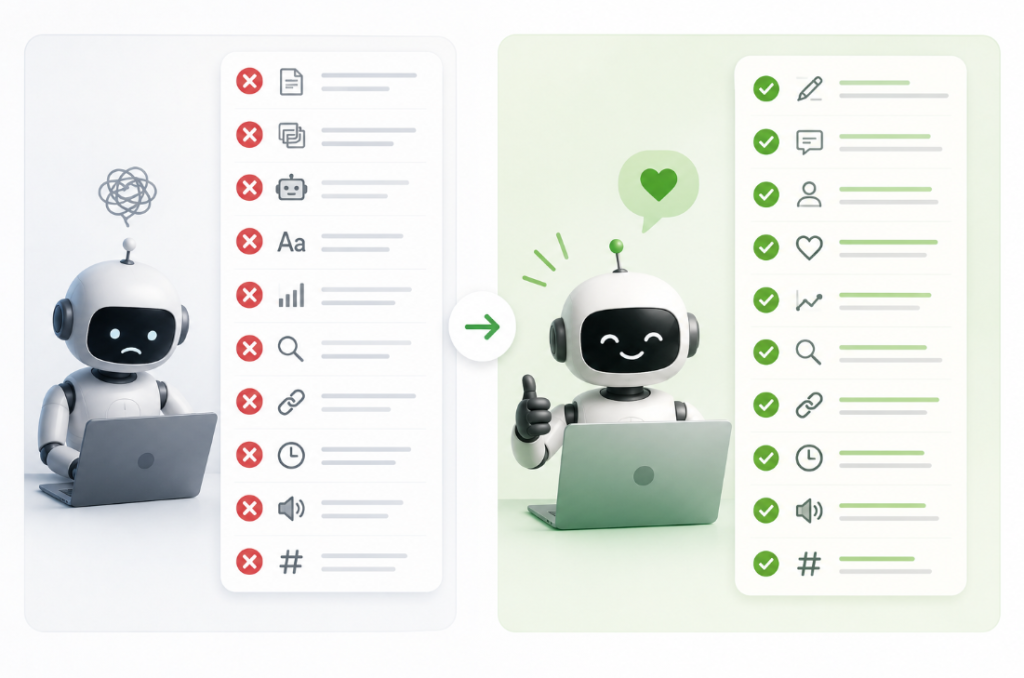
Mistake 1: Publishing Without Editing
The biggest mistake. AI first drafts are never publication-ready. Fix: Treat AI output as a rough outline, not a final product.
Mistake 2: Using Vague Prompts
“Write about productivity” gives AI nothing to work with. Fix: Prompt like you’re explaining the task to a colleague. Be specific about tone, audience, angle.
Mistake 3: Ignoring Your Brand Voice
AI doesn’t know if you’re formal or casual, funny or serious. Fix: Show AI examples of your best writing. Include voice guidelines in every prompt.
Mistake 4: Repeating Keywords Unnaturally
“AI writing tools help with AI writing. AI writing is faster. Many AI writing tools…” Fix: Use semantic variations. “AI writing assistants,” “generative AI platforms,” “AI copywriting software” – same topic, different words.
Mistake 5: Zero Fact-Checking
AI confidently states things that are completely wrong. Fix: Verify every statistic, date, and specific claim against original sources.
Mistake 6: All Examples Are Generic
AI examples are usually… fine. But forgettable. Fix: Replace AI examples with real ones from your work, your clients, your industry.
Mistake 7: No Emotional Elements
Robotic content states facts. Human content validates reader frustration first. Fix: Open with acknowledgment of the reader’s actual problem, then solve it.
Mistake 8: Paragraph Walls
Long blocks of text are intimidating on mobile. Fix: Break every paragraph into 2-3 sentences. Use subheadings liberally.
Mistake 9: Formal Tone for Informal Topics
Writing about productivity hacks in corporate-speak sounds off. Fix: Match tone to topic. Casual topics need casual language.
Mistake 10: No Real Voice or Opinions
Balanced, neutral content sounds generic. Fix: Take a perspective. “This approach beats the alternatives because…” or “Most people do this wrong. Here’s what actually works.”
Real-World Use Cases
Case Study 1: Freelance Writer, 3 Blog Clients
Maria was spending 30+ hours per week on blog content for three clients. Each had different voice guidelines. She was burned out.
Process she implemented:
- ChatGPT for research synthesis and outlines (saves 1 hour per article)
- Hemingway Editor to check readability (5 minutes)
- Manual rewrite of introduction and conclusion (15 minutes)
- Added one personal example per section (10 minutes)
- Final proofread using text-to-speech (10 minutes)
Result: 20 hours per week on the same 3 clients. Same quality, maintained voices, not exhausted anymore.
Case Study 2: SaaS Marketing Manager
Jake’s company needed blog content but couldn’t hire a full writer. Budget was $0.
Instead of hiring:
- Used Claude to generate blog outlines from customer questions
- Rewrote intro/outro sections to match product positioning
- Added screenshots and real customer results
- Published twice per week for three months
Result: 24 blog posts on zero budget. Several ranked for target keywords. Used AI as the first-draft engine, human expertise as the differentiation.
Case Study 3: Content Agency, 5 Brands
The agency was inconsistent. Different team members wrote for the same brand and it sounded like different people.
Solution:
- Created “voice templates” in prompts (formal B2B, friendly SaaS, professional services)
- Editor reviewed every piece against a brand voice checklist
- Used same AI tools across team so everyone had consistent baseline
- Added “human touch” requirements to every brief
Result: Faster client delivery, higher brand consistency, easier to scale.
Best Practices You Can’t Skip
These aren’t suggestions. These are rules if you want publishing-quality content:
Always fact-check everything.
AI makes mistakes confidently. Your credibility depends on accuracy.
Never publish a first draft.
Even you probably wouldn’t read it. It’s just scaffolding.
Mix speed with creativity.
Use AI for research and outlines. Use your brain for insights and examples.
Maintain consistent voice.
AI should sound like your brand, not like a hundred brands mixed together.
Add specificity AI can’t create.
Real examples, real numbers, real situations. These are your competitive advantage.
Read your final content aloud.
You’ll hear awkwardness your eyes missed. Trust your ear.
Optimize for readers first.
Then optimize for search. Content that serves humans will rank better anyway.
The Bottom Line
AI writing sounds robotic because it’s treated as a finished product instead of a starting point. The moment you switch your mindset from “AI will write this for me” to “AI will give me a structure I can humanize,” everything changes.
Your superpower isn’t learning to prompt better (though that helps). It’s being able to edit and add perspective that AI can’t create. Real examples from your life. Actual expertise from your experience. Voice that only you can bring.
The teams winning with AI aren’t the ones blindly publishing AI drafts. They’re the ones using AI to handle the busywork while they focus on the irreplaceable parts: clarity, credibility, and personality.
Start small. Use AI for one blog post this week. Edit it properly. Read it aloud. Add your own examples. Fact-check everything. Then measure the result. You’ll immediately see the difference between published first drafts and edited AI content.
That’s when you’ll understand: AI isn’t here to replace writers. It’s here to amplify the writers who know how to use it.
Frequently Asked Questions
Is AI-generated content bad for SEO?
Not inherently. Google doesn’t ban AI content. It bans low-quality content, whether AI-written or human-written. Well-edited, factually accurate AI content with original examples will rank. Poorly edited AI content won’t.
Can Google detect if an article was written by AI?
Google doesn’t have a reliable detection tool and hasn’t stated they prioritize detection. What they do detect: low-quality content, duplicated content, factual inaccuracies. Edit well and you’re fine.
What’s the best AI writing tool for natural-sounding content?
Claude and ChatGPT (GPT-4) are both strong. The difference is minimal. Your prompts and edits matter more than which tool you use.
Should I edit AI content before publishing?
Yes. Without exception. No first drafts. Edit for voice, specificity, accuracy, and readability.
How do professional writers use AI?
As a research tool and rough-draft generator. They use it for 30-40% of the work (outlining, synthesizing research, creating structure). They write the 70% that matters: intro, examples, unique insights, conclusion.
What makes an effective AI writing prompt?
Specificity. Include: role, tone, audience, length, what to include, what to avoid, examples if possible.
Can AI replace human writers?
No. Not yet. Not for work that requires original thinking, specific expertise, or authentic voice. It’s a tool that amplifies good writers and reveals bad ones.