
AI Search Visibility Metrics KPIs are becoming essential as AI-powered search changes how people discover brands online. Your brand could be appearing in ChatGPT right now. A user has asked about solutions in your category, and an AI assistant has generated an answer that references your content. Yet when you open Google Analytics, you see no session, no click, and no referral source.
This is the measurement gap marketers face in 2026.
As AI-powered search platforms become a primary source of information, traditional SEO metrics are no longer enough on their own. Google Analytics tracks what happens after someone reaches your website, but it cannot tell you whether an AI system cited your content, recommended your brand, or included you in a generated answer. This blind spot matters because users increasingly find answers without ever visiting your site. Instead, they discover your brand through ChatGPT, see your solution recommended by Claude, or read about your business in Perplexity.
The rise of AI Search Visibility Metrics KPIs reflects a fundamental shift in how brands measure digital presence. These metrics reveal how often your brand is cited, recommended, and represented across AI-generated answers, providing visibility that traditional analytics platforms cannot capture.
In this guide, you’ll learn how to build an AI search visibility measurement framework that complements Google Analytics 4 and Google Search Console rather than replacing them. We’ll cover the KPIs that matter most, how to measure them consistently, and how to connect AI visibility with meaningful business outcomes.
Quick Summary Box
What you need to know:
- AI Search Visibility Metrics KPIs measure how often your brand appears in AI-generated answers across ChatGPT, Perplexity, Google AI Overviews, Gemini, and Claude
- Google Analytics cannot track AI citations, brand mentions, or zero-click visibility, creating a measurement blind spot affecting 25.8% of Google searches that now trigger AI Overviews
- Five core metrics to track: citation frequency, brand mention rate, share of AI voice, prompt coverage, and AI referral traffic
- Recommended measurement approach: combine AI monitoring tools with GA4 filtered tracking and monthly manual prompt testing
- Best tools include Semrush AI Visibility, Profound, Rankscale, ZipTie, MaxAEO, and platform-native monitoring through Google Search Console branded queries
Why Google Analytics Can’t Measure AI Search Visibility
Google Analytics was built for a different information landscape. It tracks sessions, users, page views, and conversions that result from clicks. Every metric assumes someone visited your website. But AI search operates differently.
When ChatGPT answers a query about your product category, it synthesizes information from multiple sources. Your content might be included in the answer. The AI assistant might cite your research, quote your founder, or recommend your solution. The user reads the answer and makes a decision. They may never click to your site.
From Google Analytics perspective, nothing happened.
Research from WebFX examining 2.3 million U.S. queries found that 25.8% now trigger an AI Overview, with rates exceeding 50% for long-tail informational searches. That represents roughly one-quarter of your potential organic visibility disappearing from your analytics dashboard.
The gap goes deeper. AI systems cite content without sending traffic. A brand might gain 200 monthly mentions in Perplexity while GA4 shows zero referrals from that source. Recommendation frequency matters for brand building but creates no clicks. Zero-click visibility has always existed (featured snippets, knowledge panels), but AI systems normalize it across every conversational interaction.
Consider also the attribution challenge. When someone uses AI to research your competitor, then searches for you the next day, Google Analytics attributes the subsequent visit to branded search. It never records that AI exposure influenced the decision. This is why measuring AI visibility requires stepping outside traditional analytics entirely.
Comparison Table: What Google Analytics Measures vs. What It Cannot
| Google Analytics Measures | What It Cannot Measure |
| Sessions from referred traffic | AI citations and mentions |
| Click-through rates | Brand recommendations in AI |
| Bounce rates | Recommendation frequency |
| Conversions from source | Prompt visibility and coverage |
| User engagement events | AI answer inclusion rate |
| Keyword conversion paths | Share of AI voice |
What Are AI Search Visibility Metrics KPIs?
AI Search Visibility Metrics KPIs represent how often, where, and how your brand appears in AI-generated answers across conversational and synthesized search platforms.
Unlike traditional SEO metrics that measure ranking position or click volume, AI visibility KPIs answer different questions: Is my brand cited in AI answers? How often does this happen? How does my visibility compare to competitors? What happens when users encounter my brand inside an AI answer?
Featured Snippet Definition
AI Search Visibility Metrics KPIs are measurements that track your brand’s presence, accuracy, and competitive position within AI-generated answers across platforms like ChatGPT, Perplexity, Google AI Overviews, Gemini, and Claude. They measure citations, mentions, recommendation frequency, and sentiment to connect upstream AI visibility to downstream business outcomes.
Core Metrics Explained
AI Citations measure how often an AI system directly references your content, links to your website, or quotes your research. Citations are the highest-value metric because they indicate the AI selected your source as authoritative enough to use in its answer.
Brand Mentions track when your company name appears in AI responses, whether as a recommendation, comparison point, or example. Mentions carry less weight than citations (the AI referenced you, not necessarily your content), but frequency indicates how often your brand enters AI-synthesized responses.
Prompt Coverage measures how many different prompts trigger your brand in the answer. A brand that appears in responses to competitor research, use-case exploration, and feature comparison demonstrates broader topical relevance than one appearing only in branded searches.
Recommendation Frequency reveals how often your solution is suggested among options. This matters more than presence alone because it reflects whether the AI positions your brand as a viable choice.
AI Answer Inclusion tracks whether your content makes it into the final synthesized response. Some sources get cited multiple times in training data but never appear in actual answers, making inclusion rates more meaningful than raw mention counts.
Practical SaaS Example
Imagine Acme CRM, a project management platform. They want to understand AI visibility.
Using prompt testing, they discover:
- Citation frequency: 34% of CRM comparison prompts cite their blog post on team workflows
- Brand mention rate: 27% of project management prompts mention Acme alongside three competitors
- Share of voice: Acme appears in 31% of AI answers, while competitor X appears in 28%, competitor Y in 25%
- Prompt coverage: Acme is recommended in answers about team collaboration (12 prompts), remote work setups (8 prompts), and nonprofit operations (5 prompts)
These metrics tell them Acme has solid visibility for general comparisons but weak coverage in nonprofit-specific use cases. This insight drives content strategy they’d never discover through GA4.
The AI Search Visibility Measurement Framework
Effective AI visibility measurement requires organizing KPIs across four pillars that move from awareness through business impact.
Visibility Pillar
This layer tracks raw presence inside AI systems.
- AI mention frequency: How many times does your brand appear across all tracked prompts monthly?
- Citation frequency: How many prompts result in your content being cited, not just mentioned?
- Prompt coverage: Across how many different prompt variations does your brand appear?
- AI answer visibility: What percentage of relevant prompts include your brand in the final answer?
Visibility is the foundation. You cannot improve what you do not detect. This pillar answers: Are we being found and included?
Authority Pillar
This layer measures quality of representation.
- Citation source quality: Are you being cited for opinion pieces or authoritative research?
- Entity recognition: Does the AI consistently identify you as an authority in your category?
- Topic authority score: How often do you appear in answers about core topics versus tangential ones?
- Competitive mention context: When competitors are mentioned alongside you, how is the positioning?
Authority reveals whether your visibility is built on credibility or mere presence. The difference matters because credible citations drive more downstream influence.
Coverage Pillar
This layer maps topical distribution.
- Product coverage: Does the AI mention multiple products or only your flagship offering?
- Topic coverage: How many different topic areas trigger your brand?
- Vertical coverage: Do you appear in vertical-specific answers (healthcare, enterprise, nonprofit)?
- Competitor parity: Are there topic areas where competitors appear but you don’t?
Coverage prevents false confidence from concentrated visibility. You might have strong presence in one topic but miss adjacent opportunities entirely.
Business Impact Pillar
This layer connects upstream visibility to outcomes.
- AI referral traffic: Does attributed traffic from AI sources grow over time?
- Branded search growth: Does increased AI visibility correlate with more branded searches?
- Assisted conversions: Do leads cite AI research in their buying journey?
- Revenue influence: Can you correlate AI visibility increases with pipeline or revenue growth?
This is where measurement earns business relevance. Strong visibility means little if it does not influence how prospects research and decide.
12 AI Search Visibility Metrics Every Marketing Team Should Track
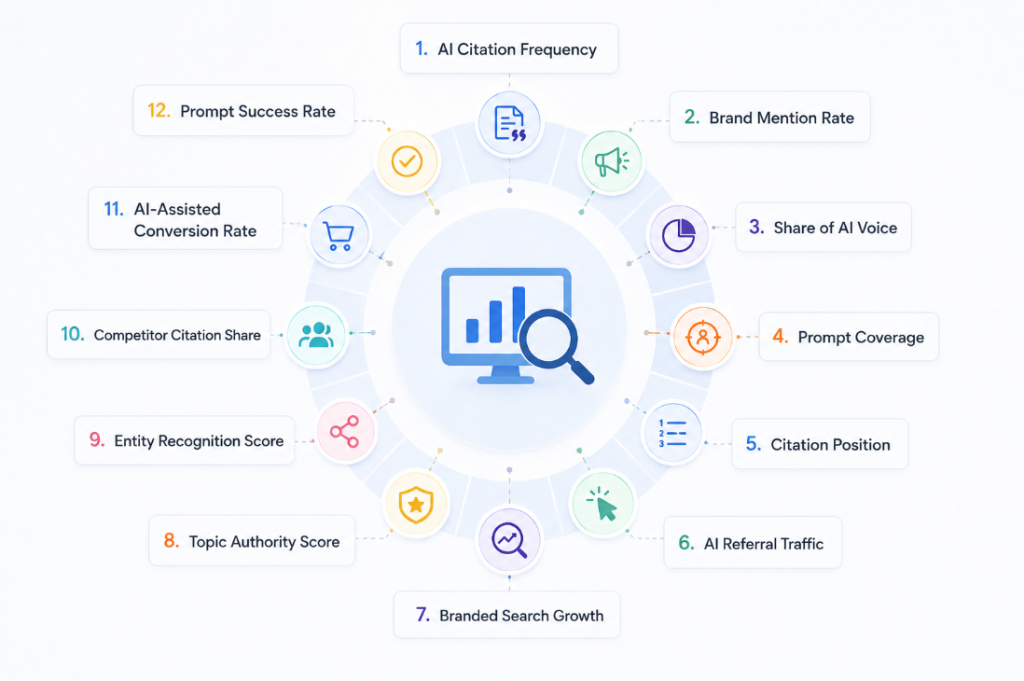
1. AI Citation Frequency
Definition: The percentage of tracked prompts in which your content is directly cited by AI systems.
Why It Matters: Citations are the highest-quality signal because they indicate the AI selected your source as authoritative enough to include in synthesis. A citation carries more weight than a mention because it signals that the AI considered your content authoritative enough to reference.
How to Measure: Use tools like Rankscale or Profound that track citation appearance, or manually test 20 relevant prompts monthly across platforms, documenting which cite you.
Recommended Tools: Rankscale, Profound, MaxAEO, LLM Pulse
Best Practices: Track citations by platform (ChatGPT citations matter differently than Perplexity) and by content type (research gets cited differently than product pages). Aim to increase monthly citation frequency by 15-25% year-over-year.
2. Brand Mention Rate
Definition: The percentage of tracked prompts that include your brand name in AI responses, whether cited or mentioned contextually.
Why It Matters: Mentions indicate your brand has entered the AI’s knowledge base as relevant to these topics. High mention rates with low citations suggest content quality issues.
How to Measure: Use monitoring tools to count mentions across tracked prompts, or manually scan AI responses for your brand name.
Recommended Tools: Semrush AI Visibility, ZipTie, Anvil, Rankscale
Best Practices: Separate capitalized brand mentions (official company references) from generic mentions (your product type). Track sentiment alongside frequency.
3. Share of AI Voice
Definition: Your brand’s percentage of total mentions compared to competitors within tracked prompts.
Why It Matters: Share of voice is competitive positioning. A brand with 25% share in a four-player category dominates AI-generated answers about that category.
How to Measure: Divide your mentions by total competitive mentions across the same prompts, multiplied by 100.
Recommended Tools: Profound, Semrush, Rankscale, MaxAEO
Best Practices: Track this monthly and segment by platform. A 30% share in ChatGPT might differ from your 18% share in Perplexity, suggesting platform-specific content optimization opportunities.
4. Prompt Coverage
Definition: The number of distinct prompt variations that trigger your brand in AI responses.
Why It Matters: A brand appearing in 50 different prompt types demonstrates broader topic authority than one appearing in 5. Coverage reveals whether your visibility is concentrated or distributed.
How to Measure: Count unique prompt templates that result in your brand appearing. Example prompts: “best tools for X,” “how to implement Y,” “compare X vs Y,” “what is X.”
Recommended Tools: Rankscale, ZipTie, XFunnel, LLM Pulse
Best Practices: Expand coverage into adjacent topic areas. If you appear in “project management tools” prompts but miss “nonprofit software” prompts, create targeted content for nonprofit-specific use cases.
5. Citation Position
Definition: Where your citation appears in the AI’s source list or answer structure.
Why It Matters: Citations near the answer’s beginning carry more weight than those buried at the end. Position reflects how central your source is to the answer.
How to Measure: Track not just whether you are cited, but at what point in the answer (opening, middle, conclusion). Some tools automate this.
Recommended Tools: Profound (detailed position tracking), ZipTie (answer position screenshots)
Best Practices: Optimize for early positioning by ensuring your content directly addresses the core question rather than adding tangential context.
6. AI Referral Traffic
Definition: Traffic to your website attributed to referrals from AI systems like ChatGPT, Perplexity, or Claude.
Why It Matters: Visibility without traffic is vanity. This metric connects upstream presence to downstream visits, showing whether visibility converts to actual user engagement.
How to Measure: Set up GA4 filters for referral sources containing platform names (chatgpt.com, perplexity.ai). Create a custom dimension for AI source traffic. Monitor monthly trends.
Recommended Tools: Google Analytics 4, Plausible, Fathom Analytics
Best Practices: Traffic from AI sources tends to be high-intent (users already have a question and clicked a link), so track conversion rates separately from organic traffic. This traffic often converts better despite lower volume.
7. Branded Search Growth
Definition: Month-over-month growth in searches for your brand name in Google Search.
Why It Matters: Increased branded search often correlates with AI visibility growth because users who encounter your brand in AI answers search for you by name to learn more. This is indirect attribution, but it signals influence.
How to Measure: In Google Search Console, filter for branded queries (your company name, product names) and track total impressions and clicks over time. A 15-30% quarterly increase suggests AI exposure is driving demand.
Recommended Tools: Google Search Console (free), branded keyword tracking in GA4
Best Practices: Branded search growth is a leading indicator of brand lift. If AI visibility increases but branded search remains flat, the AI mentions may lack impact. Investigate sentiment and positioning.
8. Topic Authority Score
Definition: A composite measure of how often your brand appears across multiple related topics within your category.
Why It Matters: Brands that appear in 40 different topic variations look more authoritative than brands appearing in 5. This directly influences AI recommendation patterns.
How to Measure: Map your topic area (e.g., “project management software”), identify 30-50 sub-topics (team collaboration, remote workflows, resource allocation, agile methodologies), test prompts for each, score your appearance across the set.
Recommended Tools: Rankscale (auto-scores), Profound (manual mapping), MaxAEO (topic clustering)
Best Practices: Identify gaps where you rank low and create targeted content. A 60% topic authority score tells you the opportunity area for the remaining 40%.
9. Entity Recognition Score
Definition: How consistently and accurately AI systems recognize your brand as an entity in your category.
Why It Matters: Better entity recognition increases the likelihood your brand is included in AI synthesis. Poor entity recognition means the AI may not even consider you as an option.
How to Measure: Test prompts asking the AI “Who is [Your Company]?” and “What does [Your Company] do?” If the AI provides accurate, detailed responses, recognition is strong. If responses are generic or incomplete, entity optimization is needed.
Recommended Tools: Manual testing, ChatGPT plugins, Claude analysis
Best Practices: Improve entity recognition by ensuring your About page clearly states what you do, who you serve, and what makes you different. Use consistent terminology across your site that matches how AI systems categorize you.
10. Competitor Citation Share
Definition: Your citation frequency compared to each specific competitor, expressed as a percentage.
Why It Matters: Relative position matters more than absolute numbers. A 40% citation rate means little if competitors each claim 50%. This metric shows whether you are winning the citation battle.
How to Measure: For 20 tracked prompts, count your citations and each competitor’s citations. Calculate your share: (Your Citations / Total Citations) × 100.
Recommended Tools: Profound, MaxAEO, Rankscale, LLM Pulse
Best Practices: Focus on competitors most relevant to your product. Benchmarking against 20 competitors is noise; focus on your top 3-5 direct competitors.
11. AI-Assisted Conversion Rate
Definition: The percentage of leads or customers who mention that AI research influenced their decision, broken down by AI platform.
Why It Matters: This is the revenue metric. High visibility means nothing if prospects do not convert. AI-assisted conversion tracking closes the measurement loop between visibility and business outcome.
How to Measure: Add a field to your CRM asking “How did you research us before reaching out?” or survey customers post-purchase. Track which platforms they mention: ChatGPT, Perplexity, Google AI Overviews, etc.
Recommended Tools: Typeform (surveys), Hubspot (lead tracking), Salesforce (custom fields)
Best Practices: This metric requires active collection. Include the question in sales discovery calls, customer onboarding, or post-purchase surveys. Track these conversations in your CRM for monthly reporting.
12. Prompt Success Rate
Definition: The percentage of your target prompts (priority prompts you want to win) in which your brand appears.
Why It Matters: Not all prompts matter equally. Your success rate on commercial intent prompts (buying-focused) matters more than success on informational prompts. This metric prevents you from optimizing for vanity mentions.
How to Measure: Define your 30-50 most important prompts (those most likely to influence revenue). Test them monthly. Success rate = (Prompts where you appear / Total priority prompts) × 100.
Recommended Tools: ZipTie, XFunnel, manual tracking with spreadsheets
Best Practices: Aim for 70%+ success rate on your top-priority prompts. If certain critical prompts consistently miss you, they should drive immediate content or optimization work.
KPI Summary Table
| Metric | Measures | Ideal Frequency | Primary Tool |
| Citation Frequency | Quality of presence | Monthly | Rankscale, Profound |
| Brand Mention Rate | Awareness in AI | Monthly | Semrush, ZipTie |
| Share of AI Voice | Competitive position | Monthly | Profound, Rankscale |
| Prompt Coverage | Topic breadth | Quarterly | Rankscale, XFunnel |
| Citation Position | Answer prominence | Monthly | Profound, ZipTie |
| AI Referral Traffic | Click-through attribution | Monthly | GA4 |
| Branded Search Growth | Demand lift | Monthly | GSC, GA4 |
| Topic Authority Score | Category depth | Quarterly | Rankscale, Profound |
| Entity Recognition | Brand clarity | Quarterly | Manual testing |
| Competitor Citation Share | Relative standing | Monthly | MaxAEO, Rankscale |
| AI-Assisted Conversions | Revenue impact | Monthly/Quarterly | CRM, Surveys |
| Prompt Success Rate | Critical visibility | Monthly | ZipTie, Spreadsheet |
Best Tools for Measuring AI Search Visibility
The AI visibility measurement landscape has matured rapidly. Most tools now track citations across multiple platforms, but they differ significantly in depth, price, and workflow integration.
Tool Comparison Matrix
| Tool | Citation Tracking | Prompt Monitoring | Competitor Tracking | Reporting | Best For |
| Profound | 5+ models, detailed position | Advanced, 500+ prompts | Full competitive matrix | Executive dashboards | Enterprise governance |
| Rankscale | 4 models, consistent tracking | 200+ prompts, automated | Segment-level comparison | Detailed breakdowns | GEO specialists |
| Semrush AI Visibility | 3 models, GSC integration | Limited prompt sets | Basic competitor view | Multi-client reporting | Agencies, SaaS teams |
| ZipTie | Screenshot-based tracking | Custom prompt sets | Visual comparison | Evidence-focused reports | Client communication |
| MaxAEO | 4 models, clean UI | Structured testing | Strong competitive | Dashboard + exports | Mid-market companies |
| Anvil | 3 models, newer coverage | Emerging prompt library | Solid tracking | Modern interface | Smaller teams, startups |
| Rankscale.ai | Specialized positioning | Deep prompt analysis | Competitor heat maps | Detailed scoring | Competitive analysis |
| LLM Pulse | Multi-model coverage | Prompt performance tracking | Cross-platform view | Agency white-label | White-label needs |
Manual Monitoring Methods
If budget is limited, manual monitoring remains viable:
Use GA4 to filter for AI source referrals by creating specific traffic segments. Track ChatGPT, Perplexity, and other known referrers over time.
Google Search Console branded queries reveal indirect demand lift from AI exposure. Filter for your brand name and monitor impression growth.
Prompt testing using a spreadsheet: Create 30-50 relevant prompts across platforms (ChatGPT, Perplexity, Google AI Mode). Test monthly. Document who appears in answers. Compare month-over-month.
Branded search trend monitoring through Google Trends shows whether AI visibility correlates with broader brand awareness.
How to Build an AI Search Visibility Dashboard
A useful AI visibility dashboard separates AI-specific KPIs from traditional SEO metrics. The goal is clear line-of-sight from visibility to business impact.
Dashboard Categories
Visibility KPIs include citation frequency, mention rate, share of voice, and prompt coverage. This shows raw presence across platforms. Review weekly or bi-weekly to catch visibility shifts early.
Authority KPIs show citation position, entity recognition, and competitive positioning. Review monthly to understand whether your visibility is built on credibility or just frequency.
Traffic KPIs connect AI visibility to actual visitor behavior: AI referral traffic, conversion rates from AI sources, and traffic trends by platform. Review weekly to identify high-performing sources.
Competitive KPIs benchmark your position: your citation share vs. competitors, topic authority gaps, and where competitors are beating you. Review monthly to inform strategy.
Business KPIs measure revenue impact: AI-assisted conversions, assisted revenue, pipeline influence. Review quarterly to validate whether AI visibility drives business growth.
Recommended Review Frequency
Daily: Major visibility swings (sudden citation increases or drops) warrant immediate investigation.
Weekly: Core metrics (citation frequency, mention rate, top prompt performance) to catch early signals.
Monthly: Topic authority, competitive positioning, and business impact metrics for strategic planning.
Quarterly: Deep dives into data trends, content effectiveness, and strategy adjustments based on six-month patterns.
Read More: How AI Overviews and Answer Engines Are Cutting Website Traffic
Dashboard Example Table (30-Day View)
| Metric | Current | Previous Month | Change | Target | On Track |
| Citation Frequency (%) | 38% | 34% | +4% | 40% | Yes |
| Brand Mention Rate (%) | 45% | 42% | +3% | 50% | Yes |
| Share of AI Voice | 28% | 25% | +3% | 30% | Yes |
| Prompt Coverage (topics) | 47 | 44 | +3 | 50 | On track |
| Citation Position (avg) | 3.2 | 3.8 | +0.6 | 2.5 | No |
| AI Referral Traffic | 324 | 287 | +12.9% | 400 | Yes |
| Branded Search Lift | +18% | +12% | +6% | +20% | On track |
Practical Use Cases by Organization Type
For Beginners (Solo Entrepreneurs, Small Businesses)
Goals: Establish baseline AI visibility, understand whether your brand exists in AI systems at all, prove ROI to justify budget for dedicated tools.
KPIs to Track: Citation frequency, brand mention rate, AI referral traffic (3-5 key prompts only), branded search growth.
Recommended Workflow: Start with manual testing. Create 20 prompts aligned with how your target customer researches you. Test monthly across ChatGPT and Perplexity. Document results in a simple spreadsheet. Track GA4 AI source referrals. Upgrade to a paid tool once you hit consistent traffic from AI sources.
Expected Outcomes: After 6 months, you should know whether your brand is visible in AI answers at all, which platforms matter for your market, and whether visibility correlates with branded search growth.
For SEO Professionals (In-House Teams)
Goals: Develop a measurement framework tied to content strategy, demonstrate AI visibility as part of organic growth, optimize content for both traditional and generative search.
KPIs to Track: All 12 metrics with emphasis on prompt coverage, topic authority, and citation position. Competitor citation share to inform strategy.
Recommended Workflow: Adopt a tool like Rankscale or MaxAEO ($189-500/month) for automated tracking. Set up GA4 custom dimensions for AI traffic. Establish monthly reviews with your content team to connect visibility data to content calendar decisions. Run quarterly competitive analyses to identify topic gaps.
Expected Outcomes: Within 6 months, you should have a clear picture of content that drives AI visibility, identify topic areas where competitors dominate, and implement content strategies to improve prompt success rate on priority topics.
For Agencies
Goals: Report client AI visibility to clients, differentiate services by measuring what competitors cannot track, build recurring revenue through AI visibility monitoring.
KPIs to Track: All metrics with emphasis on executive reporting. Separate by platform for transparency. Use screenshot-based tools (ZipTie) for client-ready evidence.
Recommended Workflow: Use agency-focused tools with white-label or client reporting features (Semrush, LLM Pulse, MaxAEO). Create templated dashboards. Build a monthly reporting cadence. Connect AI visibility to content creation, link building, and technical SEO work. Show month-over-month trending.
Expected Outcomes: Become a known authority on AI visibility measurement. Build a recurring measurement product clients renew monthly. Charge $500-2000/month per client depending on competitive set size.
For SaaS Companies
Goals: Measure AI visibility impact on product demand, connect AI citations to pipeline and revenue, optimize category positioning against competitors.
KPIs to Track: All metrics with heavy emphasis on business impact (AI-assisted conversions, assisted revenue, branded search growth). Track by product line if multiple products exist.
Recommended Workflow: Use Profound or MaxAEO for comprehensive tracking across multiple competitors. Integrate CRM data to track AI-assisted conversions. Establish a monthly cross-functional review with sales, marketing, and product to discuss implications. Run quarterly content strategy updates based on topic authority gaps.
Expected Outcomes: Develop a clear understanding of how AI visibility influences the sales cycle. Identify which topics matter most for pipeline. Build a content strategy optimized for both traditional search and AI discoverability.
For Enterprise Teams
Goals: Measure brand presence across multiple AI platforms at scale, maintain governance over how AI systems represent your brand, track revenue impact of AI visibility across business units.
KPIs to Track: All metrics, tracked by business unit, geography, and platform. Competitor analysis across 10+ competitors. Sentiment tracking to monitor accuracy of AI descriptions.
Recommended Workflow: Use enterprise platforms like Profound with governance features. Set up brand monitoring automation. Establish weekly reviews at the strategic level. Create cross-functional working groups for content strategy, digital PR, and technical SEO alignment on AI optimization. Tie AI visibility to corporate revenue goals.
Expected Outcomes: Establish AI visibility as a standard KPI in corporate reporting. Develop a centralized content strategy optimized for AI discoverability across all business units. Build a competitive intelligence engine for AI-driven research.
For Local Businesses
Goals: Understand whether local brand appears in AI answers, measure impact on local demand, optimize local content for AI discoverability.
KPIs to Track: Local branded search volume, geographic prompt coverage (e.g., “[Your City] + Your Service Type” prompts), AI referral traffic by location, citation frequency for local queries.
Recommended Workflow: Focus on local-intent prompts. Test “best [service] in [city]” and “[city] [service] recommendations.” Set up GA4 geographic segmentation. Monitor Google Search Console local branded queries. Use a simple spreadsheet for testing. Many enterprise tools over-serve national brands; local businesses often benefit from manual tracking plus one platform like Rankscale.
Expected Outcomes: Measure whether local AI visibility drives foot traffic or local inquiry volume. Build a content strategy around local-intent prompts. Track local competitive positioning.
Best Practices for Improving AI Search Visibility
Measuring AI visibility is only the first step. Consistently improving it requires a strategy that strengthens your authority, relevance, and discoverability across AI search platforms.
Publish Original Research
Create original studies, surveys, case studies, or proprietary data instead of relying only on opinion-based content. Unique insights give AI systems authoritative sources to cite.
Improve Entity Relationships
Connect your brand with the topics and concepts that define your industry. Consistent entity associations help AI systems better understand your expertise and category relevance.
Strengthen Topical Authority
Cover related topics alongside your core offering. Broader topical coverage increases your chances of appearing across a wider range of AI-generated answers.
Build Trustworthy Citations
Support your content with credible sources, including original research, academic publications, and respected industry references. Strong sources improve both trust and citation potential.
Structure Content for AI Retrieval
Use clear headings, concise summaries, and direct answers. Place the key takeaway first, followed by supporting details.
Refresh Evergreen Content
Review and update evergreen pages regularly, especially those containing statistics, pricing, or competitive comparisons, to keep them accurate and relevant.
Track Prompts Regularly
Monitor the same prompts every week or month instead of relying on a single test. Consistent tracking reveals meaningful trends and changes in AI visibility.
Monitor Competitors
Compare where competitors earn citations and recommendations. Their content strategy can help uncover opportunities to strengthen your own visibility.
Measure Branded Search Growth
Growing AI visibility should gradually increase branded searches. If it doesn’t, review how your brand is being positioned within AI-generated responses.
Combine AI Metrics with Traditional SEO
Don’t treat AI visibility separately from SEO. The strongest strategy is content that ranks well in search engines while also being cited by AI platforms.
Common Mistakes to Avoid
Measuring Only Traffic
AI visibility doesn’t always generate immediate clicks. Focusing only on referral traffic overlooks the long-term value of citations, mentions, and brand exposure. Measure visibility independently from traffic.
Ignoring AI Citations
A brand can receive many mentions but few actual citations. Mentions build awareness, while citations establish credibility. Prioritize earning authoritative citations, not just mentions.
Relying Only on Google Analytics
Google Analytics cannot measure AI citations, recommendations, or zero-click visibility. Combine GA4 with AI visibility monitoring tools for a more complete picture of performance.
Tracking Rankings Instead of AI Visibility
AI platforms generate answers rather than rank webpages. Instead of trying to measure “rankings,” track citation frequency, prompt coverage, and visibility across AI-generated responses.
Neglecting Entity Optimization
If AI systems don’t clearly recognize your brand as an entity, you’re less likely to appear in relevant answers. Strengthen entity signals with consistent branding and topical relevance.
Overlooking Branded Search Growth
Growing branded search volume is often an early indicator that AI visibility is influencing user interest. Monitor branded queries alongside your AI visibility metrics.
Not Benchmarking Competitors
Your metrics only have context when compared with competitors. A strong citation rate may still indicate missed opportunities if competing brands consistently perform better.
Limitations and Considerations
AI Search Data Is Still Evolving
AI systems change their training data, ranking factors, and citation behavior frequently. Expect volatility. Data from three months ago may not reflect current patterns.
Attribution Remains Imperfect
Direct attribution from AI visibility to revenue is difficult. Use multiple signals: branded search, assisted conversions, customer surveys. No single metric explains the full picture.
Different AI Platforms Behave Differently
ChatGPT citation patterns differ from Perplexity. Google AI Overviews behave differently from Claude. Do not assume that optimizing for one platform helps all others equally.
Some Metrics Require Manual Validation
Automated tools have blind spots. Spend time manually testing key prompts to validate tool data and catch nuances tools miss.
AI Monitoring Tools Vary in Coverage
No single tool has perfect data across all platforms and prompts. Most tools cover 70-90% of relevant prompts. Accept good coverage instead of waiting for perfect coverage.
AI Referrals Are Inconsistent
Some AI platforms send referral traffic reliably. Others rarely send direct traffic. Use AI referral traffic as one signal alongside others, not the primary metric.
Conclusion
Google Analytics remains a cornerstone of digital marketing, but it wasn’t built to measure how brands are discovered through AI-generated answers. As platforms like ChatGPT, Perplexity, and Google AI Overviews become part of the research journey, marketers need new ways to measure visibility beyond clicks and sessions.
That’s where AI Search Visibility Metrics KPIs come in. They complement traditional SEO metrics by revealing how often your brand is cited, recommended, and represented across AI search platforms. Together with Google Analytics and Google Search Console, they provide a more complete view of your digital presence.
You don’t need to track every metric from the start. Begin with citation frequency, brand mention rate, and AI referral traffic, then expand your framework as you gather consistent data and identify opportunities for improvement.
The future of search measurement isn’t about replacing traditional SEO;it’s about combining it with AI visibility tracking. Brands that build this measurement framework today will be better equipped to adapt as AI continues to reshape how people discover and evaluate businesses.
Next Steps
- Test 20–30 relevant prompts across ChatGPT and Perplexity to establish a baseline.
- Configure GA4 to track AI referral traffic and monitor branded queries in Google Search Console.
- Choose an AI visibility monitoring tool and review your core metrics monthly.
- Connect AI visibility insights with your content strategy and, over time, measure their impact on leads and revenue.
Frequently Asked Questions
What is an AI Search Visibility Metrics KPI?
AI Search Visibility Metrics KPIs are measurements that track how often your brand appears in AI-generated answers, how prominent those appearances are, and whether they influence business outcomes. They include citation frequency, mention rate, share of voice, and referral traffic tracking.
Can Google Analytics measure AI traffic?
Google Analytics can measure traffic that originates from AI platforms like ChatGPT or Perplexity when those platforms send referrals. It cannot measure mentions or citations that do not produce clicks, or zero-click visibility.
How do I measure ChatGPT visibility?
Use dedicated tools like Rankscale or Profound that test prompts across ChatGPT, or manually test 20-30 relevant prompts monthly and document whether ChatGPT includes your brand in its answers. Set up GA4 filters for chatgpt.com referrals.
What is AI citation tracking?
AI citation tracking measures how often AI systems directly reference or link to your content when answering questions. It is measured as a percentage of tracked prompts (e.g., 38% of prompts result in your content being cited).
Which AI KPIs matter most?
Citation frequency, brand mention rate, share of AI voice, prompt coverage, and AI referral traffic are the core five. Add topic authority and business impact metrics once you have baseline visibility established.
How do AI search metrics differ from SEO metrics?
SEO metrics focus on ranking position and clicks from search results. AI search metrics focus on citations, recommendations, and mentions inside AI-generated answers. These are complementary, not competing.
What tools monitor AI search visibility?
Top tools include Rankscale (citation tracking), Profound (enterprise governance), Semrush (agency reporting), ZipTie (client evidence), MaxAEO (mid-market), and LLM Pulse (white-label). Start with one platform and layer in others as needs grow.
What is Share of AI Voice?
Share of AI Voice (SOV) is your brand’s percentage of total mentions compared to competitors within tracked prompts. If four brands total 100 mentions and you have 30, your SOV is 30%.
How often should AI search performance be measured?
Measure core metrics (citation frequency, mention rate) monthly. Test critical prompts weekly. Track AI referral traffic continuously through analytics. Adjust strategy quarterly based on trend data.
Is AI referral traffic reliable?
AI referral traffic is growing but inconsistent. Some platforms send referrals reliably (ChatGPT increasingly does). Others rarely send traffic. Use it as one signal among many, not the primary metric for AI visibility strategy.