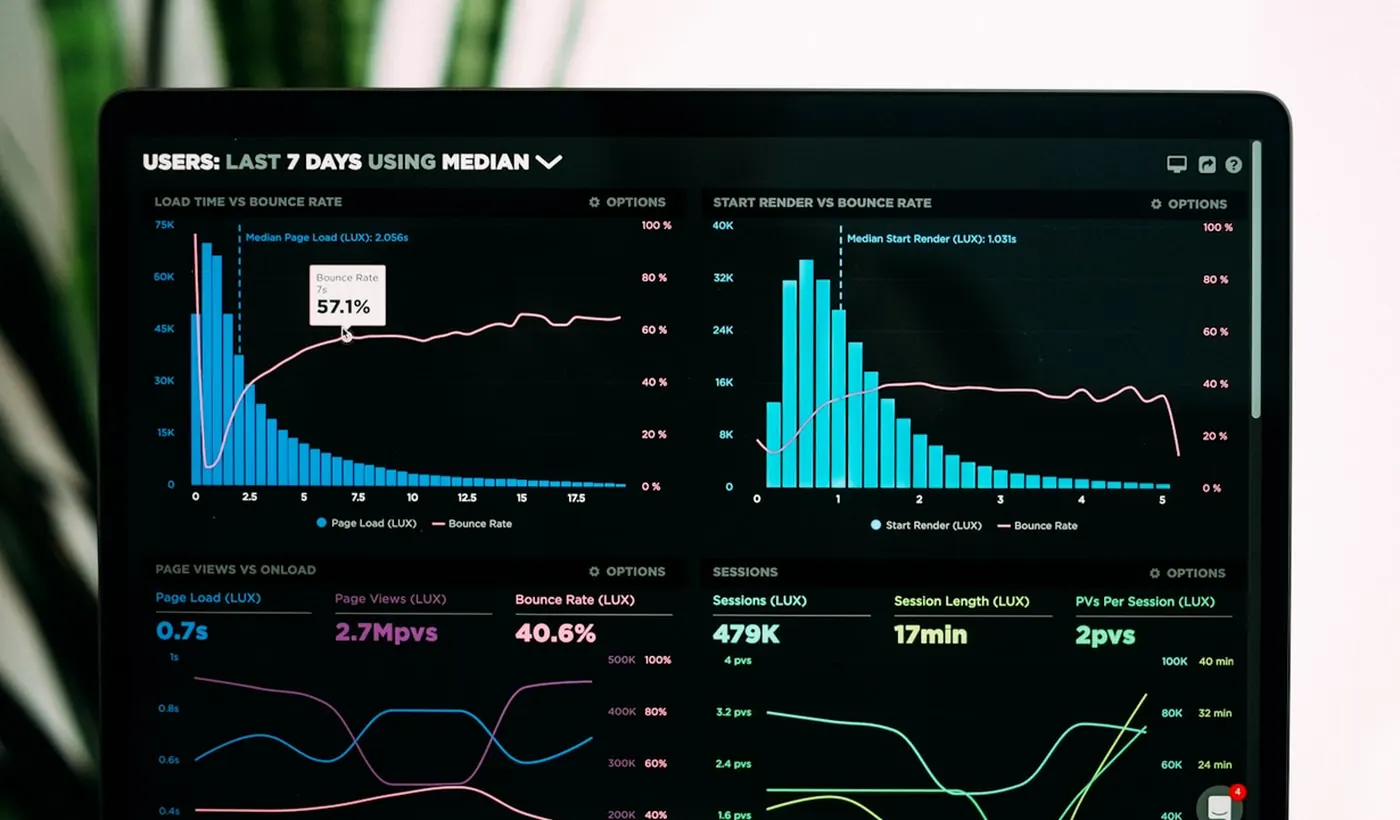
Marketing budgets are staying flat, but client expectations keep rising. If you’re still writing every brief, building every audience segment, and formatting every report manually in 2026, you’re already falling behind teams that have delegated repetitive work to AI while keeping strategy firmly in human hands.
This guide covers the best AI tools for marketing this year, based on real adoption, actual pricing, and what each tool does well once the demo ends. You will find a ranked breakdown of 13 tools across content, SEO, ads, email, and automation, comparison tables, workflow examples for different team types, and honest limitations nobody puts in a sales deck.
Quick Summary: Best AI Marketing Tools by Category
- Best overall: HubSpot (AI layered across CRM, email, and content)
- Best for SEO: Semrush (keyword data plus AI Visibility tracking)
- Best for content writing: Jasper (brand voice at scale)
- Best for content optimization: Surfer SEO (real-time on-page scoring)
- Best for workflow automation: Zapier / Gumloop (no-code AI workflows)
- Best for ad creative: AdCreative.ai (predictive ad scoring)
- Best for email and SMS: Klaviyo (ecommerce-first automation)
- Best for design: Canva (Magic Studio generative layer)
- Best budget option: Mailchimp free tier or Copy.ai Chat plan
If you only have time to try two tools this quarter, start with the one solving your biggest time sink and one that touches your revenue directly. For most content teams, that is Surfer SEO plus Jasper. For most ecommerce teams, that is Klaviyo plus AdCreative.ai.
Why AI Is Important in Marketing
AI has stopped being an experiment and become infrastructure. Marketing decisions increasingly depend on AI processing large volumes of customer data, spotting patterns humans would miss, and acting on predictive insights in real time, with major platforms now treating AI as the core engine behind marketing operations rather than a bolt-on feature.
Here is why that shift matters for your team specifically.
Speed at scale. A single marketer can now produce, optimize, and distribute content that once required a five-person team. Briefs, drafts, image variants, and email sequences that took days now take hours.
Better decisions, not just faster ones. Predictive analytics flags which leads will convert, which subject lines will underperform, and which ad creative is fatiguing before spend gets wasted. That is decision quality, not just output volume.
Personalization that actually scales. Segmenting an audience into 200 micro-groups by hand is not realistic. AI-driven segmentation and dynamic content make it routine, which directly improves engagement and conversion rates.
Budget discipline. With hiring frozen at most companies, AI tools let lean teams cover ground that used to require more headcount. That is not a hypothetical; it is the reason adoption has moved from “nice to have” to expected across marketing job descriptions.
Visibility in a new kind of search. Google AI Overviews, ChatGPT, and Perplexity are now genuine referral sources. Brands that ignore AI-driven visibility tracking are losing traffic they cannot even see disappearing.
The 13 Best AI Marketing Tools in 2026
1. HubSpot — Best Overall AI Marketing Platform
If you want one platform that handles CRM, email, automation, lead nurturing, and reporting with AI built into every layer, HubSpot remains one of the strongest choices in 2026. It is especially valuable for teams that want marketing, sales, and customer data working from the same system instead of scattered across multiple tools.
What it does: HubSpot combines CRM, email, content, and ad management with AI layered across the entire funnel.
Key features: AI email copy suggestions, predictive lead scoring, smart send-time optimization, and content recommendations tied to actual contact behavior rather than generic templates. Because the CRM integration connects AI outputs to real pipeline data, the assistant can generate email subject lines, CTAs, and landing page copy grounded in what is already working.
Best for: Mid-market B2B and B2C teams that want CRM, email, and automation under one roof.
Pricing: HubSpot offers a free CRM, with the Starter tier around $20 per month for 1,000 contacts, Professional around $890 per month for full automation and A/B testing, and Enterprise around $3,600 per month for predictive lead scoring and custom objects.
Pros: Deep CRM integration, strong reporting, scales from small teams to enterprise.
Cons: The jump from Starter to Professional pricing is steep, and advanced reporting often needs a certified specialist to configure properly.
2. Semrush — Best for SEO and AI Search Visibility
SEO is no longer just about rankings on traditional search engines. Semrush has evolved into a powerful AI-driven visibility platform that helps marketers track keywords, competitors, backlinks, and even brand presence across AI search experiences like ChatGPT and Google AI Overviews.
What it does: An all-in-one SEO and competitive intelligence platform now built around AI recommendations rather than raw data dumps.
Key features: Semrush Copilot ships free with every subscription and automatically analyzes data across six core Semrush tools to surface prioritized recommendations, flag technical issues, and explain why specific actions matter, without requiring manual review of every report. The platform also added an AI Visibility Toolkit that tracks brand presence inside ChatGPT and Google AI Overviews, along with ContentShake AI for automated content drafting.
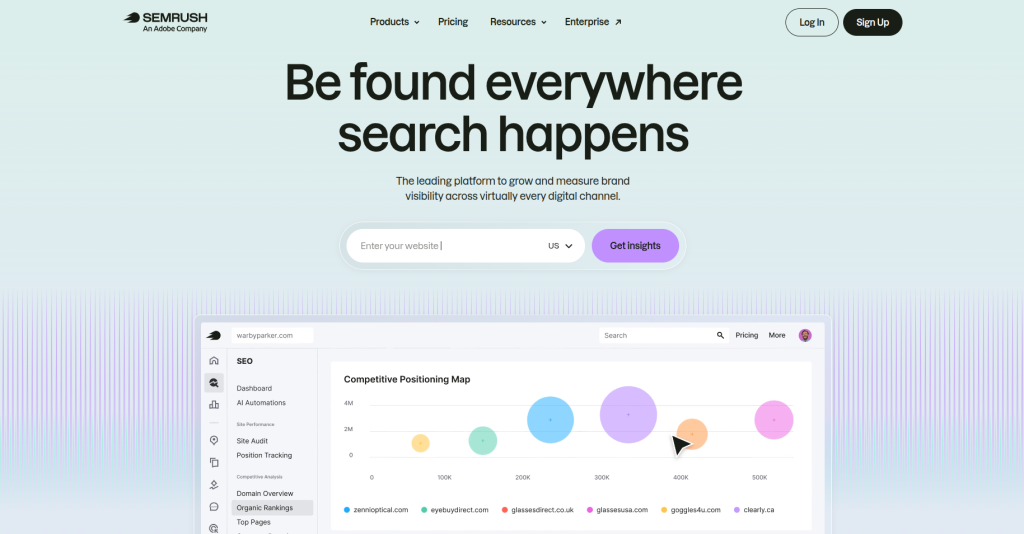
Best for: Agencies and SEO teams that need one platform instead of five separate subscriptions.
Pricing: Annual plans run roughly $117 to $417 per month, with the AI Visibility Toolkit priced separately at $99 per month.
Pros: Massive keyword and backlink database, strong technical audit depth.
Cons: Single-user access on lower tiers, a steep learning curve, and Google-only search focus limit it for smaller teams needing multi-platform coverage.
3. Jasper — Best for Brand-Consistent Content at Scale
Creating content quickly is easy with AI, but keeping it aligned with your brand voice is much harder. Jasper solves that by helping marketing teams generate high-volume content that feels consistent, polished, and tailored to brand guidelines rather than sounding generic.
What it does: An AI writing platform purpose-built for marketing teams that need output to sound like the brand, not like a generic chatbot.
Key features: Brand Voice training from uploaded style guides, Canvas editor, campaign workflows, and a Surfer SEO integration for on-page scoring inside the same editor.
Best for: Agencies and in-house teams juggling multiple brand voices or client accounts.
Pricing: The Pro plan runs $59 per month billed annually for one seat, including the Canvas editor, two Brand Voices, and the Chrome extension. A lower Creator tier starts around $39 per month, while Business pricing is negotiated case by case for teams needing unlimited seats and API access.
Pros: Genuine brand voice consistency, strong campaign structure, active model updates.
Cons: SEO scoring requires a separate Surfer SEO subscription, which pushes the real monthly cost for SEO-focused teams closer to $158 rather than the $59 headline price.
4. Surfer SEO — Best for Content Optimization
Surfer SEO helps turn content into something search engines actually want to rank. Instead of guessing which keywords, headings, or topics matter, it gives writers data-backed recommendations in real time while they create content.
What it does: Scores content against top-ranking pages in real time while you write, rather than generating drafts outright.
Key features: Surfer structures and scores content, in contrast to tools like Jasper that generate the draft, which is why the two are often paired together. It also offers keyword clustering to prevent internal pages from competing against each other for the same query.
Best for: SEO content teams and agencies where organic search is a primary acquisition channel.
Pricing: Plans range from roughly $99 to $999 or more per month depending on tier and content volume.
Pros: Concrete, data-backed targets instead of vague advice; strong Google Docs and WordPress integration.
Cons: No free trial, and recommendations can get repetitive on mature sites with an established content library.
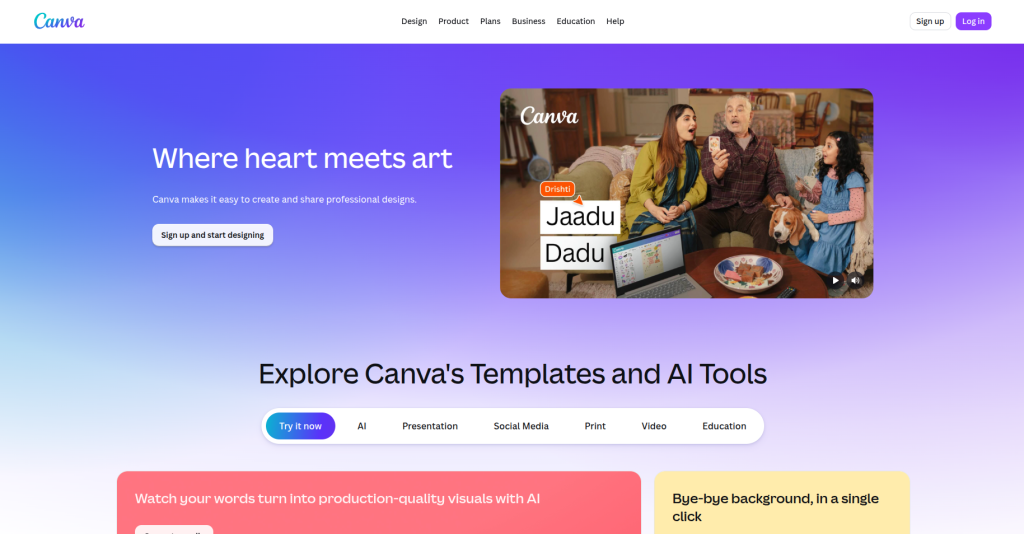
5. Canva (Magic Studio) — Best for Fast, On-Brand Design
Design bottlenecks slow down many marketing teams, especially smaller ones without dedicated creatives. Canva’s AI-powered Magic Studio makes it easier to generate polished visuals, presentations, ads, and social creatives in minutes without advanced design skills.
What it does: Generative image creation, background removal, and text-to-image layered onto Canva’s existing design platform.
Key features: Magic Design generates a full presentation or social post layout from a text prompt, and the brand kit keeps logos, fonts, and colors consistent across every output.
Best for: Small teams and ecommerce brands that need clean branded assets without a dedicated designer.
Pricing: A free plan is available, with Pro starting at $15 per month per person.
Pros: Fast, accessible, huge template library.
Cons: Outputs are recognizably “Canva,” so brands with a strong visual identity often need heavy customization before publishing.
6. AdCreative.ai — Best for AI Ad Creative and Testing
Ad performance often depends more on creative quality than targeting alone. AdCreative.ai helps marketers generate ad variations at scale while using AI to predict which creatives are most likely to drive clicks and conversions before spending budget.
What it does: Generates ad visuals and copy at scale, then predicts performance before any media spend goes out.
Key features: Ad creatives are generated after analyzing millions of ads across one of the industry’s largest campaign databases, and each output receives a Conversion Score out of 100 based on click-through data and successful content patterns. It also produces AI-driven product photoshoots.
Best for: Ecommerce brands and performance agencies running high-volume creative testing.
Pricing: A three-day free trial includes 100 credits, after which full access runs around $109, with additional credit packs available at roughly $50 per month.
Pros: Genuine pre-spend performance prediction; fast variant generation.
Cons: Best suited to teams with real ad budgets to test against; thinner value for brands running only a handful of campaigns.
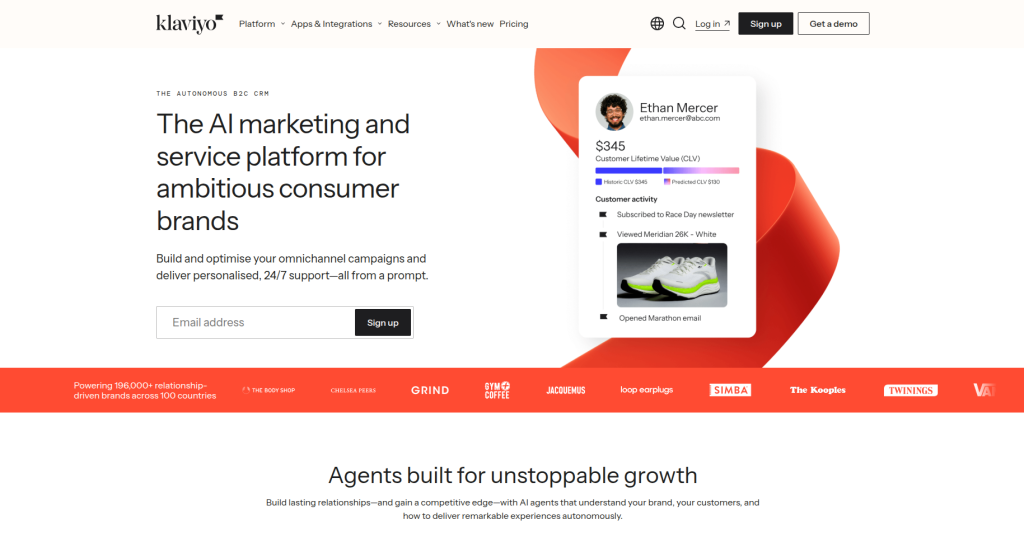
7. Klaviyo — Best for Ecommerce Email and SMS
For ecommerce brands, customer retention often drives more revenue than customer acquisition. Klaviyo uses AI and behavioral data to automate personalized email and SMS campaigns that increase repeat purchases, recover carts, and improve lifetime value.
What it does: Unifies email, SMS, and customer data into behavior-triggered marketing flows built specifically for online retail.
Key features: Klaviyo’s AI can turn a plain-language description of a desired automation into a complete multi-channel flow, including triggers, conditional splits, and content, built in minutes rather than weeks. It also builds audiences based on predicted lifetime value and churn risk rather than open history alone.
Best for: Shopify and ecommerce brands running cart abandonment and win-back flows.
Pricing: Plans start around $20 per month and scale with active profile count rather than just messaged contacts, which can surprise teams growing quickly.
Pros: Strong segmentation and genuinely easy setup for flows like welcome series and abandoned cart, backed by clear analytics.
Cons: Costs climb as the contact list grows, and some advanced flow configurations take real time to learn.
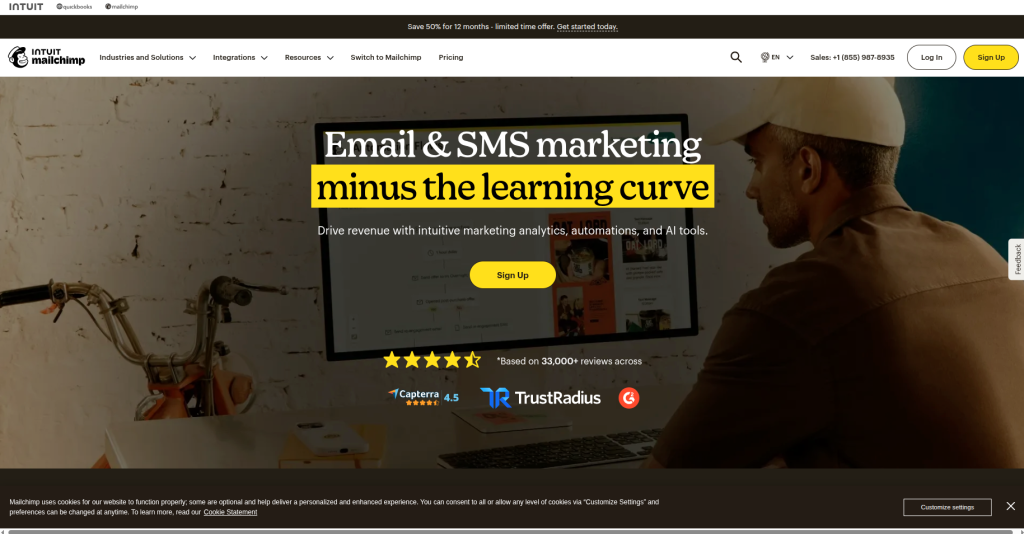
8. Mailchimp — Best Budget Option for Small Teams
Mailchimp remains a popular starting point for businesses entering email marketing because of its simplicity and low barrier to entry. Its newer AI features help beginners write better campaigns and automate workflows without a steep learning curve.
What it does: Beginner-friendly email marketing with AI-assisted copy and send-time optimization.
Key features: Intuit Assist provides an AI marketing assistant with Write with AI and Creative Assistant features, plus AI-generated automation flows that build multi-step campaigns with fully designed emails on Standard plans and above.
Best for: First-time email marketers and small service businesses.
Pricing: The free tier supports 500 contacts and 1,000 monthly sends, though automation was removed from the free plan; automated campaigns now require the Essentials tier starting at $13 per month.
Pros: Best onboarding experience in email marketing; low barrier to entry.
Cons: For businesses generating meaningful Shopify revenue, Klaviyo and Omnisend offer deeper purchase prediction and integration than Mailchimp provides.
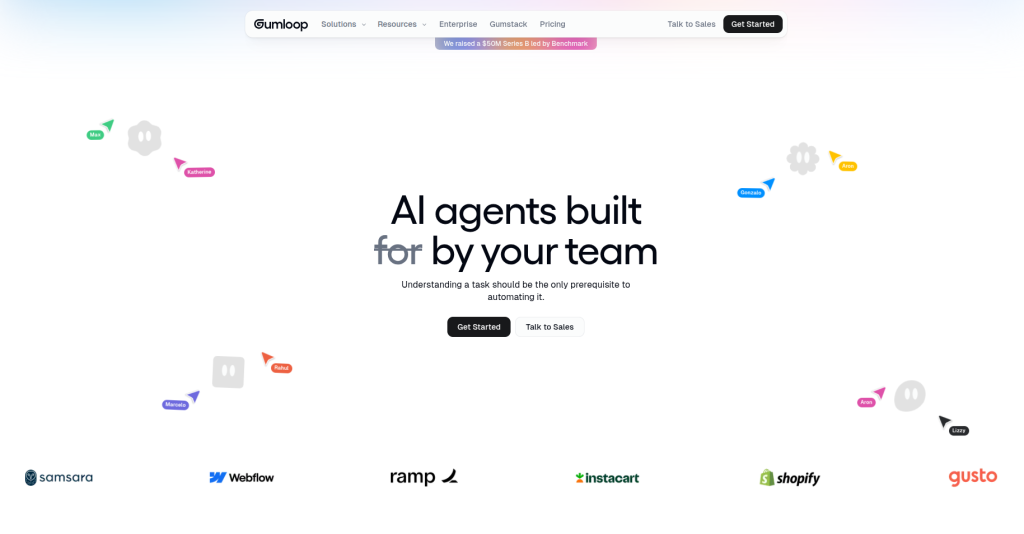
9. Zapier / Gumloop — Best for No-Code Workflow Automation
Many marketing teams lose hours every week moving data between disconnected tools. Platforms like Zapier and Gumloop solve this by automating repetitive workflows, allowing AI to trigger tasks, update systems, and reduce manual operations.
What it does: Connects marketing tools together and layers AI on top of the connections, so a form submission can trigger content generation, CRM updates, and a Slack alert automatically.
Key features: Gumloop lets you connect any large language model to internal tools and workflows without writing code, and it does not require your own API keys since premium model access is included.
Best for: Operations-minded marketers who want to stitch a fragmented tool stack into one pipeline.
Pricing: Free tiers available; paid plans typically start in the $20 to $50 per month range and scale with automation volume.
Pros: Removes manual handoffs between tools; clean, approachable interface.
Cons: Initial setup requires mapping your workflow clearly, or automations multiply confusion instead of reducing it.
10. Brand24 — Best for Sentiment and Reputation Monitoring
Brand24 tracks online brand mentions and analyzes sentiment in real time. It helps teams monitor reputation and respond quickly to trends or crises.
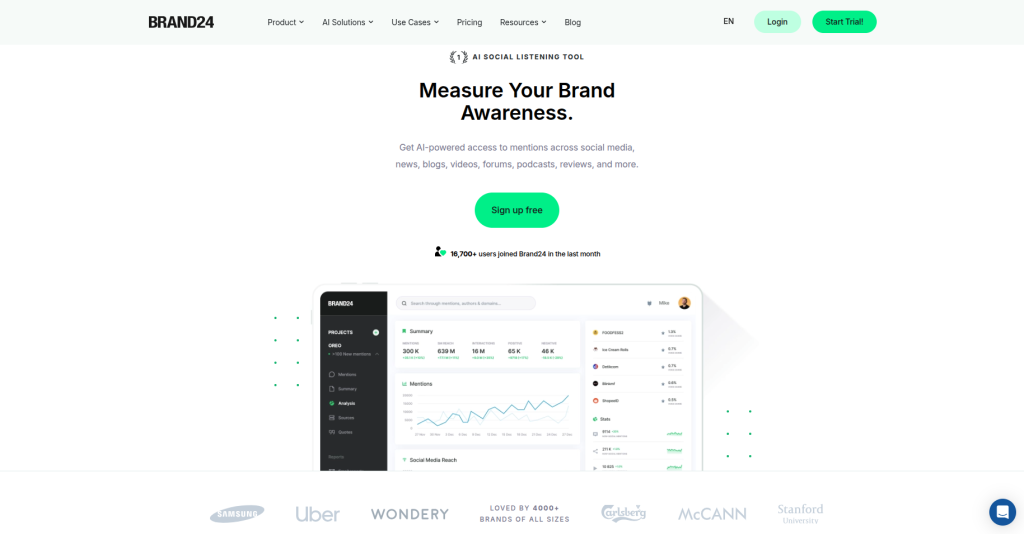
What it does: Brand24 Scans news sites, social platforms, forums, and blogs for brand mentions and applies sentiment analysis to the results.
Key features: Sentiment analysis identifies not just what people are discussing but the emotion behind it, which helps teams understand public perception rather than just tracking mention volume. Upgraded detection now accurately catches sarcasm and local slang across more than 100 languages, alongside predictive share-of-voice forecasting.
Best for: Brands needing real-time reputation and PR crisis detection.
Pricing: Plans generally start around $79 per month.
Pros: Real-time insights let teams respond quickly to negative feedback and catch product issues before they escalate.
Cons: Adds another subscription for teams already running social listening inside a broader platform.
11. Copy.ai — Best Value for Small Teams
Copy.ai focuses on fast AI copywriting and workflow automation. It offers strong value for small teams producing large volumes of content.
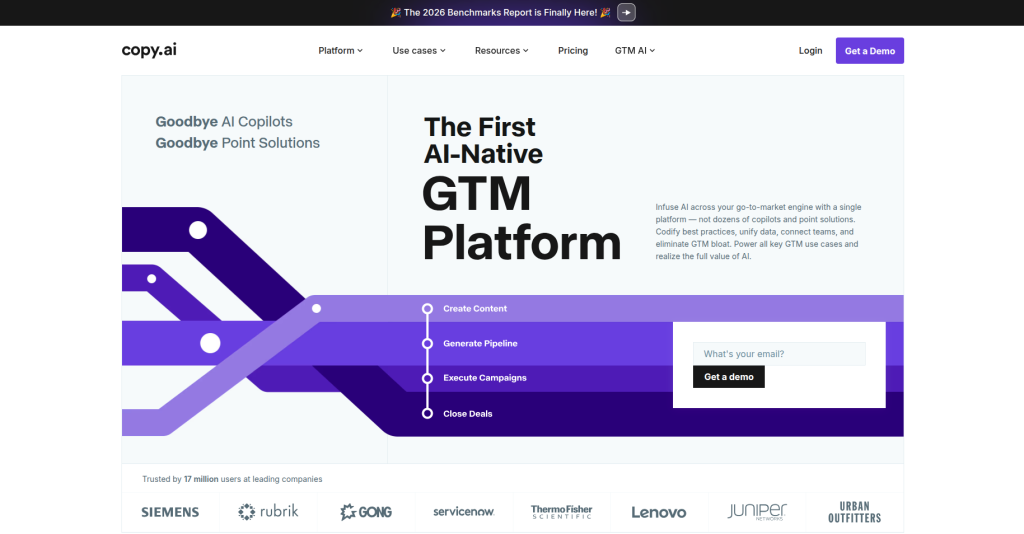
What it does: AI copywriting and workflow automation priced per team rather than per seat.
Key features: Unlike seat-based competitors, Copy.ai’s Chat plan at $29 per month includes five user seats with basic AI writing, and the Pro plan at $49 per month adds unlimited word generation for the same five seats.
Best for: Small teams producing high content volume on a fixed budget.
Pricing: Chat starts at $29/month, Pro at $49/month, with an Agents tier at $249/month unlocking brand-voice automation workflows.
Pros: Strong per-user economics for teams of five or more.
Cons: Output quality generally trails Jasper for long-form, brand-specific content.
12. Wrike — Best for AI-Powered Marketing Project Management
Wrike combines project management with AI-powered work intelligence. It helps larger marketing teams streamline planning and execution.
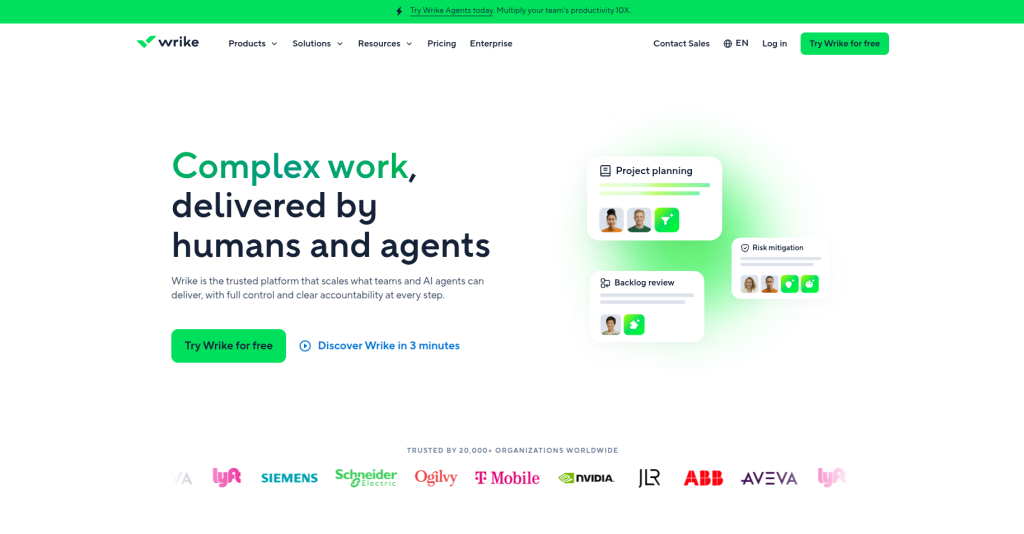
What it does: Combines project management with AI work intelligence for campaign planning and intake.
Key features: Wrike Copilot lets teams ask natural-language questions about project status and generate dashboard widgets without manual reporting, while AI agents parse incoming campaign briefs and auto-populate fields.
Best for: Mid-size to enterprise teams managing complex, multi-channel campaigns.
Pricing: Plans typically start around $10 per user per month, with AI features concentrated in higher tiers.
Pros: Automated intake triage saves significant hours for teams handling high volumes of creative requests.
Cons: Overkill for solo marketers or very small teams.
13. Google Performance Max — Best for Automated Paid Search
Google Performance Max uses AI to optimize campaigns across Search, YouTube, Maps, and Display. It’s designed to maximize ad performance with less manual optimization.
What it does: Uses AI to identify high-performing ad assets and serve them across Google’s full advertising network automatically.
Key features: Performance Max uses Gemini-powered AI to identify strong assets and match them to the right audience across Google’s channels, and the newer AI Max for Search has replaced legacy search ads with an agentic system that reads real-time user intent.
Best for: Advertisers running budget across Google Search, Maps, YouTube, and Gmail simultaneously.
Pricing: No platform fee; standard Google Ads spend applies.
Pros: Cross-channel automation and predictive budget rebalancing shift spend toward campaigns forecasted to perform best.
Cons: Limited manual control over exactly where budget goes, which frustrates advertisers who want granular targeting.
Feature Comparison Table
| Tool | Core Use Case | Automation Depth | AI Quality | Ease of Use | Integrations | Starting Price |
| HubSpot | CRM + full funnel | High | Strong | Moderate | Extensive | Free / $20 mo |
| Semrush | SEO + AI visibility | Medium | Strong | Advanced | Extensive | ~$117 mo |
| Jasper | Content writing | Medium | Strong | Moderate | Good | $39 mo |
| Surfer SEO | Content optimization | Low | Strong | Moderate | Good | $99 mo |
| Canva | Design | Low | Good | Beginner | Good | Free / $15 mo |
| AdCreative.ai | Ad creative | Medium | Strong | Moderate | Limited | ~$109 |
| Klaviyo | Email/SMS ecommerce | High | Strong | Moderate | Extensive | $20 mo |
| Mailchimp | Email marketing | Medium | Good | Beginner | Extensive | Free / $13 mo |
| Zapier/Gumloop | Workflow automation | High | Good | Moderate | Extensive | Free / $20 mo |
| Brand24 | Sentiment monitoring | Low | Good | Beginner | Moderate | ~$79 mo |
| Copy.ai | Team copywriting | Medium | Good | Beginner | Moderate | $29 mo |
| Wrike | Project management | High | Good | Moderate | Extensive | ~$10/user |
| Performance Max | Paid search/display | High | Strong | Moderate | Google only | Ad spend only |
Pricing Comparison by Monthly Cost Tier
Under $50/month: Canva Pro, Mailchimp Essentials, Copy.ai Chat, Gumloop free/starter tiers
$50–150/month: Jasper Pro, Surfer SEO Essential, Klaviyo (mid-size list), Wrike per-user
$150–500/month: HubSpot Starter/Professional entry, Semrush single-user plans, Brand24 mid-tier
$500+/month: HubSpot Professional and Enterprise, Semrush Business, Jasper Business, agency-scale Klaviyo
Best Use Case: Beginner vs Team vs Enterprise
Beginner / solo marketer: Canva free, Mailchimp free or Essentials, Copy.ai Chat. Total cost: $0 to $80/month.
Growing team (2–10 people): Jasper Pro, Surfer SEO Essential, Klaviyo, Zapier. Total cost: roughly $250 to $450/month.
Enterprise / agency: HubSpot Professional or Enterprise, Semrush Business, Jasper Business, Wrike, AdCreative.ai. Total cost: $2,000+/month depending on seats and contact volume.
Practical AI Workflows
Beginner workflow: Idea generation in ChatGPT or Copy.ai → draft in Jasper → design assets in Canva → schedule and publish through Mailchimp. This covers a full content cycle without touching a spreadsheet.
Professional workflow: Keyword and gap research in Semrush → content brief generation → drafting with Surfer SEO scoring live inside the editor → performance tracking through Semrush Copilot’s recommendations.
Business/team workflow: Lead capture through a form → automatic segmentation in HubSpot or Klaviyo → triggered email/SMS sequences → weekly performance reporting pulled automatically instead of built by hand.
Agency workflow: Zapier or Gumloop connects each client’s CRM, ad account, and content calendar into one dashboard, so account managers monitor ten clients without ten separate logins.
Best Practices for Building an AI Marketing Stack
Choose tools that solve your actual bottleneck first, not the tool with the most features. If content production is the slow point, fix that before buying an ad-optimization platform you barely use.
Combine tools deliberately. Jasper plus Surfer SEO is a common pairing because one generates and one scores; using either alone leaves a gap.
Keep a human reviewing every AI output before it publishes, especially for anything touching brand voice, pricing claims, or customer-facing promises. AI drafts are a starting point, not a final answer.
Write specific prompts. Vague prompts produce vague content. Include audience, tone, format, and the specific angle you want, every time.
Revisit your stack quarterly. Pricing and feature sets change fast in this market, and a tool that made sense in January might be outclassed by June.
Limitations and Considerations
AI tools still hallucinate facts, statistics, and sources. Every AI-generated claim needs a human fact-check before it goes live.
Brand voice inconsistency remains common outside dedicated tools like Jasper. Generic AI writing tools tend to sound the same regardless of which brand is speaking.
Data privacy matters more as customer information flows through more third-party AI systems. Enterprise-grade tools typically offer stronger compliance credentials, such as SOC 2, and reviewing data retention and third-party sharing terms before onboarding any new tool is worth the time it takes.
Subscription costs stack quickly. A single “AI stack” can quietly become five or six overlapping subscriptions if nobody is auditing usage.
Over-automation is a real risk. Fully automated ad bidding or email sequences without human checkpoints can drift off-brand or waste budget before anyone notices.
Final Verdict
There is no single best AI marketing tool. There is a best combination for your specific bottleneck, team size, and budget.
If you are a solo marketer or small business, start with Canva, Mailchimp, and Copy.ai. All three have real free tiers, and together they cover design, email, and content without a paid commitment.
If you run a content-driven team, pair Jasper with Surfer SEO. One generates on-brand drafts, the other keeps them competitive in search.
If you are an ecommerce brand, Klaviyo and AdCreative.ai will do more for revenue than any content tool, because they sit closer to the purchase decision.
If you manage a full team or agency, HubSpot, Semrush, and Wrike give you the infrastructure to scale without every task running through one person’s inbox.
The market will keep shifting. New agentic tools are already handling entire campaign cycles with minimal human input, and that trend will only deepen through the rest of 2026. The teams that win are not the ones chasing every new release. They are the ones who pick a focused stack, learn it properly, and keep a human making the final call.
Frequently Asked Questions
What is the best AI tool for marketing overall?
HubSpot is the strongest all-around choice because it connects AI-generated content and predictions directly to real CRM and pipeline data, rather than operating as a disconnected tool.
Which AI tool is best for SEO?
Semrush leads for comprehensive SEO and AI search visibility tracking, while Surfer SEO is the stronger choice specifically for on-page content optimization.
Are free AI marketing tools worth using?
Yes, for early-stage teams. Canva, Mailchimp, and Gumloop all offer usable free tiers that cover real workflows before you need to pay for anything.
Can AI replace marketers?
No. AI replaces repetitive production tasks, not strategy, brand judgment, or the relationships that drive long-term growth.
What is the cheapest way to build an AI marketing stack?
Combine free tiers: Canva, Mailchimp, and Gumloop cover design, email, and basic automation at no cost to start.
Is Jasper better than ChatGPT for marketing content?
Jasper is built specifically for marketing teams with brand voice controls and campaign workflows, while ChatGPT is more flexible and cheaper for general writing tasks without those brand-specific features.
How much does an AI marketing tool stack cost per month?
A small team typically spends $250 to $450 per month on a focused stack, while enterprise stacks with CRM, SEO, and ad platforms combined often exceed $2,000 per month.
Do AI marketing tools work for small businesses?
Yes. Canva, Mailchimp, and Copy.ai are specifically priced and designed for small teams and solo operators.
What is the best AI tool for social media marketing?
Canva’s Magic Studio handles visual content well, while scheduling platforms with AI copy assistance handle the posting and timing side.
What is the best AI tool for email marketing?
Klaviyo for ecommerce brands needing behavior-triggered flows; Mailchimp for beginners who want simplicity over advanced segmentation.