Open-weight AI models have reached a turning point. In 2026, the question is no longer whether they can compete with proprietary AI models it’s which one is right for your use case, infrastructure, and budget.
Recent releases like GLM-5.2, DeepSeek V4, and Kimi K2.7 Code have proven that open-weight models can deliver production-grade performance without vendor lock-in, privacy concerns, or the high costs of API-only solutions. Combined with models like Llama 4 Scout and Qwen 3.5, organizations now have more capable and flexible deployment options than ever before.
In this guide, we’ll compare the 10 best open-weight AI models in 2026 based on benchmark performance, real-world capabilities, licensing, deployment options, hardware requirements, and pricing-helping you choose the right model for your specific needs rather than relying on benchmark scores alone.
What You’ll Learn
- The best open-weight AI models for coding, reasoning, multimodal AI, and enterprise use
- Honest benchmark comparisons beyond marketing claims
- Self-hosting costs vs. managed API pricing
- Deployment options with Ollama, vLLM, and TensorRT-LLM
- Licensing differences and hardware requirements
- Recommendations based on your use case and budget
Quick Answer: Best Open-Weight AI Models in 2026
| Use Case | Best Model | Key Metric | Context Window |
| Overall Capability | GLM-5.2 (Z.ai) | 91.2% GPQA | 1M tokens |
| Coding | GLM-5.2 or Qwen3-Coder-480B | 69.6% SWE-bench Verified | 256K–1M |
| Enterprise | DeepSeek V4-Pro | $0.10/1M output tokens | 1M tokens |
| Local Deployment | Llama 4 Scout | 10M context window | 10M tokens |
| Reasoning | Kimi K2.7 Code | 30% fewer thinking tokens | 1M tokens |
| Multimodal | MiniMax M3 | Video understanding | 1M tokens |
| Cost | DeepSeek V4 Flash | $0.01/1M output tokens | 1M tokens |
| Small Model | Qwen3-Coder-Next (3B active) | 80B MoE, low latency | 256K |
What Is an Open-Weight AI Model? (And Why It Matters)
Open-weight means the model’s parameters are publicly released. You download the weights, run them on your hardware, fine-tune them, and own the data processed through them. This is fundamentally different from both open-source software and closed APIs.
Comparison Table: Open-Weight vs. Alternatives
| Dimension | Open-Weight | Open-Source (OSI) | Closed API | Open API |
| Model Weights | Downloadable | Downloadable | Proprietary | Proprietary |
| Training Code | Usually not | Required | Proprietary | Proprietary |
| Training Data | Usually not | Required | Proprietary | Proprietary |
| Commercial Use | (Licensed) | (OSI License) | (Per API TOS) | (Per API TOS) |
| Self-Hosting | Possible | Possible | Not possible | Not possible |
| Fine-tuning | Possible | Possible | Limited/Paid | Limited/Paid |
| Data Privacy | Complete control | Complete control | Data to vendor | Data to vendor |
| Examples | Llama 4, DeepSeek V3 | OLMo, Pythia | GPT-5, Claude | ChatGPT API |
The practical truth: True open-source AI (code + weights + training data) barely exists. Models that dominate leaderboards-Llama, Qwen, DeepSeek-are open-weight but not open-source by OSI standards. The distinction matters for licensing compliance but rarely impacts deployment. For builders, “open-weight” means what you want: full model access, no vendor lock-in, and data residency under your control.
How We Selected These Models
We evaluated 40+ open-weight models released since April 2024 against these criteria:
- Benchmarks: SWE-bench Verified (coding), GPQA (reasoning), AIME (math), LiveCodeBench (production coding)
- Context Window: Native length (extendable via RoPE variants)
- Licensing: Commercial-use clarity and enforcement history
- Deployment: Community adoption of Ollama, vLLM, TensorRT-LLM, and API hosting
- Hardware Requirements: GPU memory, quantization options, CPU-fallback viability
- Fine-tuning Support: LoRA, QLoRA, full-weight tuning
- Multimodal Capability: Vision, video, audio support
- Enterprise Readiness: SLA availability, vendor support, compliance certifications
- Cost: Per-token pricing plus self-hosting infrastructure math
- Real-World Gaps: Places models fail in production that benchmarks miss
Models entered evaluation only if they crossed these thresholds:
- Released publicly with downloadable weights
- Minimum 63% on SWE-bench Verified (production-viable coding)
- Active community or enterprise backing
- Inference-optimized serving framework support
Best Open-Weight AI Models in 2026
GLM-5.2 (Z.ai): Best Overall
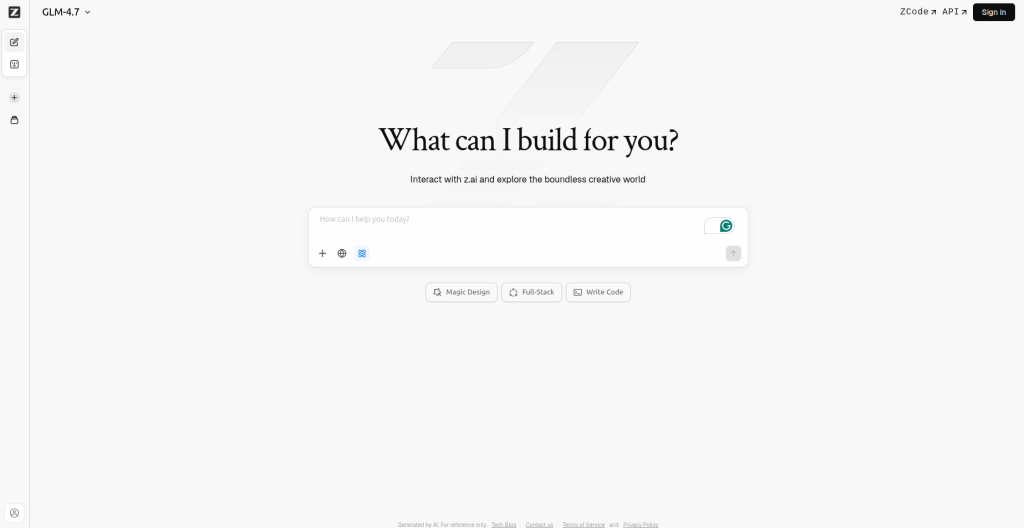
GLM-5.2 posts 62.1% on SWE-bench Pro at $1.40 input, and GLM-5.2 currently leads among open-weight LLMs (91.2% gpqa). Z.ai’s flagship represents the highest open-weight capability on difficult reasoning and long-horizon engineering tasks. The model is not the fastest or cheapest, but it’s the most capable.
Key Features
- 1M-token context window (extendable to 2M with careful RoPE scaling)
- Mixture-of-Experts architecture: 1.3T total parameters, 60B active
- Multimodal: native text + image understanding (no video)
- Long-horizon agent execution: handles complex, multi-step software tasks
- Fine-tuning: full-weight and LoRA supported
Benchmarks
- GPQA: 91.2% (best-in-class reasoning)
- SWE-bench Verified: 69.6% (best for open-weight coding)
- SWE-bench Pro: 62.1% (multi-file repository changes)
- LiveCodeBench: 86.4% (production coding quality)
Context Window: 1M tokens (native), extendable to 2M via Yarn
Licensing: Proprietary but permissive for commercial use. Z.ai requires attribution but allows self-hosting, fine-tuning, and internal deployment. No user-cap restrictions.
Hardware Requirements
- Minimum: Single A100 80GB (quantized to int8 or FP8)
- Recommended: H100 for inference below 500ms TTFT
- Local quantization reduces memory to 40GB+ (with accuracy tradeoffs)
Strengths
- Strongest reasoning among open weights (especially on math and logic)
- Best multi-file codebase understanding for long-context engineering
- Aggressive inference optimization: friendly to vLLM and TensorRT-LLM
- Active community fine-tuning (100+ LoRA adaptations on Hugging Face)
Weaknesses
- Slower inference than similarly-sized models (reasoning overhead)
- Context beyond 200K shows quality degradation on specific benchmarks
- No video understanding (unlike Kimi K2.7)
- Smaller community than Llama (fewer third-party optimizations)
Best For: AI engineers and research teams building complex reasoning systems, code-to-code transformation agents, technical writing assistants, and compliance-reasoning workflows.
Deployment Options
- vLLM (recommended for production)
- TensorRT-LLM (if pure throughput is priority)
- Ollama (for local prototyping, slower)
- Hugging Face Inference Endpoints
- Together AI, Fireworks AI (managed hosting)
Fine-tuning Support: Yes. LoRA reductions of 4:1 to 8:1 are production-viable. Full-weight fine-tuning requires H100-class GPUs.
Pricing
- Input: $0.14 per 1M tokens (Fireworks)
- Output: $1.40 per 1M tokens (Fireworks)
- Self-hosting cost: ~$0.30–0.80 per 1M tokens (GPU amortization on $600K GPU cluster)
Expert Opinion
GLM-5.2 is the “Opus of open-weight” – highest capability, slowest, most expensive. Teams adopting it are typically replacing Claude Opus or GPT-4 Turbo on reasoning-heavy tasks, not cutting costs. The value is capability, not price.
DeepSeek V4-Pro: Best Enterprise Value
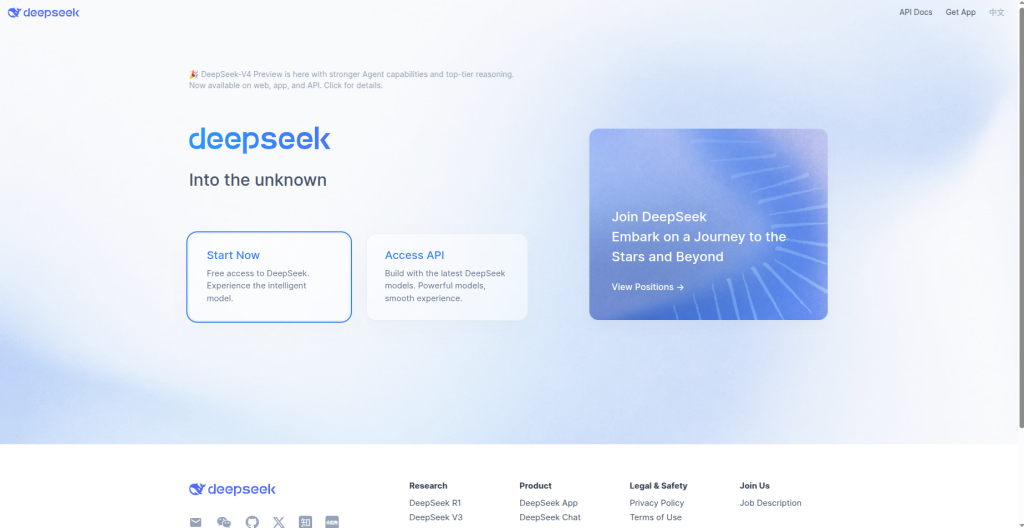
DeepSeek’s V4 models were released in April 2026 under the MIT license (a highly popular, permissive open-source software license). They are designed to deliver strong performance at relatively low cost. The models use token compression and DeepSeek Sparse Attention to support very long context windows of up to 1 million tokens while keeping memory use manageable.
Key Features
- 671B total parameters, 37B active (MoE)
- 1M-token context window (native)
- MIT License (true open-source, commercial-use unrestricted)
- Sparse Attention: handles million-token prompts efficiently
- Multimodal: text + image (no video)
Benchmarks
- SWE-bench Verified: ~70% (competitive with GLM-5.2)
- LiveCodeBench: 93.5% (production coding quality, best-in-class)
- Codeforces rating: 3206 (beats all frontier models)
- GPQA: 87.1% (strong but not elite reasoning)
Context Window: 1M tokens (native, efficiently cached)
Licensing: MIT License. Unrestricted commercial use, no user caps, no regional restrictions. This is genuinely open-source, not just open-weight.
Hardware Requirements
- Minimum: Single A100 80GB at FP8
- Recommended: H100 for <200ms latency at scale
- CPU inference: viable for small batches with llama.cpp
Strengths
- Best per-token economics: $0.01 (output) at official API pricing
- Sparse Attention makes million-token operations practical
- MIT License removes enterprise licensing friction
- Production-grade inference: minimal latency variance
- Strong coding and math (better than much larger closed models)
Weaknesses
- Reasoning lag vs GLM-5.2 (GPQA difference: 4.1 points)
- Weaker on instruction-following with ambiguous prompts
- Community is smaller than Llama despite capability
Best For: Cost-sensitive enterprises, startups with tight budgets, high-volume inference workloads, teams processing millions of internal documents, edge deployments.
Deployment Options
- vLLM (primary recommendation)
- Ollama (for local use)
- DeepSeek official API (fastest)
- Together AI, Fireworks AI, Modal Labs
Fine-tuning Support: Yes. LoRA widely used. Full fine-tuning on H100s takes 48 hours per 1000-step run.
Pricing
- Input: $0.27 per 1M tokens (official)
- Output: $1.10 per 1M tokens (official)
- Flash variant: $0.01 output (for lower-quality, speed-priority tasks)
Expert Opinion
DeepSeek V4 is the price-performance king. If every token costs matter and reasoning demands are moderate (not frontier), this wins. Enterprises have already started replacing GPT-3.5 Turbo with V4 Flash.
Kimi K2.7 Code – Best for Agents
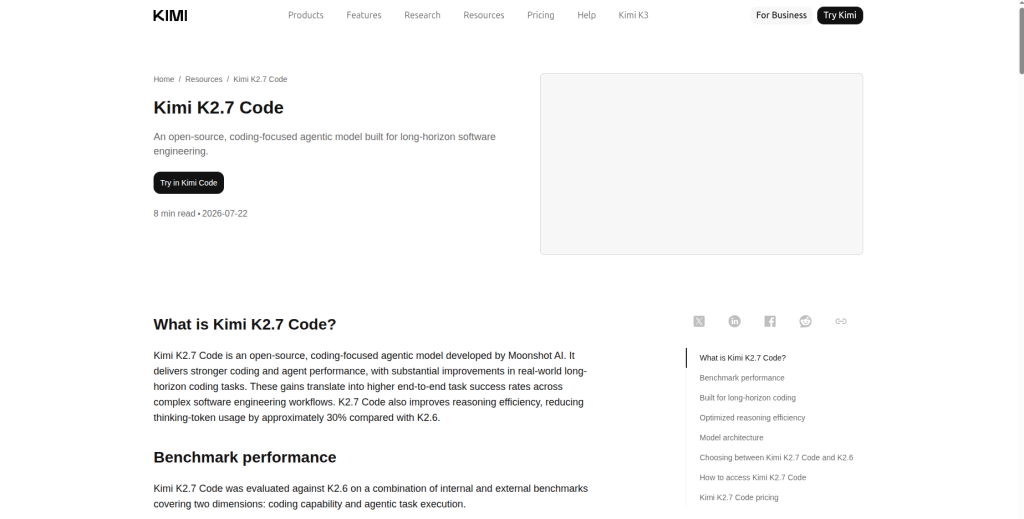
What makes it interesting is that it always thinks before it answers. You can’t turn off the reasoning, but Moonshot has tuned the model to use 30% less thinking tokens than K2.6. So it reasons more efficiently. It can also see images, which most open weight models on this list cannot do. You can drop a screenshot of a broken UI or an error message into your workflow and the model can actually look at it!
Key Features
- 1T total parameters, 128B active (MoE) with 32B-per-token active
- 1M-token context window
- Integrated reasoning (always-on, optimized)
- Multimodal: text + image + video understanding
- Agent Swarm: coordinate up to 100 sub-agents
- Built for tool use (function calling, MCP integration)
Benchmarks
- SWE-bench Verified: 67.8% (strong coding)
- MCP Mark (tool use): 81.1% (best-in-class for agentic workflows)
- AIME: 96.1% (math reasoning)
- Live agent testing: outperforms K2.6 on 23/25 real GitHub issues
Context Window: 1M tokens (native)
Licensing: Modified MIT for commercial use below 100M MAU. Approval required for larger deployments.
Hardware Requirements
- Minimum: A100 80GB at FP8 quantization
- Recommended: H100 for multi-turn agent loops
- Reasoning token overhead: 30% more tokens than non-reasoning models
Strengths
- Best open-weight for multi-turn agent execution (tool use, error recovery)
- Only open-weight model with native video understanding
- Reasoning integrated but optimized (30% token reduction vs K2.6)
- Image understanding: paste UI screenshots, error messages, code visualizations directly
- Strong math and logic (AIME 96.1%)
Weaknesses
- Reasoning always-on (can’t turn off for speed)
- Token overhead: 30% more tokens required than non-reasoning models
- Slower inference than DeepSeek V4 (reasoning latency)
- 100M MAU restriction on larger deployments
Best For: Autonomous coding agents, multi-turn problem solving, tasks requiring tool use, visual debugging workflows, RAG systems that iterate.
Deployment Options
- vLLM (with Pipelined reasoning token scheduling)
- Ollama (with Kimi CLI integration)
- Together AI (managed, optimized for Kimi)
- Moonshot API (official, lowest latency)
Fine-tuning Support: LoRA available. Full fine-tuning for agentic adaptation available through Moonshot.
Pricing
- Input: $0.40 per 1M tokens
- Output: $1.40 per 1M tokens (Moonshot API)
- Reasoning cost: additional token burn (transparent in API responses)
Expert Opinion
Kimi K2.7 Code is the preferred choice for autonomous coding agents in production. If your workflow involves tool calls, error recovery, and iteration, Kimi’s always-on reasoning pays off. The video understanding is a genuine differentiator for debugging and design workflows.
Llama 4 Scout: Best Local Deployment
The Scout model fits on a single high-end GPU, processes 10 million tokens of context, and approaches the performance of models that cost cents per token to access.
Key Features
- 17B active parameters, 109B total (MoE)
- 10M-token context window (largest among open-weight)
- Mixture-of-Experts: efficient inference
- Multimodal: text + image (no video)
- Meta Llama License (commercial use, with 700M MAU cap)
- Wide deployment ecosystem
Benchmarks
- SWE-bench Verified: 57.3% (solid, not elite)
- GPQA: 81.2% (good reasoning)
- Coding Arena: 6.8 (behind GLM and Kimi)
- Needle-in-haystack (8M tokens): 95% retrieval accuracy
Context Window: 10M tokens (native, largest in production)
Licensing: Meta Llama License. Commercial use allowed unless you have >700M monthly active users. EU-domiciled companies have restrictions (as of 2026).
Hardware Requirements
- Minimum: Single A100 40GB at FP8
- Recommended: A100 80GB or H100 for <200ms latency
- CPU fallback: llama.cpp handles Scout at ~2 tokens/sec on Apple Silicon
Strengths
- Extraordinary context window (10M tokens handles entire codebases)
- Efficient MoE: activates only 17B of 109B parameters
- Distributed ecosystem: Ollama, llama.cpp, vLLM, LM Studio all optimized
- Meta backing: continuous optimization, enterprise support available
- Multimodal capability with reasonable latency
Weaknesses
- Coding capability lags contemporaries (SWE-bench 9 points behind GLM-5.2)
- Reasoning not elite (GPQA 10 points behind GLM)
- 700M MAU cap creates licensing complexity for scale-ups
- Context beyond 4M shows quality degradation on some tasks
Best For: Local development, edge deployment, teams building document processing at scale, companies needing ultimate data privacy, self-hosting on commodity hardware.
Deployment Options
- Ollama (best DX, “ollama run llama4-scout”)
- llama.cpp (best efficiency, CPU-compatible)
- vLLM (for production throughput)
- LM Studio (best GUI, no CLI needed)
- Apple MLX (native on Mac)
Fine-tuning Support: Yes. LoRA is primary path. Full fine-tuning on H100.
Pricing
- Open-weight (free)
- Self-hosting: $2-5 per million output tokens on typical GPU infrastructure
- Inference provider pricing: $0.15–0.40/1M output (Together AI, Modal)
Expert Opinion
Scout is the best “I want to run this myself” model. The 10M context window and MoE efficiency make it viable on single high-end GPUs. If your use case is document processing, codebase analysis, or privacy-sensitive workloads, Scout’s combination of scale, privacy, and accessible hardware economics is unbeatable.
Qwen 3.5 (Alibaba): Best Multimodal Generalist
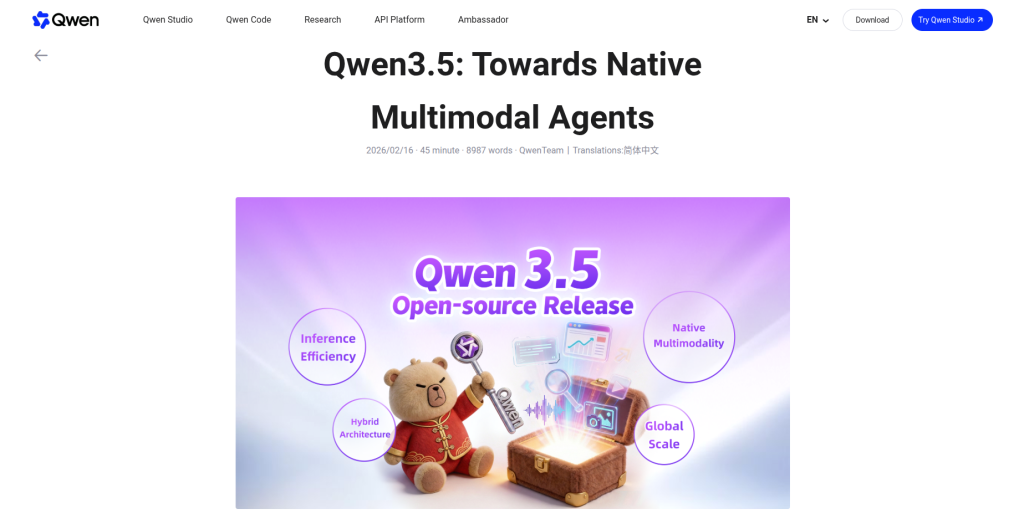
It ships with a native 262,144-token context window that extends toward roughly one million tokens, native vision-language support, and coverage of an astonishing 201 languages.
Key Features
- Dense 32B, MoE 122B-A10B, and 480B-A35B variants
- 262K native context, extensible to ~1M via Yarn
- Multimodal: text + image (strong vision-language performance)
- Apache 2.0 License (true open-source)
- 201 languages supported
Benchmarks
- SWE-bench Verified: 69.6% (best with Qwen3-Coder variant)
- MMLU: 92.3% (strong across knowledge)
- Vision tasks: competitive with Gemini 2.0 on visual understanding
- Math (AIME): 93.4%
Context Window: 262K native (extendable to 1M)
Licensing: Apache 2.0 (unrestricted commercial use, no caps)
Hardware Requirements
- Dense 32B: Single A100 40GB
- MoE 122B-A10B: A100 80GB or H100
- MoE 480B-A35B: Distributed (2+ H100s)
Strengths
- Apache 2.0: simplest licensing for enterprises
- Multilingual: 201 languages (only model at this scale)
- Variant flexibility: dense, small-MoE, large-MoE options
- Vision-language: competitive with frontier models on image understanding
- Community optimization: extensive llama.cpp and vLLM tuning
Weaknesses
- Coding lags GLM-5.2 and V4 on SWE-bench Pro
- Reasoning not elite (GPQA 85%, behind GLM)
- Longer context adds latency (PagedAttention helps but doesn’t eliminate it)
Best For: Global applications, multilingual teams, image understanding workflows, enterprises that demand pure Apache 2.0 licensing, teams building on Alibaba cloud.
Deployment Options
- vLLM (primary)
- Ollama (with community quantizations)
- Alibaba Cloud inference endpoints
- Hugging Face Inference Endpoints
Fine-tuning Support: Yes. LoRA and full fine-tuning supported.
Pricing
- Open-weight (free to download)
- API (Alibaba): $0.08–0.25 input, $0.24–1.20 output
- Inference providers: $0.15–0.50
Expert Opinion
Qwen is the Swiss Army knife of open-weight models. It’s not elite at any single task, but it’s competitive across everything: coding, reasoning, vision, multilinguality. For enterprises choosing Apache 2.0 licensing over Llama’s restrictions, Qwen is the safer bet.
DeepSeek R1: Best Reasoning (With Tradeoffs)
Overview
DeepSeek’s reasoning-focused variant includes chain-of-thought tokens, proving reasoning consistency on complex problems. Smaller and more efficient than frontier reasoning models.
Key Features
- 671B parameters, 37B active
- Reasoning tokens: 2K–10K per response (transparent in API)
- 1M context window
- Superior performance on proof-based tasks
- MIT License
Benchmarks
- AIME: 96% (among best open-weight)
- GPQA: 88.2% (elite reasoning)
- SWE-bench Verified: 70.1% (reasoning aids coding)
- Codeforces: 3456 (best algorithm implementation)
Context Window: 1M tokens
Licensing: MIT
Hardware Requirements: Same as V4 (H100 for scale)
Strengths
- Reasoning tokens transparent: see model’s thinking
- Best for algorithm problems, mathematical proofs
- Better iterative debugging (reasoning recovery from errors)
- Cheaper than frontier reasoning models (GPT-o1)
Weaknesses
- Reasoning tokens inflate total token count (cost multiplier of 2–4x)
- Slower inference (reasoning overhead)
- Overkill for tasks not requiring deep reasoning
- Token tracking complexity (must account for both input and reasoning)
Best For: Scientific research, complex algorithm design, proof verification, problems requiring mathematical rigor.
Deployment Options: Same as V4 (vLLM, Ollama, Together AI)
Pricing
- Input: $0.55 per 1M
- Output: $2.19 per 1M
- Reasoning tokens: counted separately (usually 2–5x input tokens)
Expert Opinion
R1 is not a daily-driver model. Use it when you need provable correctness and the token cost is acceptable. For most production workflows, V4-Pro delivers better price-performance.
Mistral Large 3: Best Open-Weight from Europe
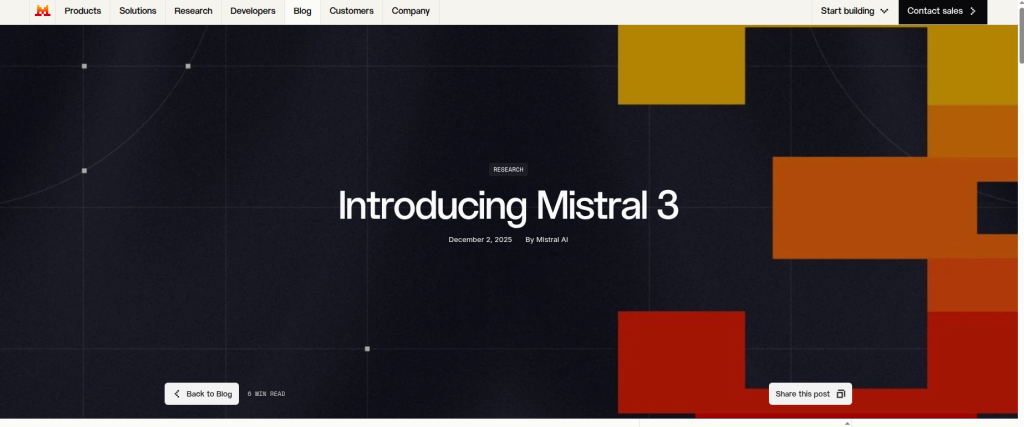
Among the leading open-weight models, Qwen 3.5/3.6 and Mistral Large 3/Small 4 offer the most business-friendly licensing. Their Apache 2.0 licenses allow unrestricted commercial use with no user or deployment limits.
Key Features
- MoE architecture: 271B total parameters
- 256K context window
- Apache 2.0 License
- European company: data governance clarity
- Strong tool use and instruction following
Benchmarks
- SWE-bench Verified: 66.4%
- GPQA: 83.1%
- Tool-use (tool-use benchmark): 88.3%
- Instruction following: competitive with GPT-4
Context Window: 256K
Licensing: Apache 2.0
Hardware Requirements: A100 80GB or H100
Strengths
- Apache 2.0 from European company (privacy-friendly)
- Strong instruction following (better than larger models on ambiguous prompts)
- Tool use capability (function calling reliability)
- Smaller than Llama/Qwen alternatives (faster inference)
Weaknesses
- Coding weaker than peers (11-point SWE-bench gap to GLM)
- Context shorter than alternatives
- Smaller community ecosystem
Best For: European enterprises (GDPR alignment), instruction-following tasks, tool-use workflows, teams in compliance-heavy industries.
Deployment Options: vLLM, Ollama, Mistral API, Together AI
Pricing: Open-weight (free); API via Mistral: $0.15–1.40
Expert Opinion
Mistral Large 3 is the safe European choice. Apache 2.0, good instruction following, strong compliance story. Not the fastest or cheapest, but the clearest licensing and governance for risk-averse enterprises.
Gemma 3 (Google): Best Small Open-Weight
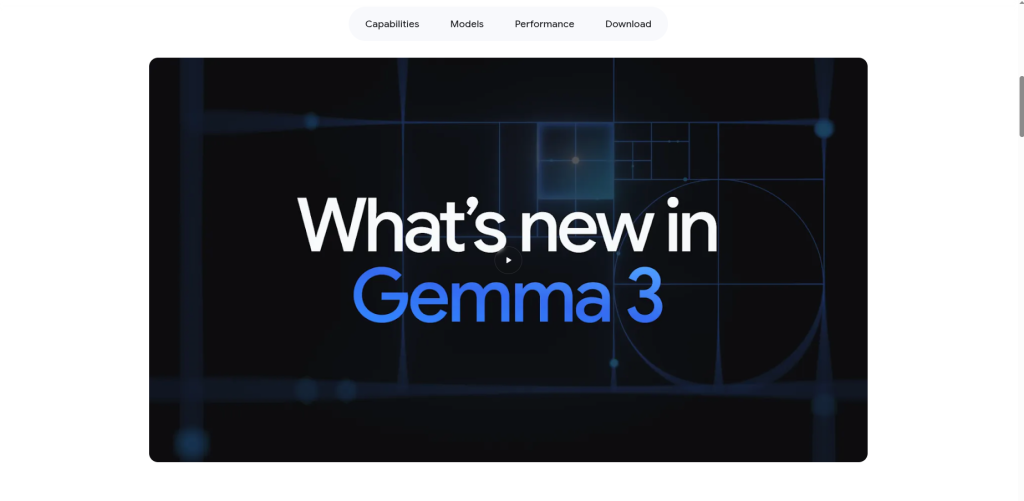
Gemma 3 is Google’s open-weight model family, built to deliver strong reasoning and multimodal capabilities while remaining efficient enough for local and resource-constrained deployments.
Key Features
- 27B and 7B variants (Apache 2.0)
- Competitive with Llama 3 on small-model benchmarks
- Efficient inference: low latency even on modest GPUs
- Strong instruction tuning
Benchmarks
- MMLU: 85.9% (27B variant)
- SWE-bench Verified: 51.3% (weaker coding)
- Latency: 40ms per token on A100 (fastest in class)
Best For: On-device AI, real-time applications, teams with limited GPU, edge deployment, cost-minimized production.
Licensing: Apache 2.0
Pricing: Open-weight
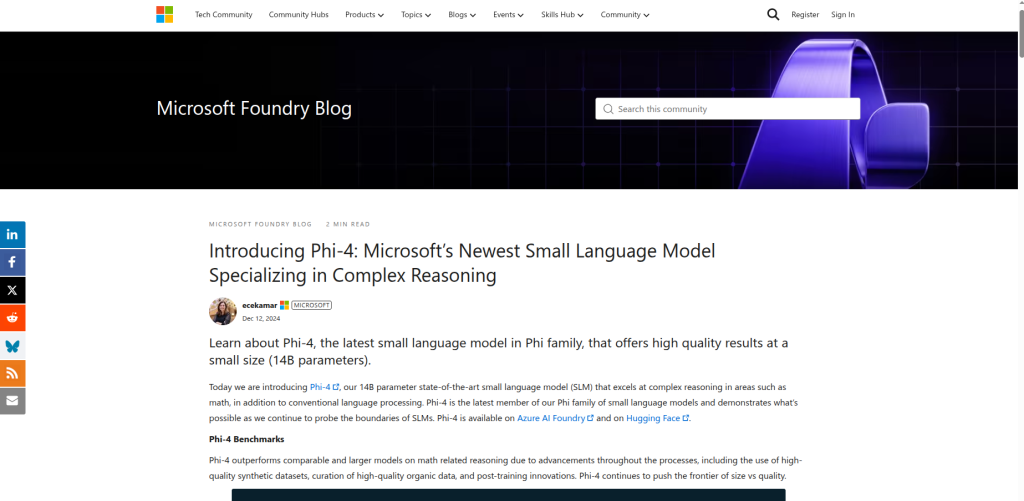
Phi-4 (Microsoft): Best Efficient Model
Overview
Phi-4 is Microsoft’s lightweight open-weight model, designed to deliver advanced reasoning capabilities while remaining efficient enough for local deployment..
Key Features
- Distilled from larger models (reasoning capability punches above weight)
- 128K context window
- Strong on SWE-bench for a 14B model
- Fast inference
Benchmarks
- SWE-bench Verified: 58.9% (excellent for 14B)
- GPQA: 82.1% (reasoning despite small size)
- Latency: excellent
Best For: On-device reasoning, edge agents, teams building with limited compute, cost-optimized deployments.
Licensing: MIT
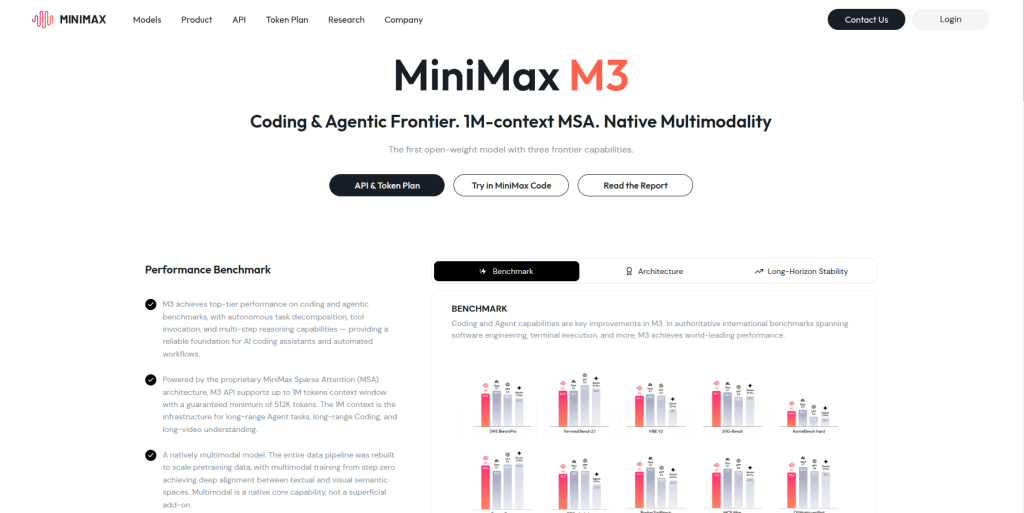
MiniMax M3: Best Video Understanding
MiniMax M3 is an open weight model created by MiniMax, a Shanghai-based AI company. It came out in June 2026, and it’s the best model (IMO) on this list for multimodal tasks. It can look at text, images, and even video! None of the other models here can watch a video and understand what it’s about.
Key Features
- 1T total parameters
- Native video understanding (text + image + video)
- 1M context window
- Sparse Attention (efficient long-context)
- Multimodal agent training
Best For: Video analysis, visual Q&A, design workflows, content understanding, accessibility features (captioning).
Benchmarks
- SWE-bench Pro: 59.0%
- Video understanding: competitive with Gemini 2.0 on visual reasoning
Licensing: Proprietary (permissive for research and limited commercial)
Expert Opinion
M3 is the only open-weight model that truly understands video. If your product needs video analysis, this is your choice. Trade the cost and latency for capability that closed models gatekeep.
Comparison Table: Open-Weight Models at a Glance
| Model | Best For | Reasoning | Coding | Context | Multimodal | License | Local Deploy | Enterprise |
| GLM-5.2 | Overall capability | 91.2 | 69.6 | 1M | Image | Proprietary | vLLM | Yes |
| DeepSeek V4 | Cost | 87.1 | 70.0 | 1M | Image | MIT | Ollama | Yes |
| Kimi K2.7 | Agents | 88.4 | 67.8 | 1M | Video | Modified MIT | vLLM | <100M |
| Llama 4 Scout | Local | 81.2 | 57.3 | 10M | Image | Meta | Ollama | <700M |
| Qwen 3.5 | Multilingual | 85.1 | 69.6 | 262K | Image | Apache 2.0 | vLLM | Yes |
| DeepSeek R1 | Reasoning | 96.0 | 70.1 | 1M | Text | MIT | vLLM | Yes |
| Mistral Large 3 | Instruction | 83.1 | 66.4 | 256K | Text | Apache 2.0 | Ollama | Yes |
| Gemma 3 | Small/Efficient | 78.9 | 45.2 | 128K | Image | Apache 2.0 | Ollama | Yes |
| Phi-4 | Edge/Reasoning | 82.1 | 58.9 | 128K | Text | MIT | Ollama | Yes |
| MiniMax M3 | Video | 84.3 | 62.0 | 1M | Video | Proprietary | vLLM | Approval |
Read More: How to Automate Your Work with AI in 2026
Which Open-Weight AI Model Should You Choose?
The best open-weight AI model depends on your workload, deployment strategy, and budget rather than a single benchmark score. While every model in this list has its strengths, a few stand out for specific use cases.
| Requirement | Recommended Model | Why It Stands Out |
| Best Overall Performance | GLM-5.2 | Industry-leading reasoning and coding performance. |
| Best Overall Value | DeepSeek V4 | Excellent balance of capability, cost, and deployment flexibility. |
| Software Engineering & Coding Agents | GLM-5.2, Kimi K2.7 Code | Strong code generation, repository understanding, and agent workflows. |
| Enterprise Deployments | DeepSeek V4, Qwen 3.5 | Enterprise-ready licensing, scalability, and multilingual support. |
| Self-Hosted & Long-Context Workloads | Llama 4 Scout | Massive context window with mature self-hosting support. |
| Reasoning & Mathematical Tasks | DeepSeek R1 | Optimized for complex reasoning and mathematical problem-solving. |
| Multilingual Applications | Qwen 3.5 | Broad language coverage with strong multilingual performance. |
| Vision & Video Understanding | MiniMax M3 | Native multimodal capabilities, including video understanding. |
| AI Agents & Tool Use | Kimi K2.7 Code | Excellent function calling, MCP support, and autonomous workflows. |
| Resource-Constrained Devices | Phi-4, Gemma 3 | High efficiency with modest hardware requirements. |
Our Recommendation
If you’re looking for the most capable open-weight model available today, GLM-5.2 is the benchmark leader for reasoning and software engineering tasks. For most organizations, however, DeepSeek V4 offers the strongest combination of performance, deployment flexibility, and cost efficiency, making it our overall recommendation for 2026. Teams focused on self-hosting should consider Llama 4 Scout, while Kimi K2.7 Code is the best choice for AI agents and tool-driven workflows. For multilingual deployments, Qwen 3.5 remains one of the most versatile options available.
Deployment Guide: From Model to Production
Choosing the right deployment framework depends on your use case, infrastructure, and scale.
Ollama – Best for Local Development
Ideal for developers who want to run open-weight models locally with minimal setup. Ollama handles model downloads, quantization, and serving automatically, making it a great choice for prototyping, testing, and personal projects. However, it’s designed for single-user workloads and isn’t suitable for production deployments.
Best for: Local development, demos, and experimentation.
vLLM – Best for Production
vLLM is the preferred deployment framework for production workloads. It supports efficient batching, quantization, and high-throughput inference while working with most popular open-weight models. Although it requires more infrastructure expertise than Ollama, it offers significantly better scalability and performance.
Best for: Production applications, APIs, and enterprise deployments.
TensorRT-LLM – Best for Maximum Performance
If you’re deploying exclusively on NVIDIA GPUs and need the highest possible throughput, TensorRT-LLM provides aggressive inference optimizations. It delivers excellent performance but has a steeper setup process and is best suited for experienced ML infrastructure teams.
Best for: Large-scale, high-volume inference on NVIDIA hardware.
Managed APIs – Best for Zero Infrastructure
If you don’t want to manage GPUs or deployment infrastructure, managed inference providers such as Together AI, Fireworks AI, Hugging Face Inference Endpoints, and Modal Labs let you deploy open-weight models through APIs. This is the fastest way to get started, though it comes with higher per-token costs and less control over your infrastructure.
Best for: Startups, rapid prototyping, and teams without dedicated ML Ops.
Which Deployment Option Should You Choose?
| Deployment | Best For |
| Ollama | Local development and testing |
| vLLM | Production APIs and enterprise workloads |
| TensorRT-LLM | Maximum performance on NVIDIA GPUs |
| Managed APIs | Fast deployment with no infrastructure management |
Common Mistakes to Avoid
1. Choosing Based Only on Benchmarks
Benchmarks lag real-world performance by 3–6 months. A 2-point GPQA difference matters less than your actual task performance. Test on your data.
2. Ignoring Licensing Restrictions
- Meta Llama: 700M MAU cap
- Qwen/Mistral/DeepSeek: Apache 2.0 (unlimited)
- Proprietary models: negotiation required at scale
Get legal review before assuming commercial use is allowed.
3. Underestimating Inference Costs
Self-hosting “saves money” only if:
- Volume >100M tokens/month, OR
- Compliance requires it
Otherwise, managed APIs are cheaper when you include engineering labor.
4. Ignoring Context Window Quality Degradation
Advertised context (10M for Scout) doesn’t mean usable context. Needle-in-haystack accuracy drops sharply beyond 4–6M tokens. Test your use case.
5. Picking the Largest Model
Larger ≠ better for your task. Test: is DeepSeek V4 (671B active) really worse than GLM-5.2 (1.3T) for your specific workflow? Usually not. Smaller = faster + cheaper.
6. Misunderstanding “Open-Weight” Licensing
Open-weight ≠ Open-source (OSI). You get model weights, not necessarily training code. License carefully for compliance.
7. Forgetting to Test Quantization
FP8 quantization saves 50% memory but may cost 1–2% accuracy. Test on your evaluation set before production.
8. Assuming Ollama = Production Ready
Ollama is a development tool. It’s single-user and doesn’t scale. Use vLLM or TensorRT for anything handling >10 concurrent requests.
Final Verdict
There isn’t a single best open-weight AI model in 2026-only the best one for your specific needs. GLM-5.2 leads in reasoning and coding, DeepSeek V4 offers the best overall value for most teams, Kimi K2.7 Code excels at AI agents and tool use, Llama 4 Scout is the top choice for self-hosting, and Qwen 3.5 stands out for multilingual and enterprise deployments. Before choosing a model, consider your workload, deployment strategy, hardware, licensing requirements, and budget. With today’s open-weight ecosystem, you can achieve frontier-level performance while maintaining full control over your infrastructure and data.
Frequently Asked Questions
Can open-weight AI models compete with GPT-4 and Claude?
Yes. Leading models like GLM-5.2 and DeepSeek V4 now deliver comparable performance on coding, reasoning, and many enterprise workloads. However, proprietary models still tend to perform better on highly creative, ambiguous, or general-purpose tasks.
Should I self-host an open-weight model or use an API?
APIs are ideal for startups and teams that want the fastest deployment with minimal infrastructure management. Self-hosting is a better choice when data privacy, regulatory compliance, or long-term inference costs are a priority.
Which open-weight AI model is best for enterprise use?
For most organizations, DeepSeek V4 offers the best balance of performance, cost, and deployment flexibility. If licensing is a key consideration, Qwen 3.5 and Mistral Large 3 are excellent choices thanks to their Apache 2.0 licenses.
How much GPU memory do I need to run these models?
Hardware requirements vary by model size and quantization. Smaller models such as Gemma 3 and Phi-4 can run on consumer GPUs, while larger models like GLM-5.2 or DeepSeek V4 typically require multiple enterprise-grade GPUs for production workloads.
Can I fine-tune open-weight AI models?
Yes. Most modern open-weight models support parameter-efficient fine-tuning methods such as LoRA and QLoRA, allowing you to customize them for domain-specific tasks without retraining the entire model. Full fine-tuning generally requires significantly more compute and memory.
Are open-weight multimodal models ready for production?
Yes, especially for image understanding and vision-language tasks. Video-capable models are improving rapidly, but text and image workflows remain the most mature and widely deployed in production environments.
Are open-weight AI models secure enough for enterprise deployments?
When self-hosted, open-weight models provide complete control over your data, infrastructure, and security policies. If you use managed APIs, review the provider’s privacy, compliance, and data retention policies before deploying sensitive workloads.
How do I choose the right open-weight AI model?
Start by defining your primary use case, whether it’s coding, reasoning, multilingual support, multimodal AI, or local deployment. Then compare factors such as licensing, hardware requirements, deployment options, and total cost of ownership instead of relying solely on benchmark scores.