Artificial intelligence has fundamentally transformed how we work, create, and solve problems. Today’s business landscape demands speed, accuracy, and intelligent automation, and the right AI assistant can deliver all three.
The competition between ChatGPT, Claude, and Gemini has intensified dramatically. Each platform brings distinct capabilities, pricing models, and integration strategies to the table. For developers building applications, marketers creating campaigns, teams managing documentation, or students conducting research, the choice matters significantly.
Selecting the wrong AI assistant means slower workflows, missed productivity opportunities, and potentially higher costs. Selecting the right one accelerates your output, reduces decision-making friction, and scales your capabilities without proportional team growth.
This comprehensive comparison examines the strengths, weaknesses, pricing, and ideal use cases for each platform. By the end, you’ll understand which AI assistant truly fits your workflow.
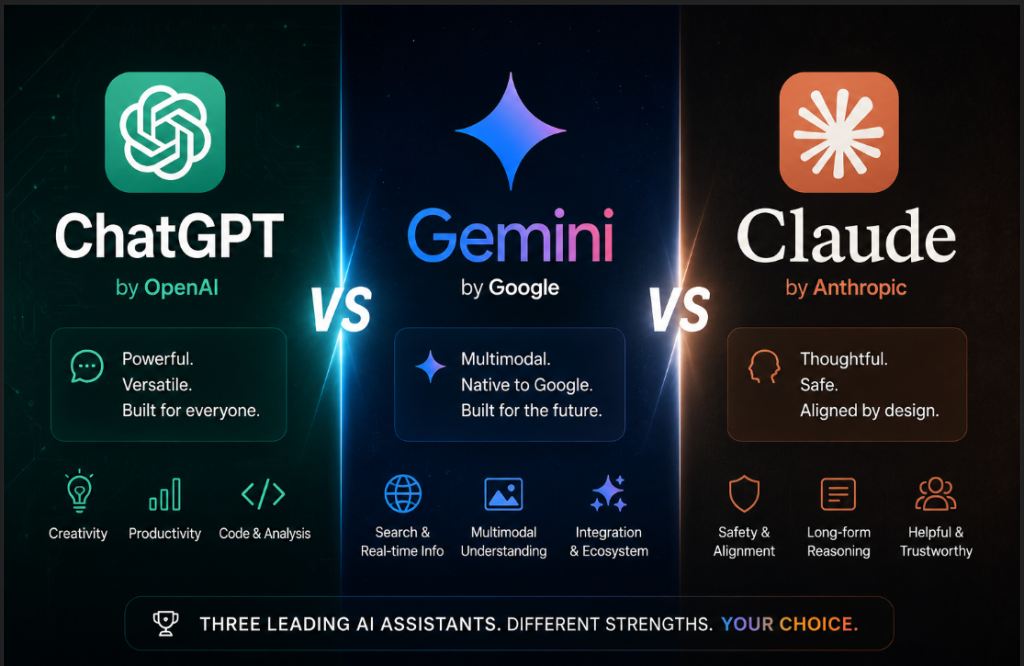
Quick Comparison Overview
| Feature | ChatGPT | Claude | Gemini |
| Developer | OpenAI | Anthropic | |
| Best For | General-purpose, content creation | Long-form documents, reasoning | Productivity workflows, Google integration |
| Context Window | 128K tokens | 200K tokens | 2M tokens (Gemini 2.0) |
| Coding Ability | Excellent | Excellent | Very Good |
| Writing Quality | Excellent | Excellent | Very Good |
| Multimodal Support | Image input/output | Image input only | Full multimodal |
| Free Tier Available | Yes | Yes | Yes |
| Enterprise Ready | Yes | Yes | Yes |
| Mobile App | iOS/Android | iOS/Android | iOS/Android |
| Pricing (Pro) | $20/month | $20/month | $20/month |
| API Availability | Yes | Yes | Yes |
ChatGPT: The Industry Standard
Overview
ChatGPT remains the most widely adopted AI assistant globally. Launched by OpenAI in late 2022, it democratized access to advanced language models and set the baseline for AI assistant capabilities.
With over 200 million weekly active users, ChatGPT has become the default choice for millions of professionals, students, and businesses. Its strength lies in consistency, broad knowledge, and accessibility across devices and platforms.
Key Capabilities
ChatGPT excels at multi-turn conversations, creative writing, code generation, and general problem-solving. The platform supports image analysis, document upload, and real-time web browsing (in paid tiers), making it versatile for diverse workflows.
GPT-4 and GPT-4o models deliver sophisticated reasoning for complex tasks, while GPT-4o Mini provides faster, cost-effective processing for routine inquiries.
Strengths
Broad Knowledge Base: ChatGPT maintains comprehensive training data with strong performance across diverse domains.
User Experience: The interface is intuitive, with smooth conversational flows and minimal learning curve.
Ecosystem Integration: Seamless integration with thousands of third-party apps through OpenAI’s plugin system and API.
Speed and Responsiveness: GPT-4o delivers impressive speed without sacrificing quality.
Accessibility: Free tier allows everyone to experiment, with generous usage limits compared to competitors.
Weaknesses
Context Limitations: 128K token window is sufficient but smaller than Claude (200K) or Gemini (2M).
Accuracy Gaps: Occasional hallucinations and less reliable performance on specialized domains.
Limited Mobile Functionality: Mobile app lacks some desktop features.
No Image Generation in Free Tier: Advanced image capabilities require paid subscription.
Ideal Users
Content marketers, startup founders, general business professionals, students, and developers building consumer applications find ChatGPT most suitable.
Real Workflow Example
A marketing manager uses ChatGPT to generate blog post outlines, refine email copy, and analyze competitor messaging in a single workflow. The speed and conversational nature make iterative refinement effortless, reducing content creation cycles from days to hours.
Claude: The Reasoning Champion
Overview
Anthropic’s Claude represents a different philosophy: prioritizing safety, reasoning capability, and long-form document handling. Claude has gained significant adoption among developers, researchers, and knowledge workers processing large documents.
The latest Claude models (Claude 4.6 Sonnet and Claude 4.6 Haiku) demonstrate exceptional performance on complex reasoning tasks, with particular strength in code generation and technical problem-solving.
Key Capabilities
Claude’s 200K context window accommodates entire codebases, lengthy research papers, or comprehensive documentation in a single conversation. Constitutional AI training makes Claude particularly reliable for nuanced reasoning and reduced hallucination.
Advanced code analysis, document summarization, and research synthesis represent core strengths.
Long-Context Advantages
Processing an entire 400-page technical manual becomes feasible within a single conversation. A researcher can upload five research papers and ask Claude to synthesize findings, contradictions, and emerging themes without context reset.
This capability fundamentally changes how knowledge workers approach large-scale content analysis.
Strengths
Exceptional Reasoning: Claude excels at breaking down complex problems into logical steps.
Long-Context Handling: A 200K-token window enables comprehensive document analysis in a single conversation.
Code Quality: Generated code is notably clean, well-commented, and production-ready.
Reduced Hallucination: Constitutional AI training delivers more accurate, factual outputs.
Document Understanding: Superior handling of technical specifications and complex written materials.
Enterprise Adoption: Strong growth among Fortune 500 companies for internal workflows.
Weaknesses
Smaller Ecosystem: Fewer pre-built integrations compared to ChatGPT, though rapidly expanding.
Learning Curve: Slightly steeper interface learning curve for non-technical users.
Image Capabilities: Cannot generate images; only supports image input for analysis.
Speed Trade-off: Reasoning quality sometimes comes with slower response times.
Ideal Users
Software developers, technical architects, researchers, legal professionals, and enterprises handling sensitive documentation benefit most from Claude.
Real Workflow Example
An engineering team uploads their entire API documentation (150K tokens), architecture diagrams, and codebase context. Claude comprehensively understands the system and generates implementation proposals, identifies potential issues, and suggests improvements. This eliminates context-switching and dramatically accelerates code review cycles.
Gemini: The Productivity Integrator
Overview
Google’s Gemini integrates AI assistance directly into the Google Workspace ecosystem. For organizations already invested in Gmail, Drive, Sheets, and Docs, Gemini represents a native productivity layer rather than a separate tool.
Gemini 2.0 introduced a massive 2 million token context window, potentially the largest in the industry, with seamless Google Workspace integration.
Google Ecosystem Integration
Gemini assists users while staying within familiar productivity tools. Draft Gmail responses directly, analyze entire Google Drive folders, summarize spreadsheets, and generate presentation content without context-switching.
Workspace Productivity Advantages
Teams using Google Workspace experience native AI assistance across all applications. Calendar scheduling with AI, email drafting, document collaboration with AI suggestions, and sheet analysis all operate within existing workflows.
Multimodal Capabilities
Gemini handles text, image, video, and audio analysis, making it exceptionally versatile for multimedia content creation and analysis.
Strengths
Seamless Workspace Integration: Native integration with Gmail, Drive, Docs, Sheets, and Meet.
Massive Context Window: 2M tokens (Gemini 2.0) enables processing of entire video transcripts, massive codebases, or comprehensive knowledge bases.
Multimodal Processing: Handles text, images, video, and audio natively.
Cost Efficiency: For heavy Workspace users, Gemini represents excellent value through bundle pricing.
Real-time Collaboration: AI features work within shared docs and collaborative files.
Video Processing: Unique capability to analyze and summarize video content.
Weaknesses
Lock-in Risk: Deep Google integration creates dependency on the ecosystem.
Competitive Reasoning: While strong, Claude’s reasoning capabilities lag slightly behind.
Enterprise Adoption: Slower enterprise adoption for standalone use cases outside Workspace.
Privacy Nuance: Google’s data handling requires careful review for sensitive workflows.
Limited Standalone Strength: Outside the Workspace context, Gemini lacks differentiation from competitors.
Ideal Users
Google Workspace organizations, teams prioritizing productivity integration, content creators requiring multimedia capabilities, and enterprises with existing Google infrastructure benefit most.
Real Workflow Example
A product team uses Gemini to analyze customer feedback spreadsheets, email support threads, and video call transcripts simultaneously. Gemini synthesizes patterns across all inputs, generates insights within a shared Google Doc, and the team collaboratively refines recommendations without external tools.
Detailed Feature Comparison
Complete Feature Matrix
| Category | Feature | ChatGPT | Claude | Gemini |
| AI Performance & Intelligence | Reasoning | Excellent | Superior | Very Good |
| Creativity | Excellent | Excellent | Very Good | |
| Factual Accuracy | Very Good | Excellent | Very Good | |
| Long-Form Content | Excellent | Superior | Excellent | |
| Code Generation | Excellent | Superior | Very Good | |
| Research Synthesis | Very Good | Excellent | Excellent | |
| Image Analysis | Excellent | Very Good | Excellent | |
| Video Analysis | Not Available | Not Available | Excellent | |
| Productivity & Workflow | Integration Count | 1000+ | Growing | Native Workspace |
| Real-time Web Access | Yes (Paid) | Coming Soon | Yes (Paid) | |
| Collaborative Features | Limited | Growing | Native | |
| Document Upload | Yes | Yes | Yes | |
| Custom Instructions | Yes | Yes | Yes | |
| API Rate Limits | Generous | Competitive | Competitive | |
| Enterprise Features | SSO/Admin Controls | Yes | Yes | Yes |
| Data Residency Options | Limited | Available | Available | |
| Audit Logging | Comprehensive | Comprehensive | Comprehensive | |
| Compliance Certifications | SOC2, HIPAA | SOC2, HIPAA | SOC2, HIPAA, FedRAMP | |
| SLA Guarantees | Yes | Yes | Yes | |
| Custom Deployment | API-based | API-based | API-based |
Comprehensive Pricing Comparison
Free Plans
ChatGPT Free
- Limited Access to GPT-5.5
- Basic web browsing
- File uploads (small)
- Limitations: Slower speeds, feature restrictions
- Best for: Students, casual users, evaluation
Claude Free (claude.ai)
- Access to Claude 4.6 Sonnet
- Document uploads (200K tokens)
- Reasonable usage limits
- Limitations: Rate limiting after heavy use
- Best for: Individual users, content creators
Gemini Free
- Access to Gemini 1.5 Pro
- Limited daily interactions
- Workspace integration (if using Google Workspace)
- Limitations: Capped usage, feature restrictions
- Best for: Workspace users, students
Paid Individual Plans
ChatGPT Plus ($20/month)
- Access to advanced OpenAI models including GPT-4o and newer reasoning models
- Web browsing, file uploads, and data analysis tools
- Advanced voice mode with screen sharing support
- Access to custom GPTs and productivity features
- Higher usage limits than the free tier
Claude Pro ($20/month)
- Access to Claude Sonnet models with higher usage limits
- Strong long-context document analysis capabilities
- File uploads and large-document processing
- Priority access during peak demand
- Early access to new Claude features
Google One AI Premium ($20/month or part of Google One)
- Gemini Advanced access
- 2M token context window
- Full Workspace integration
- Google One benefits (storage, VPN, etc.)
- Best for: Workspace power users, bundle seekers
Team & Business Plans
ChatGPT Business (formerly ChatGPT Team)
- Includes most ChatGPT Plus features
- Shared workspace and collaboration tools
- Admin controls and centralized billing
- Higher usage limits than individual plans
- Enterprise-grade data privacy protections
Pricing:
- Around $25/user/month billed annually
- Around $30/user/month billed monthly
- Minimum 2 users required
Best for: Small businesses, startups, agencies, and collaborative teams
Claude Team / Enterprise
- Shared team workspaces
- Collaboration and document-sharing features
- Admin and permission controls
- Enterprise-grade security and privacy options
- API integrations for organizational workflows
Pricing: Custom or usage-based depending on organization size and deployment
Best for: Research teams, enterprises, legal teams, and departments handling large documents
Google Workspace + Gemini
Google offers Gemini integrations across Workspace plans, though availability varies by region and plan tier.
Approximate Workspace Pricing
- Business Starter: ~$6/user/month
- Business Standard: ~$12/user/month
- Business Plus: ~$18/user/month
- Enterprise: Custom pricing
Gemini AI features may be:
- Included in select Workspace plans
- Available as add-ons
- Bundled differently depending on Google’s current pricing structure
Best for: Organizations already deeply integrated into Google Workspace
Enterprise & API Pricing
ChatGPT Enterprise
- Enterprise-grade security and compliance features
- Expanded usage limits and larger context handling
- Admin controls, SSO, and workspace management
- Custom integrations and enterprise deployment support
- Priority onboarding and support options
Pricing: Custom enterprise pricing via sales contact
Anthropic Claude API
Pricing varies by model tier and usage volume.
Approximate API Pricing (model dependent)
- Input tokens: starting around $3 per million tokens
- Output tokens: starting around $15 per million tokens for premium models
Anthropic also offers:
- Usage-based billing
- Enterprise agreements
- Scalable API access
- Long-context processing capabilities
Google Cloud Generative AI
Pricing depends on:
- Gemini model version
- Token usage
- Throughput requirements
- Hosting region
- Enterprise support tier
Google Cloud provides:
- Multi-region deployment support
- Enterprise-grade scalability
- Vertex AI integrations
- Security and compliance tooling
Cost-Effectiveness Analysis
For Individual Users: ChatGPT Plus and Claude Pro are equivalent at $20/month. Choose based on specific needs (integration ecosystem vs. reasoning power).
For Small Teams: ChatGPT Team ($30/user/month) offers strong value with native collaboration features.
For Workspace Organizations: Gemini bundled with Google Workspace provides 25-40% cost savings versus standalone tools.
For Developers: Claude API offers the lowest per-token costs for high-volume processing, especially with bulk discounts.
For Enterprises: Negotiate custom pricing; most vendors offer 30-50% discounts for multi-year commitments.
Best AI Assistant for Different Workflows
For Writers & Content Creators
Best Choice: ChatGPT
ChatGPT’s conversational nature and creative strengths make iterative content development seamless. Outline refinement, tone adjustment, and SEO optimization flow naturally through dialogue.
Real Use Case: Blog writers use Custom Instructions to maintain brand voice, quickly generating multiple angles for single topics.
For Software Developers
Best Choice: Claude
Superior code reasoning, excellent comment quality, and larger context windows enable complete codebase understanding. Claude understands architectural patterns better, reducing implementation errors.
Real Use Case: Teams upload entire projects for comprehensive refactoring, identifying security vulnerabilities and performance bottlenecks.
For Students & Researchers
Best Choice: Claude (with ChatGPT as secondary)
Claude’s reasoning capabilities and document handling excel for research synthesis. The 200K token window accommodates entire research papers without context reset.
Real Use Case: Graduate students upload 10+ papers and generate comparative analysis, identifying gaps and contradictions automatically.
For Productivity-First Teams
Best Choice: Gemini
Native Workspace integration eliminates tool-switching. For organizations already committed to Google infrastructure, Gemini represents true workflow integration.
Real Use Case: Marketing teams draft campaigns, analyze performance data, and generate insights without leaving Google Docs.
For Startups with Diverse Needs
Best Choice: ChatGPT (primary) + Claude (specialized)
Startups benefit from ChatGPT’s ecosystem breadth for general purposes while leveraging Claude for critical reasoning tasks requiring deep accuracy.
For Enterprise Deployments
Best Choice: Custom strategy combining multiple platforms
Large enterprises typically deploy ChatGPT for general use, Claude for knowledge-intensive tasks, and Gemini for Workspace-heavy organizations. This “best-of-breed” approach maximizes organizational value.
Real-World Use Cases & Performance
Content Creation & SEO Workflows
Task: Generate comprehensive SEO content targeting competitive keywords
ChatGPT: Creates outlines, generates initial drafts, suggests internal links, refines based on keyword density. Speed is exceptional; throughput high.
Claude: Delivers deeper research synthesis; outlines are more logically structured. Better for fact-intensive content where accuracy matters.
Gemini: Excellent for teams already analyzing keyword data in Google Sheets; integrates analysis directly into content creation.
Winner: ChatGPT (speed + ecosystem) for volume; Claude (accuracy) for high-stakes content.
Software Development
Task: Implement new feature across complex codebase
ChatGPT: Generates working code quickly; good for straightforward features.
Claude: Understands architectural context deeply; code is production-ready with fewer revisions required.
Gemini: Solid performance but less specialized than competitors.
Winner: Claude (reduces revision cycles significantly).
Customer Support Documentation
Task: Create comprehensive support knowledge base from support tickets and documentation
ChatGPT: Fast categorization and organization.
Claude: Synthesizes complex information better; identifies knowledge gaps automatically.
Gemini: If documentation exists in Google Drive, integrates seamlessly.
Winner: Claude for knowledge bases requiring accuracy; Gemini if using Workspace.
Research & Analysis
Task: Synthesize 15+ research papers into strategic recommendations
ChatGPT: Can handle papers sequentially; requires multiple conversations to avoid token limits.
Claude: 200K token window accommodates all papers simultaneously; synthesizes across all sources comprehensively.
Gemini: Can process video interviews alongside papers; 2M tokens create massive advantage for multimedia analysis.
Winner: Gemini for multimedia; Claude for pure text.
Business Documentation
Task: Draft contracts, proposals, and formal business communication
ChatGPT: Good baseline performance.
Claude: Superior reasoning about legal nuance and document structure; fewer errors requiring correction.
Gemini: Limited advantages unless integrated with Google Workspace.
Winner: Claude for accuracy-critical documents.
Limitations and Considerations
Hallucination Risk
All three platforms occasionally generate plausible-sounding but inaccurate information. Claude demonstrates notably lower hallucination rates, followed by ChatGPT and Gemini.
Mitigation: Use for brainstorming and exploration rather than definitive sources. Always verify critical information independently.
Privacy and Data Handling
ChatGPT: Conversations may be reviewed by OpenAI (unless on Enterprise plan). Default retention policies store conversations.
Claude: Anthropic commits to minimal data retention and transparent privacy practices. Enterprise plans offer stricter data governance.
Gemini: Google’s data handling requires review if processing sensitive information. Privacy policies apply across Google ecosystem.
Recommendation: For sensitive workflows, review each provider’s specific enterprise agreements.
AI Bias
All models reflect training data limitations and demonstrate measurable biases across protected categories. None are bias-free.
Best Practice: Use AI outputs as starting points for human review, especially for high-stakes decisions affecting people.
Subscription Fatigue
Paying $20/month for three separate tools ($60/month) becomes expensive. Organizations should standardize on primary platform with secondary tools for specialized needs.
Strategy: Audit actual usage; most organizations need 1-2 primary tools effectively rather than three mediocrely.
Accuracy Limitations
None of these tools match human expertise in specialized domains. They work best augmenting human knowledge, not replacing it.
Enterprise Security Considerations
All three offer enterprise deployments, but security posture varies. Conduct security reviews before enterprise adoption, particularly around:
- Data residency requirements
- Compliance certifications needed (HIPAA, FedRAMP, etc.)
- Custom deployment options
- Audit logging capabilities
Final Verdict
Best Overall AI Assistant: ChatGPT
ChatGPT balances capability, accessibility, and ecosystem strength. For most users and organizations, it delivers the best general-purpose experience with lowest friction.
Best for Developers: Claude
Claude’s reasoning capabilities and code quality provide tangible productivity gains. Developers save substantial revision time.
Best for Writers: ChatGPT
Conversational refinement and creative iteration work seamlessly in ChatGPT’s interface. The speed-to-quality ratio is unmatched.
Best for Enterprises: Custom Strategy
Large organizations benefit from deploying all three strategically: ChatGPT for general use, Claude for knowledge work, Gemini for Workspace-integrated teams.
Best Free AI Assistant: Claude (tied with ChatGPT)
Claude’s free tier is surprisingly generous, offering excellent capability without paid upgrade necessity.
Best AI Ecosystem: ChatGPT
Over 1,000 integrations create unmatched workflow flexibility across thousands of business applications.
Best Long-Context AI: Gemini
The 2 million token window surpasses competitors dramatically, enabling entirely new use cases for knowledge synthesis and multimedia analysis.
Final Recommendation
For most individuals and small teams: Start with ChatGPT Free. Test ChatGPT Plus ($20/month) for one month to evaluate whether the productivity gains justify the cost.
For developers and knowledge workers: Trial Claude Free. The 200K context window likely provides immediate value; pay for Claude Pro if you find yourself consistently hitting usage limits.
For Google Workspace organizations: Evaluate Gemini integrated directly into your existing tools. Bundle pricing with Workspace may provide better value than standalone alternatives.
For enterprises: Implement a tiered strategy: ChatGPT for general business use, Claude for knowledge-intensive projects, Gemini for Workspace-native teams. Negotiate volume pricing and custom deployment options.
The “best” AI assistant isn’t universal. It’s the one matching your specific workflows, integration requirements, and usage patterns. Spend two weeks systematically testing each platform with real workflow tasks. The winner will become obvious through immediate productivity gains.
Conclusion
The artificial intelligence landscape continues evolving rapidly. ChatGPT, Claude, and Gemini represent the current benchmark for AI assistant capability, each excelling in specific contexts and workflows.
ChatGPT’s ecosystem strength and accessibility make it the safest default choice for most users. Claude’s reasoning capabilities and long-context handling create tangible advantages for developers, researchers, and knowledge workers. Gemini’s integration depth makes it indispensable for Google Workspace organizations.
Rather than declaring one universal winner, the strategic approach involves matching platform to workflow. Spend time testing each platform’s free tier with actual work tasks. The productivity gains and cost savings from optimized selection will quickly exceed any evaluation time investment.
The future of AI assistants involves increased specialization and integration depth, not winner-take-all consolidation. Organizations maximizing AI value deploy multiple platforms strategically, rather than dogmatically committing to single vendors.
Start your evaluation this week. Test free tiers for real workflows. Let actual productivity gains, not marketing claims or initial impressions, guide your platform selection. The right AI assistant is the one you’ll actually use, consistently, for high-value work.
Frequently Asked Questions
Which is better: ChatGPT or Claude?
This depends on your primary need. ChatGPT excels for general-purpose speed and ecosystem integration, while Claude delivers superior reasoning and long-context handling. For most users, ChatGPT provides faster value; for developers and researchers processing large documents, Claude wins. Test both free tiers for one week to determine your personal preference.
Is Gemini better than ChatGPT?
Not universally. Gemini excels for Google Workspace users seeking native integration and those requiring massive context windows (2M tokens). For standalone use outside Google’s ecosystem, ChatGPT offers broader capabilities and deeper integration options. Gemini represents the best choice only within specific organizational contexts.
Which AI assistant is best for coding?
Claude consistently delivers the highest code quality with the fewest revisions required. Developers report 30-40% faster implementation cycles using Claude versus ChatGPT. The 200K context window enables complete codebase comprehension, eliminating context-switching and reducing implementation errors significantly.
Which AI tool is best for writing?
ChatGPT provides the most intuitive writing experience through natural conversation and iterative refinement. The speed and responsiveness make it ideal for content creators, marketers, and writers prioritizing throughput. Claude offers better research synthesis for academic writing requiring deep accuracy.
Which AI chatbot is most accurate?
Claude demonstrates measurably lower hallucination rates across benchmarks, making it the most accurate for fact-dependent tasks. ChatGPT provides excellent accuracy for creative and general tasks. Neither platform matches human expertise in specialized domains, making human verification essential for critical information.
Which AI assistant has the largest context window?
Gemini 2.0 offers 2 million tokens, dramatically exceeding Claude’s 200K and ChatGPT’s 128K. This enables processing of entire video transcripts, massive codebases, or comprehensive knowledge bases without context switching. However, larger windows don’t guarantee better outputs; they enable new use cases rather than automatically improving quality.
Is Claude better for long documents?
Yes. Claude’s 200K token window accommodates most professional documents (research papers, technical manuals, contracts) in single conversations. This eliminates context switching and enables comprehensive analysis across entire documents. For documents exceeding 200K tokens, Claude still outperforms ChatGPT’s 128K window, though neither matches Gemini’s 2M capability.
Which AI assistant integrates best with Google Workspace?
Gemini integrates natively throughout Google Workspace (Gmail, Drive, Docs, Sheets, Meet), providing true workflow integration without tool-switching. For organizations already committed to Google infrastructure, this represents a significant advantage. ChatGPT and Claude require separate login and workflow context-switching.
What are the total monthly costs for using all three AI assistants?
ChatGPT Plus ($20) + Claude Pro ($20) + Google One AI Premium ($20) = $60/month. Most organizations optimize significantly by standardizing on one primary platform with secondary tools for specialized needs, reducing monthly costs to $20-40 while maintaining coverage for critical use cases.
Which AI assistant is best for startups?
Most startups benefit from ChatGPT as the primary platform due to superior ecosystem integration and lower adoption friction, supplemented with Claude for critical reasoning tasks. This “best-of-breed” approach costs $40/month while providing comprehensive capability for diverse startup functions from marketing to development.