Google introduced Gemini 3.8 Flash on September 2, 2026, marking the next evolution of its Flash model line. Built on Gemini 3.7 Flash, this iteration delivers substantial improvements in software engineering, agentic workflows, and multi-step reasoning while maintaining the same introductory pricing and speed. The model targets developers and organizations building production AI systems that require stronger reasoning capabilities without frontier-model cost.
Quick Takeaway
- Introductory price: $0.75 per 1M input tokens / $3.75 per 1M output tokens through December 31, 2026
- Context window: Up to 1 million tokens; 64K maximum output
- Core strength: Long-horizon coding, autonomous agents, complex reasoning in specialized domains
- Benchmark standout: Competitive performance on DeepSWE v1.1 (long-horizon software engineering)
- Best use case: Production AI agents, multi-step coding tasks, knowledge-work automation
- Main limitation: May hallucinate; higher effort levels increase token consumption
Gemini 3.8 Flash at a Glance
| Specification | Details |
| Model family | Gemini 3 |
| Based on | Gemini 3.7 Flash |
| Context window | Up to 1M tokens |
| Maximum output | 64K tokens |
| Inputs | Text, images, audio, video |
| Focus | Coding, agents, reasoning, knowledge workflows |
| API | Gemini API |
| Introductory input price | $0.75 / 1M tokens |
| Introductory output price | $3.75 / 1M tokens |
| Knowledge cutoff | March 2026 |
What is Gemini 3.8 Flash? Gemini 3.8 Flash is Google’s updated workhorse AI model designed for cost-effective production deployment. It improves reasoning and coding capabilities over 3.7 Flash while keeping speed and introductory pricing consistent, making it suitable for developers building autonomous agents and complex multi-step applications.
What Is Gemini 3.8 Flash?
Gemini 3.8 Flash occupies a strategic position in Google’s model lineup. It builds directly on Gemini 3.7 Flash, released just weeks earlier, with enhancements specifically targeted at two domains: autonomous software engineering and knowledge work requiring iterative reasoning.
Google positions Gemini 3.8 Flash as a “workhorse model” because of its practical focus. Rather than pursuing raw capability at any cost, the model balances performance gains with latency and compute efficiency. The company achieved performance improvements by making a core architectural choice: the model “works harder” on complex tasks. This means executing additional reasoning steps and calling tools iteratively to refine outputs. This approach improves the quality of long-horizon problem-solving without requiring developers to pay frontier-model prices.
The model family reflects Google’s strategy to offer developers multiple tiers. Gemini 3.7 Flash remains fully supported for workflows where efficiency is the primary constraint. Gemini 3.8 Flash serves teams that need stronger reasoning but prioritize cost efficiency over maximal capability. Frontier models serve applications with no compute constraints.
Gemini 3.8 Flash Pricing
Gemini 3.8 Flash follows an introductory pricing structure that expires at the end of 2026. This creates a clear decision point for production deployments.
| Pricing period | Input | Output |
| Introductory pricing through Dec. 31, 2026 | $0.75 / 1M tokens | $3.75 / 1M output |
| From Jan. 1, 2027 | $1.50 / 1M tokens | $7.50 / 1M output |
The introductory rate matches Gemini 3.7 Flash pricing, making this version immediately cost-competitive for new deployments. Output tokens cost five times more than input tokens, a pattern common across frontier models. This pricing structure incentivizes efficient prompting and output formatting.
Understanding token economics matters for AI agents. A single complex task might consume 50,000 input tokens (for context like codebase files, prior conversation history, or reference documents) and generate 10,000 output tokens. At introductory rates, this costs $0.0375 (input) plus $0.0375 (output), totaling $0.075 per request. Higher reasoning effort levels can increase token usage by demanding additional reasoning cycles, so developers need to balance quality gains against cost increases.
Higher effort levels are most valuable for tasks where accuracy and completeness matter more than cost. Lower effort levels minimize token overhead when the model’s baseline capabilities already meet requirements.
Best for: Development teams building production AI agents, developers requiring stronger reasoning without frontier-model pricing, and organizations scaling AI automation where cost per inference affects profitability.
Gemini 3.8 Flash Features
Adjustable Reasoning Effort
Gemini 3.8 Flash introduces customizable effort levels, allowing developers to control the tradeoff between quality, cost, and latency. Higher effort tells the model to execute more reasoning steps, call tools more frequently, and refine outputs more thoroughly. This improves answer quality but increases token consumption and latency.
Lower effort levels prioritize speed and cost efficiency. Google recommends lower effort when compute efficiency is the primary constraint, such as real-time chatbot interactions or high-volume inference workloads. Higher effort suits asynchronous tasks where quality matters more than speed, like code review, financial analysis, or legal document processing.
Agentic Coding and Long-Horizon Tasks
Gemini 3.8 Flash targets one of the most demanding AI workloads: autonomous multi-file software engineering. The model can accept a description of a task, examine an entire codebase (within the 1M token context), plan the necessary changes, implement modifications across multiple files, run tests, debug failures, and iterate until the solution works.
This capability depends on tool use integration. The model calls external tools such as file editors, test runners, and linters, then evaluates the output and refines its approach. Unlike single-pass code generation, this iterative workflow mirrors how human engineers actually work.
Long-horizon tasks extend beyond coding. Finance agents use similar patterns to research market data, analyze trends, run calculations, and generate reports. Legal agents retrieve case law, assess document risks, and provide guidance. Knowledge work benefits from the model’s ability to spend more computational effort on difficult reasoning problems.
1M-Token Context Window
The million-token context window (roughly 750,000 words) enables practical use cases unavailable at smaller context sizes. Developers can submit entire codebases without truncation, researchers can process long academic papers or datasets, and enterprises can maintain multi-turn conversations with full conversation history.
Context size does not guarantee better performance on every task. The model still needs to be prompted effectively to extract relevant information from large contexts. But for specific use cases like code search and understanding within large repositories, longer context removes artificial constraints.
Multimodal Input
Gemini 3.8 Flash processes text, images, audio, and video. This enables applications like document analysis (scanning PDFs and images for text and structure), code screenshot understanding (developers can share screen recordings and the model understands the context), and video summarization for meeting transcripts or instructional content.
Multimodal understanding is especially valuable for enterprise workflows where documents arrive in mixed formats and structured data extraction is important.
Tool and Computer Use
Tool use capabilities allow the model to call external functions like APIs, databases, or code execution environments. This bridges the gap between language understanding and real-world action. Computer use extends this further, enabling the model to interact with user interfaces automating repetitive workflows.
For AI agents, tool use is foundational. The model cannot perform financial calculations directly; it calls a calculator tool and receives the result. It cannot browse the web; it calls a web search tool. The iterative loop of thinking, calling tools, observing results, and refining is what enables autonomous problem-solving.
Gemini 3.8 Flash Benchmarks
Benchmarks provide insight into model capabilities but require careful interpretation. A single benchmark measures performance on a specific task, with a specific evaluation methodology, prompt style, and effort level. Real-world performance depends on whether your exact use case matches the benchmark’s task definition, how well the model is prompted, and which effort level is configured.
Google published benchmark results across four key areas:
| Benchmark | Gemini 3.8 Flash | What it measures |
| DeepSWE v1.1 | Google’s result | Long-horizon software engineering |
| Vals Finance Agent V2 | 61.4% | Finance agent autonomous reasoning |
| Harvey Legal Agent Benchmark | 10.0% | Legal agent knowledge work |
| HLE-Verified | 54.9% | Multidisciplinary expert reasoning |
DeepSWE v1.1: Long-Horizon Software Engineering
Google’s DeepSWE benchmark evaluates end-to-end software engineering: given a complex engineering problem, can the model autonomously solve it? The test includes real GitHub issues, real codebases, and real requirements. The model must understand the problem, write code, run tests, debug failures, and iterate.
This is fundamentally different from code completion benchmarks that test single-line code suggestions. DeepSWE measures whether a model can handle multi-file projects, understand existing code architecture, write tests, and achieve working solutions. Google’s announcement indicates Gemini 3.8 Flash achieves competitive results compared to larger frontier models at a fraction of the cost, though the exact percentage score is presented in Google’s benchmark charts.
Vals Finance Agent V2: 61.4%
This benchmark evaluates autonomous financial analysis agents. The model must research financial data, perform calculations, analyze market trends, and synthesize findings into actionable reports. A 61.4% success rate means the model produces correct, usable financial analysis in that proportion of test cases. This is strong performance for specialized knowledge work and represents improvement over Gemini 3.7 Flash.
Harvey Legal Agent Benchmark: 10.0%
The Harvey Legal benchmark tests legal research and document analysis. A 10.0% score reflects the extreme difficulty of legal reasoning: the model must understand case law nuance, identify relevant precedents, and apply legal principles correctly. The score does not indicate failure; legal benchmarks are calibrated so leading models typically score in single-digit percentages. Improvement over prior versions demonstrates meaningful progress in specialized reasoning.
HLE-Verified: 54.9%
HLE-Verified measures multidisciplinary expert reasoning across STEM, humanities, and professional domains. A 54.9% score indicates strong performance on difficult questions requiring deep knowledge and logical reasoning across diverse fields.
Decision Checkpoint
Choose Gemini 3.8 Flash if your priority is:
- Strong reasoning on complex tasks
- Autonomous agent performance
- Cost efficiency with improved quality
- Long-horizon coding or knowledge work
Choose Gemini 3.7 Flash if:
- Efficiency is your dominant constraint
- Your workflows already perform well
- Higher reasoning effort is unnecessary
- Real-time response latency is critical
Gemini 3.8 Flash vs Gemini 3.7 Flash
The generational jump from 3.7 to 3.8 is primarily about quality and capability, not speed or cost. Both models run at Flash speed, both use the same introductory pricing, and both support the same 1M token context window.
| Feature | Gemini 3.8 Flash | Gemini 3.7 Flash |
| Model generation | Newer | Previous generation |
| Software engineering | Improved | Strong |
| Agentic reasoning | Improved | Strong baseline |
| Complex multi-step tasks | Improved | Competent |
| Speed / latency | Flash | Flash |
| Effort controls | Yes | Yes |
| 1M context window | Yes | Yes |
| Efficiency-first workloads | Good | Better choice |
The 3.8 improvements target specific weaknesses in 3.7: multi-file code understanding, iterative tool use in agents, and specialized domain reasoning. Gemini 3.7 Flash remains a solid choice for efficiency-focused deployments where the older model already meets requirements. The decision to upgrade should depend on whether your use case benefits from improved reasoning (agents, complex coding, specialized knowledge work) or whether existing performance is sufficient and cost minimization is paramount.
Google continues to support Gemini 3.7 Flash specifically for teams that prioritize efficiency. This reflects the reality that not every application needs maximum reasoning capability.
Gemini 3.8 Flash vs Claude and GPT
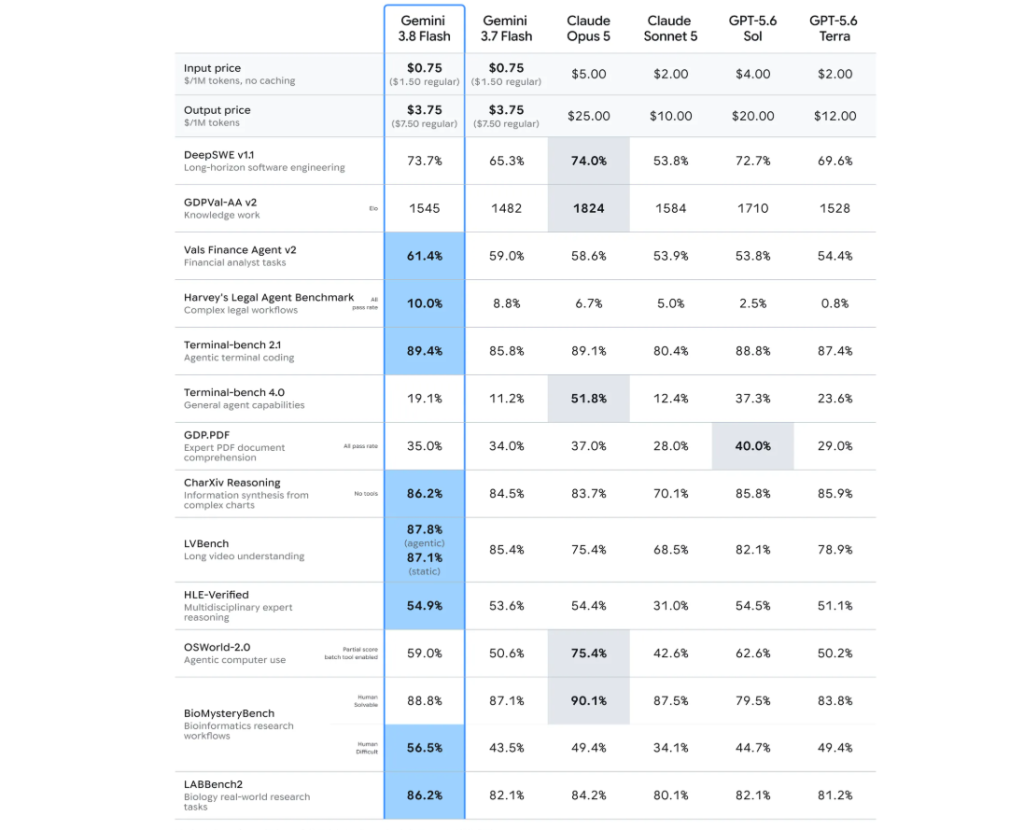
Google published benchmark comparisons showing Gemini 3.8 Flash performance relative to competing models. On DeepSWE v1.1, the model achieves competitive results with larger frontier models at lower cost. On Vals Finance Agent V2 and Harvey Legal benchmarks, Google’s published comparisons indicate strong performance relative to larger models.
Benchmark leadership varies by task. Gemini 3.8 Flash excels at long-horizon coding and agentic reasoning. Competing models lead on different tasks. No single model dominates across all benchmarks; performance depends on task definition, prompt style, and model configuration.
The most compelling comparison is cost-per-capability. Gemini 3.8 Flash achieves frontier-level performance on specific benchmarks (particularly software engineering) at Flash pricing. Developers need to evaluate whether the tasks they care about match the benchmarks where Gemini 3.8 Flash performs strongest.
Read More: ChatGPT vs Claude vs Gemini: Which AI Assistant Fits Your Workflow?
Gemini 3.8 Flash Performance in Real-World Workflows
Software Engineering
Gemini 3.8 Flash targets developer workflows: understanding complex codebases, implementing features across multiple files, debugging failures, and running tests. The model can accept a GitHub issue, examine relevant code files, plan the implementation, write the solution, and iterate if tests fail.
This capability depends on effort level. Higher effort means the model iterates more thoroughly, calls testing and linting tools more frequently, and refines implementations more carefully. Lower effort provides faster results for straightforward changes.
Knowledge Work
Finance teams use agents to research market conditions, compile earnings data, run analysis, and generate reports. Legal teams use agents to research case law, assess document risk, and provide guidance. Consulting firms use agents to synthesize research, perform calculations, and produce analysis documents.
These workflows benefit from Gemini 3.8 Flash’s 1M token context (allowing large research databases or document collections) and improved reasoning (handling complex analyses and specialized terminology).
AI Agents
Production agents require quality reasoning, cost efficiency, and reliability. Gemini 3.8 Flash is designed for this. The combination of adjustable effort (to optimize cost/quality), long context (to handle real-world scenarios), tool use (to take action), and iterative reasoning (to solve complex problems) creates a practical foundation for autonomous systems.
Agents also benefit from the model’s behavior on higher effort levels: when a task is difficult, the model spends more computation without being told explicitly. Developers can set effort at the workflow level rather than tuning every prompt.
Gemini 3.8 Flash Use Cases
Best for developers:
Agentic coding, debugging, multi-file projects, autonomous implementation, and iterative tool use in development workflows.
Best for businesses:
Document-heavy workflows, specialized knowledge agents (finance, legal, consulting), analysis automation, and scalable AI system deployment where cost per inference affects ROI.
Best for AI builders:
Applications where reasoning quality matters but frontier-model costs are unsustainable, hybrid systems combining multiple agents, and production services requiring strong cost-performance balance.
Best for casual users:
Google AI Pro and Ultra subscribers accessing Gemini 3.8 Flash through the Gemini app or Google Search, with stronger reasoning and coding capabilities for personal tasks.
Gemini 3.8 Flash Limitations
Transparency about limitations strengthens confidence in the model’s actual capabilities.
Gemini 3.8 Flash may hallucinate, generating plausible-sounding but false information. This is a general limitation of foundation models, not unique to Gemini. Hallucinations are more likely on questions outside the model’s training data or where the model is uncertain. Developers should implement verification mechanisms in production systems.
The model may experience occasional slowness or timeout issues. Higher effort levels increase latency because the model reasons more thoroughly. This matters for real-time applications; developers should test latency under their specific effort level and task distribution.
Higher effort increases token consumption. A model spending more reasoning effort might use 30% more tokens to produce a higher-quality answer. Developers need to account for this when calculating costs.
The knowledge cutoff is March 2026. The model has limited or no knowledge of events after that date. For current information, integrate knowledge bases, search tools, or real-time data feeds into agents.
Benchmarks measure specific tasks; real-world performance on your specific use case may differ based on prompt quality, effort level, and data domain.
Is Gemini 3.8 Flash Worth It?
Choose Gemini 3.8 Flash if:
- You need better coding performance than 3.7 Flash provides
- You’re building production AI agents
- You work with large code repositories or documents
- Complex reasoning is central to your workflow
- You want strong cost-performance balance
Consider Gemini 3.7 Flash if:
- Efficiency and cost are your primary concerns
- Your existing 3.7 deployment already performs well
- Higher reasoning effort is unnecessary
- Real-time latency is critical
- You’re cost-optimizing high-volume inference
The decision isn’t about absolute capability but fit. Gemini 3.8 Flash is worth upgrading to if your use case matches its strengths: coding, agents, reasoning. It’s worth skipping if efficiency-first workloads are your primary use case and 3.7 already meets your requirements.
Final Verdict
Gemini 3.8 Flash represents a meaningful but incremental advance. The model improves over 3.7 Flash specifically on coding, agentic reasoning, and specialized knowledge work. Pricing remains consistent through the end of 2026, making this version accessible for teams testing production agent workflows.
The model’s biggest advantage is cost-to-capability ratio: frontier-level performance on specific benchmarks without frontier pricing. The biggest tradeoff is task specificity: performance gains concentrate on software engineering, agents, and knowledge work. Tasks outside these areas may see modest improvement.
For developers building production agents, autonomous coding systems, or knowledge-work automation, Gemini 3.8 Flash merits evaluation. For efficiency-first deployments or applications where 3.7 Flash already performs acceptably, sticking with the older model remains rational.
Frequently Asked Questions
What is Gemini 3.8 Flash?
Gemini 3.8 Flash is Google’s next-generation workhorse AI model, building on Gemini 3.7 Flash with improvements in software engineering, agentic reasoning, and complex multi-step problem-solving. It maintains Flash-speed performance and introductory pricing while delivering stronger reasoning capabilities for production AI systems.
What is the Gemini 3.8 Flash context window?
Gemini 3.8 Flash supports a context window of up to 1 million tokens, with a maximum output of 64K tokens. This allows processing of large codebases, extended documents, and lengthy conversations within a single request.
How much does Gemini 3.8 Flash cost?
Introductory pricing through December 31, 2026 is $0.75 per million input tokens and $3.75 per million output tokens. Starting January 1, 2027, pricing increases to $1.50 per million input tokens and $7.50 per million output tokens.
What is the Gemini 3.8 Flash API pricing?
API pricing matches the standard model pricing: $0.75/$3.75 per 1M tokens (intro) or $1.50/$7.50 per 1M tokens (starting Jan 2027). Higher effort levels increase token usage, so total cost per request depends on both base pricing and model configuration.
Is Gemini 3.8 Flash better than Gemini 3.7 Flash?
Gemini 3.8 Flash improves on 3.7 Flash specifically for coding, agents, and complex reasoning. For efficiency-first workloads, 3.7 Flash remains the better choice. Improvement depends on whether your use case matches the areas where 3.8 was optimized.
What are the Gemini 3.8 Flash benchmark results?
Key results: DeepSWE v1.1 (long-horizon software engineering) shows competitive performance with larger frontier models; Vals Finance Agent V2 achieves 61.4%; Harvey Legal Agent Benchmark scores 10.0%; HLE-Verified reaches 54.9%.
Is Gemini 3.8 Flash good for coding?
Yes. DeepSWE v1.1 results demonstrate strong performance on autonomous multi-file software engineering. The model handles understanding codebases, implementing features, running tests, and iterating on failures.
Can Gemini 3.8 Flash build AI agents?
Yes. The combination of adjustable reasoning effort, 1M token context, tool use capabilities, and iterative reasoning makes Gemini 3.8 Flash well-suited for production AI agents in software engineering, finance, legal, and knowledge work domains.
Where can I use Gemini 3.8 Flash?
Gemini 3.8 Flash is available through: Gemini app (for AI Pro/Ultra subscribers), Gemini API, Google AI Studio, Gemini Enterprise Agent Platform, Google AI Mode (in Google Search), Google Antigravity, and Android Studio.
What is the difference between Gemini 3.8 Flash and Gemini 3.8 Flash Cyber?
Gemini 3.8 Flash Cyber is a specialized cybersecurity variant for vulnerability detection and patching, available only to trusted defenders through Google’s Fairwind Program. Standard Gemini 3.8 Flash is the general-purpose model available to all developers and organizations.