Google DeepMind has unveiled Gemini Robotics 2, the next generation of its robotics AI platform designed to bring more capable, adaptable, and intelligent robots into real-world environments. Alongside Gemini Robotics ER 2 for embodied reasoning and updated On-Device capabilities for edge deployment, the platform combines perception, reasoning, and whole-body control to help robots perform complex physical tasks with greater autonomy.
Unlike traditional robotics systems that separate perception, planning, and control, Gemini Robotics 2 integrates these capabilities into a unified Vision-Language-Action (VLA) model. This enables robots to understand natural language, interpret their surroundings, coordinate their entire bodies, and adapt to changing environments while completing multi-step tasks.
In this guide, we’ll explain everything Google announced, how Gemini Robotics 2, ER 2, and On-Device work together, what whole-body intelligence means, and why this launch could shape the future of manufacturing, warehouse automation, humanoid robots, and embodied AI.
Quick Summary of Gemini Robotics 2
| Feature | What It Does | Why It Matters |
| Whole-Body Intelligence | Coordinates balance, locomotion, and manipulation simultaneously | Enables humanoid robots and complex multi-limb tasks |
| Gemini Robotics 2 (VLA) | Converts visual inputs and natural language instructions into precise motor actions | Delivers whole-body control, dexterous manipulation, and adaptive robot behavior |
| Gemini Robotics ER 2 | Provides high-level reasoning, task planning, and real-time progress tracking | Helps robots understand task completion, self-correct, and adapt to changing environments |
| Gemini Robotics On-Device | Lightweight model optimized for local robot deployment | Reduces latency, improves privacy, and enables reliable edge inference |
| Multi-Robot Collaboration | Allows multiple robots to coordinate through a shared understanding of their environment | Enables complex workflows that individual robots cannot complete alone |
Platform components: Gemini Robotics 2 (Vision-Language-Action), Gemini Robotics ER 2 (Embodied Reasoning), and Gemini Robotics On-Device work together to combine perception, reasoning, and robot control.
Best use cases: Manufacturing, warehouse automation, healthcare, retail, humanoid robotics, logistics, and research.
Why it matters: Google combines whole-body control, embodied reasoning, and edge deployment into a unified robotics platform, enabling robots to perform more complex real-world tasks with greater autonomy.
What is Gemini Robotics 2?
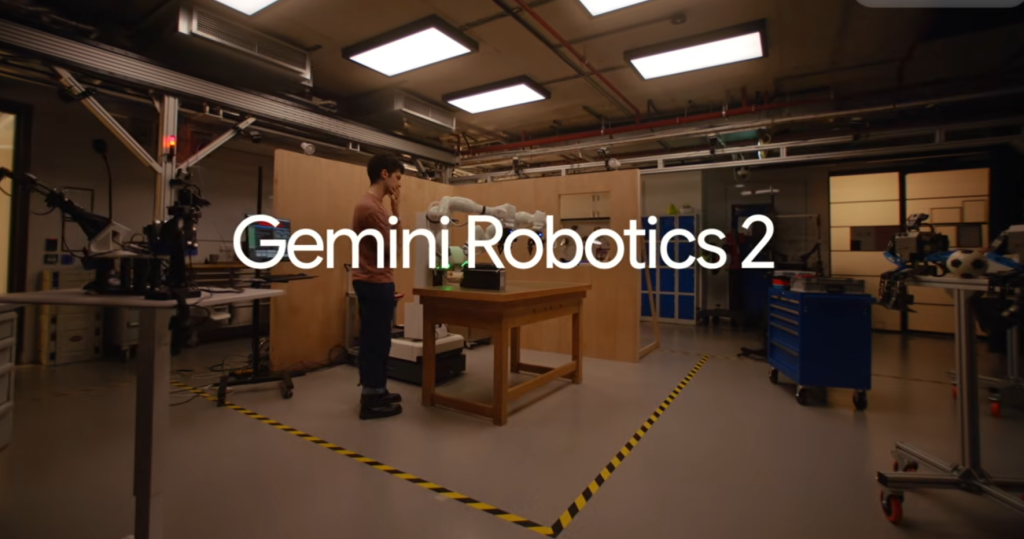
Gemini Robotics 2 isn’t a single model; it’s an ecosystem of specialized AI models designed to power the next generation of intelligent robots. Think of it as a complete cognitive system built from the ground up to understand and act in the physical world.
At its core, Gemini Robotics 2 is a Vision-Language-Action (VLA) model built on top of Gemini’s multimodal foundation. Unlike traditional language models that process text alone, VLA models process three types of information simultaneously: visual input from cameras, natural language instructions from humans, and sensory feedback from the robot’s body. The model then outputs motor commands that tell the robot exactly what to do.
What makes this different from previous robot AI is the integration of embodied reasoning-a layer of higher-level thinking that allows robots to plan complex tasks, track progress, and adapt when things go wrong.
Why Google Built Gemini Robotics 2
The fundamental problem Google was trying to solve is this: robots are great at repeating trained tasks, but terrible at reasoning about novel situations or multi-step problems they’ve never seen before.
Physical tasks are inherently complex. They’re not like playing chess, where the rules are fixed and the board is always the same. Real-world robotics involves balancing, navigating obstacles, manipulating objects of unknown weight and fragility, and responding to unexpected failures mid-task. A robot that can only execute pre-trained motions is useless the moment conditions change.
Google’s vision is to create robots that actually reason about the physical world the way humans do. This means understanding spatial relationships, planning sequences of actions, tracking whether a task is progressing correctly, and knowing when to adjust course or ask for help.
Embodied reasoning-the ability to think about what’s happening in the physical environment-is the missing piece that previous robotics AI lacked.
What’s New in Gemini Robotics 2?
Whole-Body Intelligence
The headline feature is whole-body intelligence: the ability for robots to coordinate their entire body to accomplish tasks. This isn’t just arm movement anymore. It’s balance, walking, grasping, and fine manipulation all working together in real time.
For humanoid robots like Apptronik’s Apollo, this means the robot can walk, maintain balance on uneven ground, reach for an object while stepping sideways, and then manipulate that object with precise hand movements-all without separate “modules” managing each body part.
Embodied Reasoning (ER 2)
Embodied Reasoning 2 acts as the “high-level brain” for robots. It orchestrates lower-level action models while watching continuous video feeds to understand what’s actually happening.
Here’s a concrete example: A robot is instructed to “tighten a light bulb.” ER 2 doesn’t just send one command to the action model. Instead, it:
- Plans the task sequence (walk to location, reach up, grasp bulb, rotate clockwise, verify tightness)
- Monitors video in real time to track progress
- Detects when the bulb is actually tight enough to stop
- Adapts if the robot’s hand slips or the bulb is stuck
Video Understanding for Progress Tracking
One of ER 2’s most impressive upgrades is temporal progress classification: the ability to watch a video and estimate what percentage of a task is complete (0-20%, 20-40%, etc.). Google achieved 57.4% accuracy on this metric, outperforming previous generation models.
This matters because it’s the foundation for self-correction. If a robot pours coffee into a cup, it needs to know the exact moment the cup is full enough to stop. ER 2 achieves 91.3% accuracy on “moment-finding”-identifying the precise frame where a critical event happens-with sub-second latency.
Multi-Robot Collaboration
Google also introduced multi-robot collaboration, where multiple robots of different types work together on complex tasks. A wheeled robot might navigate to a warehouse location while an aerial robot identifies items, then a humanoid robot picks and packs them. All three robots share a semantic understanding of the environment and coordinate their actions.
Natural Language Understanding
Robots can now chat with humans in natural language and accept real-time corrections without technical prompts. A human can say “that’s not quite right, try rotating it 15 degrees more” and the robot understands the instruction in context.
How Gemini Robotics 2 Works: The Architecture
Vision-Language-Action models operate in a pipeline:
Vision Input: Robot cameras capture the scene (RGB images, depth data, point clouds).
Language Processing: Human instructions or task descriptions are parsed (“pick up the red block”).
Embodied Reasoning: The model reasons about spatial relationships, task sequence, and prerequisites. “To pick up the red block, I need to: (1) locate it, (2) move my arm to approach, (3) open gripper, (4) position fingers, (5) close gripper, (6) verify grasp.”
Planning: The model creates a step-by-step action plan while accounting for the robot’s physical constraints (arm reach, gripper width, weight capacity).
Action Output: Motor commands are sent to the robot’s actuators (joint angles, gripper force, locomotion directions).
Feedback Loop: Cameras and sensors continuously feed back whether actions are succeeding. The model watches for progress and adjusts.
This is fundamentally different from traditional robotics pipelines where perception, planning, and control are separate components that don’t share information well.
The Three Components of the Gemini Robotics Platform
Rather than a single AI model, Gemini Robotics 2 is a robotics platform built around three specialized components, each designed for a different role. The Vision-Language-Action (VLA) model handles robot movement and manipulation, ER 2 provides high-level reasoning and task planning, while On-Device enables low-latency inference directly on robot hardware.
Gemini Robotics 2 (Vision-Language-Action Model)
Purpose: Direct motor control and whole-body coordination for physical tasks
Runs on: Cloud infrastructure or high-performance local servers
Latency: Optimized for accuracy over speed
Best for: Complex dexterous manipulation, whole-body movement, assembly, packing, and fine motor tasks
Strengths: Coordinates perception and movement, adapts across multiple robot types, delivers precise manipulation and whole-body control
Limitations: Requires significant compute resources and works best when paired with higher-level reasoning
Ideal deployment: Manufacturing, warehouse automation, research, and humanoid robotics
Gemini Robotics ER 2 (Embodied Reasoning)
Purpose: High-level reasoning, task planning, and real-time progress tracking
Runs on: Cloud via the Gemini API with support for low-latency streaming
Latency: Sub-second responses for continuous reasoning
Best for: Multi-step planning, progress monitoring, human interaction, and multi-robot collaboration
Strengths: Understands video context, tracks task completion, adapts to unexpected situations, and orchestrates tools and APIs
Limitations: Doesn’t generate motor commands directly and relies on a Vision-Language-Action model for execution
Ideal deployment: Warehouse operations, industrial automation, humanoid coordination, and complex robotic workflows
Gemini Robotics On-Device
Purpose: Lightweight Vision-Language-Action model for edge deployment
Runs on: Local robot hardware
Latency: Fastest inference with no cloud dependency
Best for: Time-sensitive tasks, offline operation, and privacy-focused environments
Strengths: Low latency, reduced network dependency, on-device processing, and customizable for specific robots
Limitations: Lower overall capability than cloud-based models and requires hardware-specific optimization
Ideal deployment: Retail robots, home assistants, autonomous mobile robots, and edge manufacturing systems
What is Whole-Body Intelligence?
Whole-body intelligence means the robot can coordinate its entire physical system to accomplish goals. This includes:
Balance and Locomotion: Walking on uneven surfaces, maintaining stability while manipulating, stepping over obstacles.
Fine Motor Control: Precise finger movements, dexterous grasping with multiple fingers, coordinated arm-hand control.
Force Feedback: Understanding how much pressure to apply (grasping an egg vs. a steel ball), detecting when slipping occurs.
Temporal Coordination: Timing movements across multiple body parts (stepping forward while reaching up while rotating the wrist).
This is why humanoid robots are so important to Google’s vision. Unlike wheeled arms or stationary robot arms, humanoids have the physical complexity to require true whole-body reasoning.
Vision-Language-Action (VLA) Models Explained
A Vision-Language-Action model is different from a traditional Vision-Language Model (used for image captioning or visual question answering).
Vision-Language Models answer questions about images: “What’s in this photo?”
Vision-Language-Action Models take action based on visual understanding: “Given this image and this instruction, move your arm to grasp the object.”
The key difference is the action output. VLA models are trained on millions of robot demonstrations, learning the correlation between what robots “see,” what humans ask them to do, and what motor commands actually achieve the goal.
Real-World Demonstrations
Google showcased several capabilities:
Boston Dynamics Spot: ER 2 orchestrated Spot to fetch objects via voice command, navigating multi-room environments and adapting when objects were in unexpected locations.
Apptronik Apollo Humanoid + Franka Manipulator: Two different robots collaborated on a task-one picking up items while the other sorted them-coordinated entirely through shared semantic understanding.
Light Bulb Tightening: A robot verifies a bulb is actually tightened to specification before declaring the task complete (not just “performed the motion”).
Coffee Pouring: The model detects the exact frame where a cup becomes full, stopping the pour at the right moment.
These aren’t magic-they’re examples of embodied reasoning working correctly. The robot doesn’t just execute a pre-programmed sequence; it understands what success looks like and adapts to achieve it.
Practical Applications of Gemini Robotics 2
Manufacturing & Assembly: Robots can adapt to product variations, handle assembly tasks with multiple sub-steps, and detect quality issues in real time.
Warehouse Automation: Multi-robot coordination enables complex workflows (pick-and-sort, high-bay retrieval, packing) without re-engineering for each product type.
Healthcare: Robots can assist with patient handling, medication delivery, and mobility assistance while adapting to individual patient needs.
Retail: Automated checkout, inventory scanning, shelf organization, and price checking at scale.
Hospitality: Room cleaning, delivery, and guest interaction in dynamic environments.
Research: Foundation models accelerate robotics research by enabling rapid prototyping without training models from scratch.
Safety and Responsible Robotics
Google implemented several safety mechanisms:
Safety Instruction Following: ER 2 successfully halts when humans enter the workspace and resumes only when safe.
Spatial Awareness: The model maintains real-time awareness of human proximity and adjusts behavior accordingly.
Explainability: Robots reason in natural language, making decisions transparent and allowing humans to intervene.
Graceful Failure: When uncertain, robots ask for clarification rather than guessing.
Google also published a comprehensive safety technical report evaluating the model’s ability to enforce safety constraints and assess physical feasibility.
Limitations to Understand
Early Availability: These models are in preview. Broad public access is limited to trusted testers.
Hardware Requirements: Powerful robots with quality cameras and actuators are expensive.
Controlled Demonstrations: Current demos use well-lit, relatively structured environments. Real-world messiness is harder.
Generalization Limits: While these models generalize better than predecessors, they still struggle with completely novel scenarios.
Compute Costs: Cloud-based models require API calls, adding latency and expense for continuous operation.
Training Data Bias: Models trained on certain robot types may perform worse on unfamiliar embodiments.
Read More: Agentic AI vs Generative AI: What’s the Difference?
Expert Analysis: Why This Matters
From a robotics research perspective, Gemini Robotics 2 represents a fundamental paradigm shift. For years, robotics has relied on separate pipelines for perception, planning, and control. This launch demonstrates that end-to-end foundation models can actually work better.
The progress classification and moment-finding capabilities are particularly significant. Knowing whether a task is complete and being able to detect the exact moment of task success-these are capabilities that have limited robotics for decades. Solving them opens doors to robots that can adapt to imperfect conditions without human intervention.
Multi-robot collaboration is the most ambitious bet. Most industrial automation today involves single robots in isolated cells. If Google can make robot coordination truly seamless, that’s a multi-billion-dollar market opportunity.
The biggest unsolved problem remains generalization at scale. These models work well in demonstrations, but real-world deployment requires handling edge cases and failures that no training data can cover. That gap between benchmark performance and production reliability is where most robotics companies still struggle.
Conclusion
Gemini Robotics 2 represents a genuine breakthrough in embodied AI. The combination of whole-body intelligence, real-time embodied reasoning, video-based progress tracking, and multi-robot coordination addresses problems that have limited robotics for years.
This isn’t hype. The progress classification accuracy (57.4%), moment-finding precision (91.3% with sub-second latency), and safety performance metrics are genuinely impressive compared to existing approaches.
Who should pay attention? Robotics engineers, manufacturing leaders, warehouse operators, and anyone building the next generation of automation. If you’re evaluating AI solutions for physical tasks, Gemini Robotics 2 should be on your radar.
The wider impact: We’re entering an era where foundation models aren’t just tools for language or images—they’re tools for understanding and manipulating the physical world. That shift will reshape manufacturing, logistics, healthcare, and potentially how humans interact with technology for decades.
The key takeaway is this: robots that can reason, adapt, and coordinate are no longer research projects. They’re coming to production.
Frequently Asked Questions
Is Gemini Robotics 2 commercially available now?
Gemini Robotics ER 2 is being rolled out through the Gemini API and Google AI Studio, while Gemini Robotics 2 and Gemini Robotics On-Device remain in limited preview for selected partners and trusted testers. Broader availability has not yet been announced.
Can I use Gemini Robotics 2 with my existing robot?
Potentially, if your robot has cameras, actuators, and can run the API client. Google provides examples for Boston Dynamics Spot and Apptronik Apollo. Support for other robots is expanding.
How much does it cost?
Google has not announced pricing for Gemini Robotics 2 or its related components. ER 2 access is currently being rolled out to selected developers, while commercial pricing and licensing details for broader deployment have not yet been released.
Does Gemini Robotics 2 replace roboticists and engineers?
No. These models are tools that reduce the engineering burden. Developers still need to define task workflows, handle edge cases, and maintain safety systems.
How is this different from previous robot AI?
Previous models handled single tasks or single body parts. Gemini Robotics 2 combines embodied reasoning (understanding what’s happening), vision-language understanding (interpreting instructions), and whole-body control in one system.
Can robots trained on one hardware type transfer to another?
Yes. One of Gemini Robotics’ key features is learning across multiple embodiments. A model trained on humanoids can adapt to wheeled robots and back.
When will robots be generally useful outside labs?
Narrow applications (warehouse sorting, manufacturing assembly, delivery) are 2-3 years away. Truly general-purpose household robots are 5-10 years away, if ever.
What is the difference between Gemini Robotics 2 and Gemini Robotics ER 2?
Gemini Robotics 2 is the platform’s Vision-Language-Action model responsible for robot movement and physical interaction. Gemini Robotics ER 2 focuses on high-level reasoning, task planning, and progress tracking. Together, they enable robots to reason about tasks and execute them more effectively.