Search engines are great at finding pages, but not always at answering questions. Whether you’re researching a topic or verifying a claim, you often have to piece together information from multiple sources. Perplexity AI aims to simplify that with direct answers backed by live web citations.
Perplexity AI does something different. It reads the web for you, synthesizes information from multiple live sources, and hands you a direct, citation-backed answer in seconds.
Founded in 2022 and now serving tens of millions of users worldwide, Perplexity has carved out a unique position: it is not trying to replace Google for simple queries or ChatGPT for creative tasks. Instead, it excels at the middle ground—complex questions that require synthesizing information from multiple sources with verifiable citations.
This review covers everything you need to decide: how it works, what it costs, where it genuinely beats Google, and where it still falls short.
Quick Summary: What You Need to Know
| Factor | Detail |
| Best for | Researchers, students, analysts, professionals |
| Free plan | Yes, with unlimited basic searches |
| Pro plan | $20/month |
| Standout feature | Real-time citations on every answer |
| Citation approach | Transparent, source-backed answers |
| Main limitation | Not ideal for creative writing or local search |
| Verdict | Best AI search tool for research in 2026 |
Key takeaways:
- Perplexity gives direct answers with clickable, numbered citations, not a list of links
- The free plan is genuinely usable for casual research
- Pro at $20/month is the best value for anyone doing regular research work
- It is not a Google replacement for everything, but for research tasks, it often outperforms it
What Is Perplexity AI? (And How Does It Work?)
Perplexity is best described as an answer engine, not a search engine.
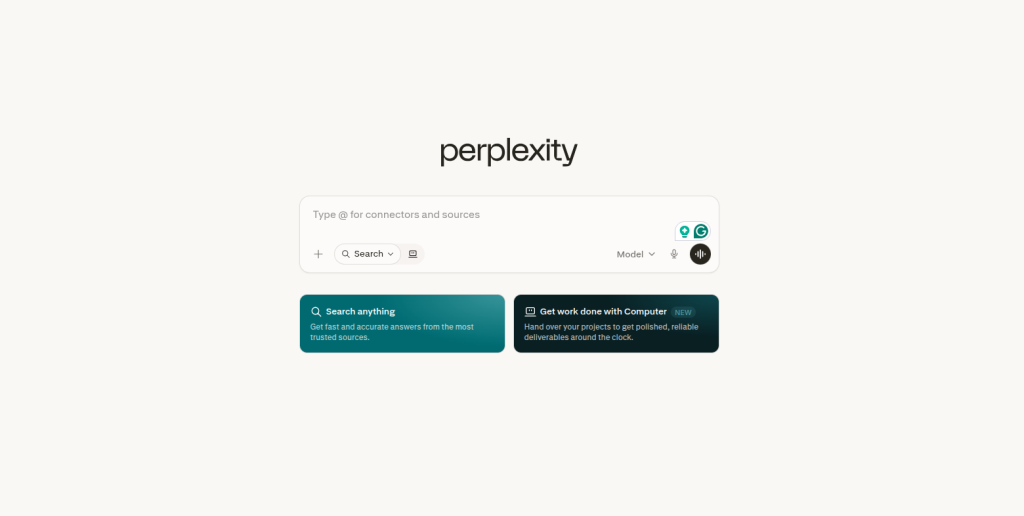
Unlike traditional search engines, Perplexity combines AI-generated responses with real-time web citations to help users verify information quickly. Instead of returning a list of links, Perplexity generates structured answers supported by references, making it easier to verify information.
The mechanics matter here. When you ask a question, Perplexity does not pull from a static training dataset. It searches the web in real-time for every query and provides numbered, clickable citations for every claim in its response. Every answer is traceable.
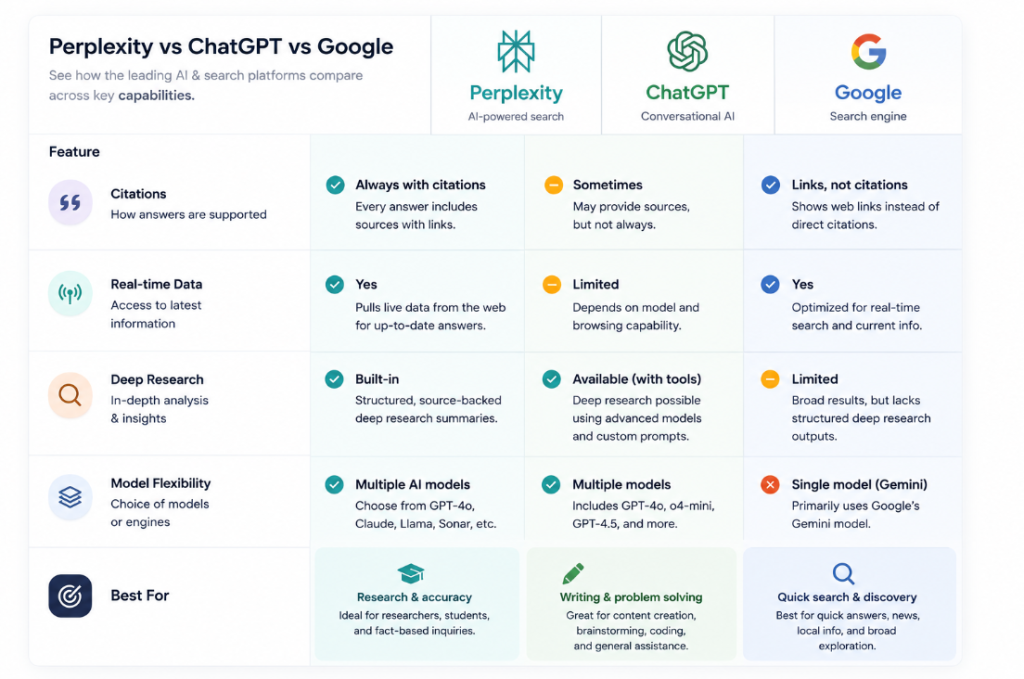
This is the core difference from ChatGPT, which generates answers primarily from its training data and can confidently state things that are simply wrong without any way to verify them.
Perplexity AI Features in 2026
Perplexity AI handles a massive volume of research and search queries every month, drawing on live web results rather than relying solely on static training data. When you search for breaking news or recent developments, it can retrieve and synthesize fresh information from across the web in real time.
Here are the features that define the platform this year:
Deep Research Mode
Deep Research is Perplexity’s premium research feature. It does not just search once. It searches dozens of times across hundreds of sources, reads full articles, compares data, and writes a detailed report. As of 2026, Deep Research leverages advanced AI models, including Anthropic’s Claude Opus family, to perform multi-step research and synthesis tasks.
Real-world example: A marketing analyst researching a competitor’s product positioning can prompt Deep Research to pull pricing pages, press releases, user reviews, and analyst commentary, then receive a structured report with every source linked. A task that used to take two hours now takes under thirty minutes.
Multi-Model Flexibility
Pro subscribers can switch between advanced AI models like GPT-4, Claude 3, and Mistral, giving them flexibility depending on the task, whether that’s coding, summarization, or creative writing.
Comet Browser
Perplexity is shipping Comet, its own AI-native web browser built on Chromium, available on Mac, Windows, and Android. It integrates AI assistance directly into browsing, allowing users to summarize pages, ask questions about content, and search without leaving their current tab.
Perplexity Patents
Perplexity Patents is a specialized AI-powered tool for exploring patents, academic papers, and technical documentation. For IP professionals and R&D teams, it offers a streamlined way to search and synthesize complex technical information.
Perplexity AI Pricing 2026
The Pro plan at $20/month includes significantly higher daily Pro Search limits, access to advanced AI models, Deep Research, expanded file uploads, image generation, video generation, and API credits.
| Plan | Price | Best For |
| Free | $0 | Casual users, light research |
| Pro | $20/month ($16.67/month billed annually) | Researchers, professionals, students |
| Max | $200/month | Power users, heavy enterprise use |
| Enterprise | Custom | Teams with admin controls and compliance needs |
In February 2026, Perplexity made headlines by abandoning advertising entirely, committing to a subscription-only business model. For users concerned about search results being influenced by advertisers, this is a meaningful shift.
Perplexity AI vs Google: How Do They Compare?
This is the comparison most people actually want to see.
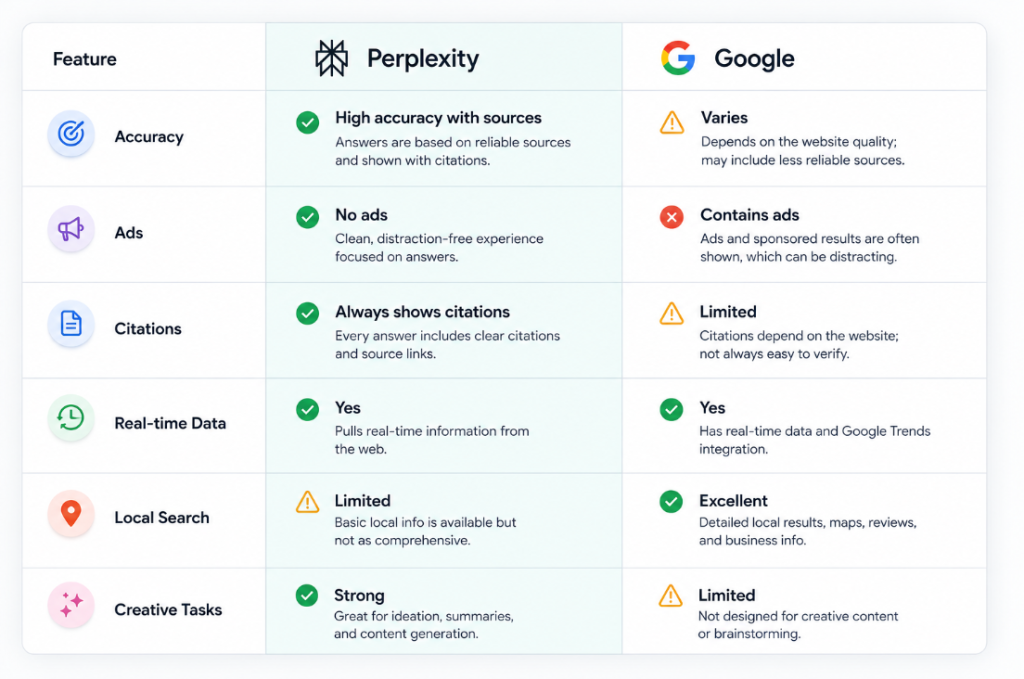
The fundamental difference is that Perplexity retrieves evidence and then generates answers, while Google generates answers from its entire ecosystem. One is an answer engine built for verifiable research. The other is a search ecosystem built for everything.
One of Perplexity’s biggest strengths is source transparency. Every response includes numbered citations that let users quickly verify information. Google has also improved the quality of AI Overviews since their launch, but the two products serve different purposes: Perplexity focuses on research workflows, while Google remains a broader search ecosystem.
| Capability | Perplexity AI | |
| Citation transparency | Every answer, numbered and clickable | Partial, in AI Overviews |
| Live web retrieval | Yes | Yes |
| Ad-free experience | Yes (subscription-focused) | No |
| Deep research mode | Yes (Pro) | Yes (Gemini Advanced) |
| Local search | Limited | Excellent |
| Shopping & Maps | No | Excellent |
| Multi-model flexibility | Yes | Limited |
| Free tier usability | Strong | Strong |
The honest verdict: Perplexity wins on source transparency, model flexibility, and research-first workflows where you cannot afford to hallucinate a citation. Gemini and Google have the edge on creative output, deep reasoning, and working inside Google’s ecosystem.
Use Perplexity for research. Use Google for local, shopping, and navigation. The smartest approach in 2026 is using both.
Who Should Use Perplexity AI in 2026?
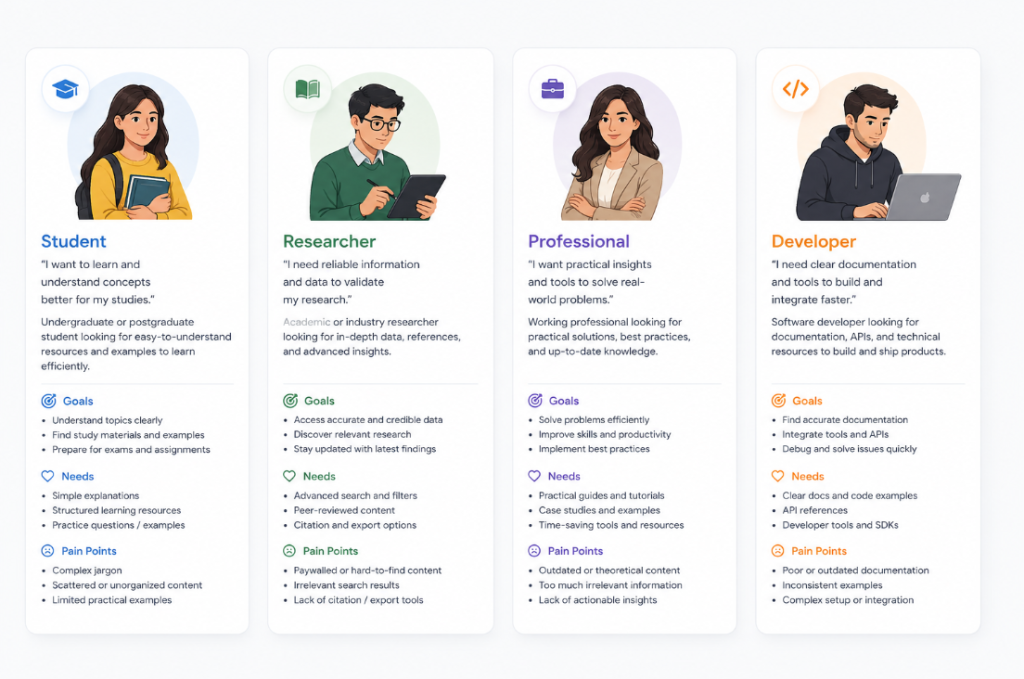
Students and Academics
Perplexity is arguably the most useful AI tool a student can have. Ask it to break down a dense research paper, find primary sources on a topic, or compare academic perspectives on an argument, and it delivers structured answers with citations you can include in a bibliography. It eliminates the noise of irrelevant search results without sacrificing source traceability.
Researchers and Analysts
A product manager at a Singapore startup uses Perplexity for competitive analysis, market sizing, and technical research daily. Tasks that used to take two hours now take 30 minutes. For anyone whose job involves synthesizing large amounts of information quickly, the Pro plan pays for itself.
Journalists and Fact-Checkers
The citation model makes Perplexity naturally suited for verification work. Every claim links back to a source. You can check accuracy in seconds rather than minutes, which is meaningful when working on a deadline.
Developers and Technical Professionals
The patent search tool, multi-model switching, and Sonar API make Perplexity a strong technical research layer. CTOs have reported their teams cutting research time in half after switching from Google to Perplexity for technical documentation searches.
Businesses and Teams
Enterprise users get admin controls, model restrictions, and integration with tools including Notion, Linear, GitHub, and Google Workspace, making Perplexity a deployable research layer across an organization.
Not recommended for:
- Pure creative writing tasks (ChatGPT or Claude is better)
- Local business search or maps (Google still wins)
- Shopping research with product comparisons (Google Shopping is more practical)
Pros and Cons of Perplexity AI
Pros
- Real-time, citation-backed answers on every query
- No ads as of February 2026, eliminating commercially biased results
- Deep Research mode produces structured multi-source reports automatically
- Multi-model access on Pro: switch between GPT-4, Claude, and Mistral
- Free plan is genuinely useful, not just a teaser
- Conversational follow-ups let you refine research without starting over
- Patent and academic paper search is industry-leading among AI tools
- Fast and clean interface with strong mobile usability
Cons
- Narrowly focused on search versus general-purpose assistants at the same price point.
- Heavy research threads quickly exhaust the free Pro search cap
- Not suited for creative writing, long-form content generation, or coding assistance
- Local and geographic searches are weaker compared to Google
- Writing style can feel somewhat mechanical, lacking the natural flow found in ChatGPT
- Data may be used for training on Free and Pro tiers, which is a consideration for sensitive work
Final Verdict
Perplexity AI in 2026 is the best dedicated research tool available. The company reportedly crossed $450 million in annualized recurring revenue in early 2026 and has been valued at around $20 billion, reflecting substantial investor confidence and rapid user growth.
Is it a Google killer? Not quite. Google remains dominant for local search, shopping, maps, and casual discovery. But for anyone whose work depends on finding accurate, verifiable information quickly, Perplexity is not just competitive with Google. For research tasks specifically, it is better.
Bottom line recommendations:
- Occasional researchers: Start with the free plan
- Students, analysts, journalists: Pro at $20/month is worth it
- Enterprise teams: Evaluate the Enterprise tier with admin controls and workspace integrations
- Everyone: Use Perplexity alongside Google, not instead of it
The future of search is not a list of links. It is a direct, verifiable answer you can trust. Perplexity is the closest thing to that future available today.
Frequently Asked Questions
What is Perplexity AI?
Perplexity AI is an AI-powered answer engine that searches the web in real time and delivers direct, citation-backed responses to questions instead of a list of links.
Is Perplexity AI free to use?
Yes. The free plan includes unlimited basic searches and approximately 3 Pro Searches per day, which is enough for light research use.
How much does Perplexity AI Pro cost?
Perplexity Pro costs $20 per month, or around $16.67 per month if billed annually. It includes higher daily Pro Search limits, Deep Research, expanded file uploads, and access to multiple advanced AI models.
Is Perplexity AI more accurate than Google?
For research-oriented queries, Perplexity’s citation-first approach makes it easier to verify information because every answer includes linked references. Google AI Overviews have improved significantly, but Perplexity generally offers greater source transparency for users who want to fact-check results
What is Perplexity Deep Research?
Deep Research is a premium feature that autonomously searches dozens of sources, reads full articles, and compiles a structured research report with citations. It is available on Pro and Max plans.
Is Perplexity AI good for students?
Yes. Perplexity is one of the best AI tools for students because it provides sourced, verifiable answers that can be traced back to original references, which is important for academic work.
Can Perplexity AI replace Google?
For research and fact-finding, Perplexity often outperforms Google. However, Google remains better for local search, maps, shopping, and casual discovery. Most power users use both.
Does Perplexity AI have a mobile app?
Yes. Perplexity AI is available on iOS and Android, with full Pro feature support on mobile.
What AI models does Perplexity use?
Pro and Max users can switch between multiple models, including GPT-4, Claude (Opus 4.5 and 4.6 for Deep Research), and Mistral, depending on the task.
What is the Perplexity Comet browser?
Comet is Perplexity’s AI-native browser built on Chromium. It integrates search and AI assistance directly into browsing, available on Mac, Windows, and Android.