
Agentic AI vs Generative AI is one of the biggest discussions in artificial intelligence today. If you’ve used ChatGPT, Claude, or Gemini, you’ve already experienced generative AI. But a new category of AI called agentic AI is changing how businesses automate work. Instead of simply answering prompts, these systems can plan tasks, use tools, make decisions, and complete multi-step workflows with minimal human input.
Because both technologies often rely on the same large language models, they’re frequently confused. In reality, they solve different problems. Generative AI excels at creating content, while agentic AI focuses on achieving goals through reasoning and automation.
Understanding this difference is becoming increasingly important as organisations adopt AI beyond chatbots and content generation. Choosing the wrong approach can lead to unnecessary costs, while choosing the right one can automate processes that previously required hours of manual work.
In this guide, you’ll learn how Agentic AI vs Generative AI compares, how each technology works, where they perform best, their limitations, and which approach makes the most sense for different use cases.
Quick Answer
Generative AI creates content by predicting tokens based on prompts; think ChatGPT writing an email. Agentic AI autonomously plans, reasons, and uses tools to complete multi-step tasks without constant human input- think an AI that researches, summarizes, and sends the email to 500 people automatically. Generative AI is reactive; agentic AI is proactive and goal-oriented.
Quick Comparison Table
| Aspect | Generative AI | Agentic AI |
| Primary Purpose | Generate content (text, code, images) | Complete autonomous tasks and workflows |
| User Input | Requires detailed prompts | Works from high-level goals |
| Autonomy Level | None; responds only when prompted | High: operates independently toward goals |
| Planning | No structured planning | Breaks tasks into steps and sequences |
| Decision-Making | Probabilistic token prediction | Reason-based decisions with evaluation loops |
| Memory | Limited to context window | Persistent, retrievable memory systems |
| Tool Usage | Limited or none | Extensive APIs, browsers, databases, tools |
| Multi-Step Execution | User orchestrates steps | AI orchestrates entire workflows |
| Output Quality | Varies based on prompt quality | Consistent due to evaluation and retry logic |
| Human Involvement | Constant guidance needed | Minimal after setup |
| Speed | Instant responses | Slower due to planning and reasoning |
| Best Use Cases | Content creation, Q&A, drafting | Automation, research, analysis, operations |
| Examples | ChatGPT, Claude, Gemini | AI Agents (CrewAI, AutoGen), Devin (coding) |
What Is Generative AI?
Generative AI is a class of artificial intelligence systems trained on vast amounts of data to predict and generate new content text, images, code, audio that resembles the training data. The most common form today is large language models (LLMs) like ChatGPT, Claude, or Gemini.
At its core, generative AI doesn’t truly “understand” in the human sense. It’s a sophisticated pattern-matching machine that predicts the next most likely token (word fragment) based on everything that came before it.
How Generative AI Works
1. Training on Transformers
Generative models are typically built on transformer architecture a neural network design that uses “attention” mechanisms to weigh the importance of different words relative to each other. This allows models to understand context across an entire document or conversation.
2. Token Prediction
When you prompt a generative model, it doesn’t generate text all at once. It predicts one token at a time, using the previous tokens plus your input as context. This happens so quickly (sometimes 100+ tokens per second) that it feels instantaneous.
3. Context Window Limits
Every LLM has a context window the maximum amount of text it can consider when generating responses. Claude 3.5 Sonnet has a 200K token context window; GPT-4o has 128K. This matters because the model can only “see” text within this window. Older context gets forgotten.
4. Prompt-Based Interaction
Generative AI is entirely reactive. It waits for input and responds to it. There’s no internal goal-seeking, no ability to pursue an objective independently. You must provide instructions for every action.
Common Examples
- ChatGPT: General-purpose conversational AI
- Claude: Anthropic’s model, strong on reasoning and long documents
- Gemini: Google’s multimodal model (text, image, video)
- Copilot (Microsoft): Integrated into Office apps for content assistance
- DALL-E / Midjourney / Stable Diffusion: Image generation models
- GitHub Copilot: Code generation for developers
Advantages
- Instant and accessible: No setup required just prompt and get results
- Versatile: Can handle writing, analysis, coding, brainstorming, translation, summarization
- Cost-effective for one-off tasks: You don’t pay for unused compute
- No coding required: Anyone can use a language model without technical skills
- Rapid iteration: Get multiple options quickly by adjusting your prompt
- Explainable outputs: You see exactly what the model produced
Limitations
- Hallucinations: Models confidently generate false information, especially with obscure facts
- No real learning: Can’t improve from feedback within a single session without fine-tuning
- No goal autonomy: Can’t pursue objectives independently
- Context window constraints: Forgets older information in long conversations
- Requires perfect prompts: Bad input = bad output (garbage in, garbage out)
- No memory between sessions: Starts fresh each time unless you manually add context
- Slow for multi-step workflows: Each step requires human orchestration
- Expensive at scale: Fine-tuning or handling millions of requests gets costly
What Is Agentic AI?
Agentic AI refers to AI systems designed to autonomously pursue specific goals through reasoning, planning, tool usage, and self-evaluation-without constant human intervention. An AI agent has a clear objective and figures out the steps needed to accomplish it.
Think of it as AI that can think like a project manager: it breaks work into subtasks, delegates to the right tools, checks progress, and adjusts if something goes wrong.
How Agentic AI Works
The workflow typically follows this pattern:
Goal Definition → Plan Creation → Reasoning → Tool Selection → Execution → Evaluation → Repeat/Adjust → Task Completion
1. Goal Setting
You give the agent a high-level objective: “Research the top AI companies and create a comparison table.” That’s it. No detailed steps required.
2. Planning
The agent breaks down the goal into logical subtasks. It might decide to: search for companies, gather data on funding, extract key metrics, organize into a table structure, format for readability.
3. Reasoning
Using an LLM as its reasoning engine (often Claude or GPT-4), the agent evaluates which tools to use, what information it needs, and whether its current approach will achieve the goal.
4. Tool Calling and API Integration
Unlike generative AI, agents actively integrate with external systems:
- Web browsers (to search and scrape information)
- APIs (to fetch real data from databases)
- Databases (to retrieve or store information)
- Code execution environments (to run scripts)
- Email systems (to send communications)
This is critical. Generative AI can only talk about using tools. Agentic AI actually uses them.
5. Execution
The agent performs actions autonomously. It might fetch 10 different sources, extract data from each, and synthesize itall without asking for confirmation.
6. Evaluation and Feedback Loop
Here’s where agentic AI differs fundamentally. After each step, it asks: “Did this get me closer to the goal? Is the output correct? Do I need to adjust?”
If the answer is no, it tries a different approach. If the answer is yes, it moves forward.
7. Memory and Context Management
Agents maintain persistent memory across multiple interactions. They can remember previous findings, decisions, and context unlike generative models that start fresh each session.
8. Multi-Agent Collaboration
Advanced agentic systems orchestrate multiple specialized agents working together. One agent might handle research, another data analysis, a third writing and formatting. They communicate and hand off work to each other.
Common Examples and Frameworks
- Devin (Cognition AI): AI software engineer that can build full applications autonomously
- Manus (OpenAI partnership): Robotic process automation and business workflows
- CrewAI: Framework for building multi-agent teams
- AutoGen (Microsoft): Enables conversations between multiple AI agents to solve complex tasks
- LangChain: Popular framework for building agentic workflows
- Claude Code: Agentic coding interface that can modify and run code autonomously
- Cursor IDE: Code editor with agentic AI capabilities
Advantages
- True automation: Completes entire workflows without human intervention
- Handles complexity: Breaks down multi-step problems independently
- Learns from failures: Evaluates outputs and adjusts approach if needed
- Persistent context: Maintains memory across multiple interactions
- Cost-effective at scale: Once built, automated workflows run with minimal overhead
- Reduces human error: Follows predefined logic consistently
- Handles real-world integration: Actually connects to APIs, databases, and external systems
- Better for compliance: Leaves audit trails and follows procedures precisely
Limitations
- High setup cost: Requires skilled engineers to build and test
- Slower execution: Planning and reasoning add latency
- Limited by available tools: Can only use tools it has access to
- Hallucinations still occur: Still uses LLMs underneath, so false confidence persists
- Difficult to debug: Hard to understand why an agent made a particular decision
- Requires clear success criteria: Must be able to objectively measure whether a goal is met
- Tool limitations: Real-world data is messy; agents struggle with ambiguous or incomplete information
- Not general-purpose: Built for specific workflows, not flexible like generative AI
Agentic AI vs Generative AI: Key Differences
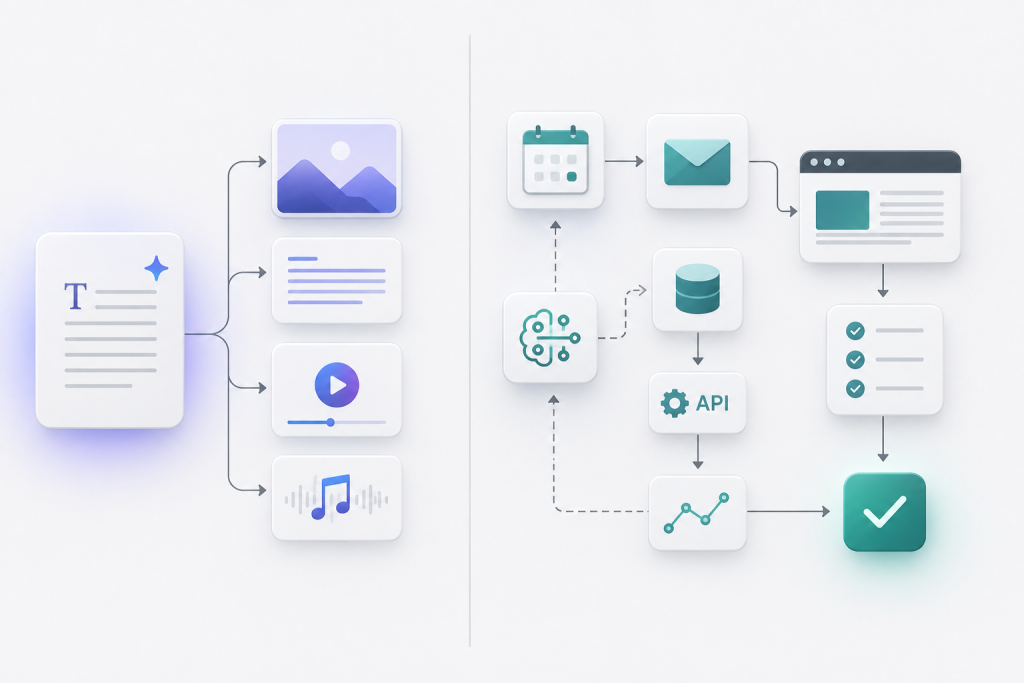
Purpose and Intent
Generative AI: Designed to respond to requests with content. It’s a tool you direct with prompts.
Agentic AI: Designed to pursue goals autonomously. It’s a worker you assign objectives to.
Real-world example: You want market research on AI companies. With generative AI, you ask ChatGPT, “Write a comparison of AI companies.” It writes one response based on its training data. With agentic AI, you tell an agent, “Research the top 10 AI companies and create a detailed comparison including recent funding, product offerings, and market positioning.” The agent autonomously searches multiple sources, cross-references information, and validates data quality.
Autonomy Level
Generative AI: Zero autonomy. It responds when prompted and stops when done. It can’t decide to take additional action.
Agentic AI: High autonomy. It pursues goals, makes decisions, retries failed steps, and adapts without asking permission.
Real-world example: A generative model can write a customer support email draft. An agentic system can read 100 customer complaints, identify patterns, draft personalized responses, send them to the right people, track open rates, and adjust its response strategy based on which emails get replied to.
Human Involvement
Generative AI: Constant human involvement. Every request requires a prompt. Every output requires review. Quality depends on human instruction quality.
Agentic AI: Minimal human involvement after setup. You define the goal and success criteria, then let it run. Humans step in to review high-stakes decisions or when the agent gets stuck.
Real-world example: A developer using generative AI to write code must prompt for each function, review every output, and fix issues manually. A developer using agentic AI gives Devin a specification: “Build a REST API with user authentication, database integration, and error handling.” Devin handles the entire build, debugging, and testing then hands off working code.
Decision-Making
Generative AI: Makes decisions based on token probability. It chooses the next word that statistically follows previous words. This works brilliantly for language patterns but struggles with logical reasoning and constraint satisfaction.
Agentic AI: Makes decisions based on goal-oriented reasoning. It evaluates whether an action moves toward the objective and adjusts if it doesn’t. It can handle conditional logic, business rules, and complex reasoning chains.
Real-world example: A generative model might write, “The best programming language is Python” because that’s a common pattern in training data. An agent reasoning about which language to use for a specific project would evaluate performance requirements, team expertise, library ecosystem, and deployment constraints then recommend accordingly.
Planning and Execution
Generative AI: No planning. It generates the entire output in one pass based on the prompt.
Agentic AI: Explicit planning. It breaks tasks into subtasks, sequences them logically, and executes them step by step. It can handle dependencies (step 2 depends on results from step 1).
Real-world example: Write a business proposal. Generative AI writes the entire proposal in one prompt. Agentic AI plans: (1) Research company background, (2) Analyze their pain points, (3) Design solution, (4) Calculate ROI, (5) Write executive summary, (6) Compile supporting docs, (7) Format final proposal, (8) Send to stakeholder. It executes each step, validates outputs, and ensures consistency across sections.
Winner: Agentic AI for complex multi-step workflows.
Tool Usage and API Integration
Generative AI: Limited or no tool usage. It can describe how to use tools but can’t actually execute them. (Newer models have function calling, but this is still human-orchestrated.)
Agentic AI: Extensive tool integration. It actively calls APIs, queries databases, executes code, controls browsers, and integrates with external systems autonomously.
Real-world example: Generative AI can write SQL queries and explain how to run them. Agentic AI actually connects to the database, runs the queries, processes results, and iterates if needed.
Memory and Context
Generative AI: Limited to its context window. Typically 128K–200K tokens for modern models. Forgets everything outside this window.
Agentic AI: Persistent memory systems. Can store and retrieve information across sessions, maintain working memory of task progress, and build knowledge bases.
Real-world example: A customer support agent needs to remember a customer’s entire interaction history, past complaints, and account details. Generative AI can only consider the last 200K tokens in the conversation. Agentic AI maintains a structured memory of all interactions and retrieves relevant context when needed.
Winner: Agentic AI for long-term context and historical awareness.
Speed
Generative AI: Very fast. A response usually arrives in seconds because it’s just token prediction.
Agentic AI: Slower. Planning, reasoning, tool execution, and evaluation loops add latency. A task might take minutes or hours.
Real-world example: Writing a 500-word blog post: Generative AI does it in 10 seconds. Agentic AI researches sources (30 seconds), plans structure (5 seconds), writes draft (20 seconds), checks facts against sources (15 seconds), formats (5 seconds) total maybe 75 seconds.
Reliability and Consistency
Generative AI: Unreliable for factual accuracy. Prone to hallucinations. Same prompt can produce different outputs.
Agentic AI: More reliable for specific tasks. Can verify outputs against reality (by checking APIs, databases), retry failed steps, and maintain consistency. Still not perfect-agents can get stuck in loops or make logical errors but better than pure generation.
Real-world example: Ask ChatGPT “What is the current stock price of Tesla?” It might guess. Ask an agent the same question, and it queries a real-time API and returns the actual current price.
Learning and Adaptation
Generative AI: Doesn’t learn from user feedback without fine-tuning. You can steer it within a session, but it won’t improve for future sessions.
Agentic AI: Can evaluate its own performance and improve its decision-making within a session. Some advanced agents can fine-tune themselves or update their knowledge bases.
Real-world example: A generative model might write bad code; you correct it; next session, it makes the same mistakes. An agentic system writes code, tests it, sees failures, and fixes them-learning from the feedback loop.
Real-World Use Cases: Where Each Excels
Content Creation
How Generative AI Approaches It: You prompt ChatGPT: “Write a 500-word blog post about AI adoption in enterprises.” It generates a complete post immediately. You edit and publish.
How Agentic AI Approaches It: You tell an agent: “Create a data-driven blog post on enterprise AI adoption, including recent statistics, case studies, expert quotes, and SEO optimization.” The agent researches current data (querying APIs), finds 3-4 relevant case studies, interviews or scrapes expert commentary, outlines the post, writes it with internal linking, and optimizes for SEO.
Better Choice: Generative AI for one-off content. Agentic AI for systematic content production at scale.
Software Development
How Generative AI Approaches It: You ask Copilot: “Write a function to sort an array.” It generates the function. You review, test, and integrate.
How Agentic AI Approaches It: You tell Devin: “Build a production-ready API for user authentication with JWT tokens, database integration, rate limiting, error handling, and unit tests.” Devin writes code, runs tests, fixes failures, documents endpoints, and delivers working software.
Better Choice: Generative AI for snippets and learning. Agentic AI for full project delivery.
Customer Support
How Generative AI Approaches It: Support agents use ChatGPT to draft responses to customer inquiries. Agents review and send.
How Agentic AI Approaches It: An agentic system reads incoming tickets, retrieves customer history, consults knowledge bases, drafts personalized responses, routes to appropriate teams, and tracks resolution.
Better Choice: Generative AI for response drafting. Agentic AI for end-to-end ticket resolution.
Research and Data Analysis
How Generative AI Approaches It: You ask Claude to summarize a research topic. It writes a summary based on training data (which is outdated for fast-moving topics).
How Agentic AI Approaches It: You ask an agent to research a topic and compile a report. It searches academic databases, finds recent papers (2024-2025), extracts key findings, cross-references information, and builds a structured report with citations.
Better Choice: Generative AI for general knowledge. Agentic AI for current, data-driven research.
Business Process Automation
How Generative AI Approaches It: Limited application. It can draft emails or documents, but can’t automate workflows.
How Agentic AI Approaches It: Automate entire business processes. An agent ingests expense reports, checks them against policy, routes for approval, updates accounting systems, and sends notifications-all autonomously.
Better Choice: Agentic AI exclusively; generative AI alone isn’t sufficient.
Personal Productivity
How Generative AI Approaches It: ChatGPT helps you brainstorm, learn, draft documents, and problem-solve. You’re the orchestrator.
How Agentic AI Approaches It: AI agents handle routine tasks (scheduling, email triage, research) while you focus on high-value work.
Better Choice: Generative AI for thinking and drafting. Agentic AI for execution and automation.
Can Agentic AI and Generative AI Work Together?
Yes, and This Is the Future
The most powerful AI systems today don’t choose between agentic and generative AI. They combine them.
Here’s how it works:
Agentic AI is the orchestrator. It breaks down goals, plans steps, and coordinates work.
Generative AI is the reasoning engine. It powers the agent’s decision-making and output generation.
Real-world workflow:
- User: “Create a comprehensive competitor analysis report.”
- Agent receives goal. It plans: (a) identify competitors, (b) research each company, (c) analyze strengths/weaknesses, (d) compile findings, (e) format report.
- For each step, the agent uses a generative model (Claude or GPT-4) to reason about the best approach.
- For competitor research, the agent queries APIs and browsing tools, then uses generative AI to synthesize findings.
- For analysis, it uses generative AI to evaluate competitive positioning and extract insights.
- For compilation, generative AI writes the report sections.
- The agent validates the report’s quality, checks internal consistency, and delivers the final output.
Why this combination is powerful:
- Agentic AI provides the goal-seeking behavior and autonomy that generative AI lacks.
- Generative AI provides the reasoning, language understanding, and creative output that rule-based systems can’t match.
- Together, they create systems that are autonomous, intelligent, and practical.
Which One Should You Choose?
Decision Table by Role
| Role/Scenario | Best Choice | Why |
| Student | Generative AI | Learn concepts, draft papers, problem-solving support |
| Freelance Writer | Generative AI | Drafting and ideation; adapt to each client’s needs |
| Software Developer | Generative AI first, Agentic for scale | Snippets and learning; agents for full projects |
| Operations Manager | Agentic AI | Automate recurring workflows and reduce manual work |
| Marketer | Generative AI + Agentic | Generate content + automate campaigns and analytics |
| Enterprise | Agentic AI | Systematic automation of business processes |
| Researcher | Agentic AI | Current data, systematic literature reviews |
| Consultant | Generative AI | Analysis and report drafting on diverse topics |
| Small Business Owner | Generative AI initially, Agentic as you scale | Start with drafting tools; move to automation for efficiency |
Read More: The Best Open-Weight AI Models in 2026
Challenges and Limitations
Hallucinations (Both)
Both generative and agentic AI hallucinate-confidently generate false information. Agentic AI mitigates this by validating against real data sources. But if your tools return bad data, the agent amplifies the problem.
Mitigation: Use fact-checking steps, validate against multiple sources, and have humans review high-stakes outputs.
Privacy and Security (Agentic AI Especially)
Agentic systems require access to APIs, databases, and business systems. This expands your security surface area.
Mitigation: Use APIs with strong authentication, implement role-based access control, audit all agent actions, and avoid exposing sensitive data to agents.
Cost (Agentic AI)
Building agentic systems requires skilled AI engineers, robust infrastructure, and ongoing maintenance. Initial costs are high.
Mitigation: Start with high-impact, high-volume workflows. ROI improves as volume increases.
Reliability (Both)
Generative AI is unreliable for facts. Agentic AI can get stuck in loops or make logical errors.
Mitigation: For generative AI, always verify factual claims. For agentic AI, build in guardrails, timeouts, and human escalation paths.
Ethical Concerns (Both)
- AI bias: Both technologies can perpetuate biases in training data.
- Transparency: Difficult to explain why AI made a decision.
- Accountability: Who’s responsible if an AI system makes a harmful decision?
- Displacement: Automation can displace workers.
Mitigation: Use diverse training data, implement human oversight for high-stakes decisions, maintain transparency, and plan workforce transitions thoughtfully.
The Future: How Agentic and Generative AI Are Evolving
Hybrid Systems Becoming Standard
By 2026, most enterprise AI applications will combine agentic and generative capabilities. Pure generative AI feels incomplete; pure rule-based agents feel limited.
Multi-Agent Orchestration
Instead of single agents, enterprises are building teams of specialized agents. One handles research, one handles analysis, one handles communication. They coordinate to solve complex problems.
Current examples: CrewAI and AutoGen already enable this. Expect to see it become standard in enterprise platforms.
Reasoning Models Improving
New models like OpenAI o1 (focused on reasoning) and Claude models (strong on long-form reasoning) are shifting capability. As reasoning improves, agents become smarter.
Impact: Agentic systems will require less human oversight and handle more complex problems autonomously.
Real-Time Learning
Agentic systems are starting to learn and improve from task execution. An agent running 1,000 customer support tickets learns patterns and adjusts its approach.
Impact: Agentic systems will get better over time, reducing setup and maintenance overhead.
Regulation and Safety
As agentic AI handles more critical tasks (financial decisions, medical recommendations, hiring), regulation will increase. Expect frameworks requiring explainability, human oversight, and audit trails.
Impact: Enterprises will invest more in “safe” agentic systems with built-in guardrails.
Conclusion
Generative AI and agentic AI represent two different approaches to artificial intelligence. While they often use the same underlying language models, they’re designed for different goals.
Generative AI is best for creating content, brainstorming ideas, and assisting with everyday tasks. It’s fast, flexible, and easy to use, but it remains reactive and depends on human guidance. Agentic AI, in contrast, is built to plan, reason, use tools, and complete complex workflows autonomously, making it ideal for automation at scale.
The core differences come down to four areas:
- Autonomy: Generative AI responds to prompts, while agentic AI pursues goals.
- Reasoning: Generative AI predicts tokens, whereas agentic AI evaluates decisions and adapts its approach.
- Capability: Generative AI creates content; agentic AI executes tasks and workflows.
- Integration: Generative AI relies on human orchestration, while agentic AI works with tools, APIs, and external systems.
For most individuals and businesses, generative AI is the best place to start. As workflows become more repetitive and complex, agentic AI becomes the natural next step. The future isn’t about choosing one over the other-it’s about combining both to create smarter, more efficient AI-powered workflows.
Frequently Asked Questions
Is Agentic AI Better Than Generative AI?
Not better-different. Agentic AI excels at autonomous workflows and complex tasks. Generative AI excels at content creation and immediate assistance. The right choice depends on your use case.
Can ChatGPT Act as an AI Agent?
Partially. ChatGPT can use function calling to interact with APIs, but it’s not truly agentic-it requires human orchestration of steps. For true agentic behavior, you need frameworks like CrewAI, AutoGen, or specialized systems like Devin.
Does Agentic AI Replace Generative AI?
No. They’ll coexist and increasingly blend together. Agentic AI uses generative models as its reasoning engine. Think of it as an evolution, not a replacement.
Which Businesses Should Adopt Agentic AI First?
Enterprises with high-volume, repetitive workflows: customer support, back-office operations, data analysis, report generation. ROI is fastest when automating tasks that happen 100+ times per month.
What Are the Biggest Benefits of Generative AI?
Accessibility, speed, versatility, and human collaboration. Anyone can use it without coding. It amplifies human creativity by handling drafting and brainstorming.
Can Agentic AI Create Content?
Yes, but it’s overkill for simple content. Agentic AI shines when creating data-driven content-research-backed reports, competitor analyses, or systematic content production with SEO optimization.
How Does Agentic AI Use LLMs?
LLMs are the reasoning backbone. An agentic system uses LLMs to decide what to do next, evaluate whether it’s working, and generate outputs. But the agent orchestrates and validates; LLMs don’t.
Should Beginners Learn Generative AI or Agentic AI First?
Generative AI. It’s more accessible, requires no setup, and teaches you what AI can do. Once comfortable, move to agentic concepts if your work requires automation.
What’s the Difference Between Autonomous AI and Agentic AI?
These terms are often used interchangeably, but autonomous AI emphasizes independence (no human control), while agentic AI emphasizes goal-driven behavior (pursuing objectives). All agentic AI is autonomous, but not all autonomous systems are agentic.
Can Agentic AI Work Without LLMs?
Technically yes, but modern agentic AI relies heavily on LLMs for reasoning. Rule-based automation exists, but it’s brittle and inflexible compared to LLM-powered agents.