
ChatGPT now serves ads to certain users, marking a significant shift in how OpenAI supports free access to its AI assistant. Starting in February 2026 in the United States and expanding to additional markets, including 31 European countries by August 2026, ads have begun appearing below ChatGPT responses for eligible users.
For millions of ChatGPT users, this raises important questions: Who sees ads? How does OpenAI select which ads to show? Can advertisers see my conversations? Do ads influence ChatGPT’s answers? This article answers those questions directly.
The short answer: ChatGPT ads are paid promotional placements that appear separately from ChatGPT’s responses. They’re shown only to Free and Go plan users in supported markets. Ads do not control or modify ChatGPT’s answers, and advertisers cannot access your conversations. Users have controls to manage their ad experience, and ad-free options exist for those who prefer them.
ChatGPT Ads: The Quick Answer
ChatGPT Ads are sponsored placements shown separately from ChatGPT’s AI-generated responses for eligible users in supported markets. OpenAI displays these ads below chat responses, clearly labeled as sponsored content. The company states that ads do not influence ChatGPT’s answers and are kept entirely separate from the model’s reasoning.
Key Takeaways:
- ChatGPT Ads are paid promotional placements displayed below ChatGPT responses
- Ads may appear for Free and Go plan users in supported markets
- Plus, Pro, Business, Enterprise, and Edu accounts currently have no ads
- Advertisers receive only aggregated performance data, not conversations
- Ads do not control, modify, or influence ChatGPT’s responses
- Users under 18 do not see ads
- Ad controls allow users to manage personalization settings
- An ads-free option exists for Free users with lower message limits and reduced features
What Are ChatGPT Ads?
ChatGPT Ads are sponsored content placements within the ChatGPT interface. Unlike traditional search ads, ChatGPT ads appear in a conversational context where users are actively exploring options, comparing choices, and making decisions.
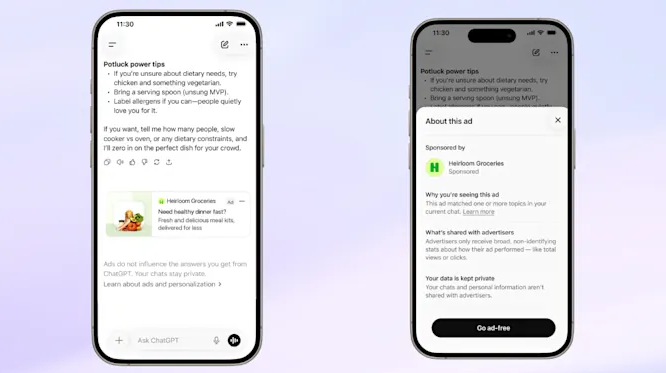
When a user asks ChatGPT a question and receives an answer, an eligible ad may appear below that response. The ad is visually separated from the AI’s response and clearly marked as sponsored content. An ad might feature a product, service, or brand relevant to the conversation context.
It’s important to understand that seeing an ad does not mean OpenAI endorses or recommends the advertiser or its products. Ads are paid placements, separate from ChatGPT’s organic responses. A sponsored product card is fundamentally different from ChatGPT’s answer to your question.
Where Do ChatGPT Ads Appear?
Ads appear below ChatGPT responses as clearly labeled sponsored placements. When you ask ChatGPT a question and receive an answer, an eligible ad may be shown beneath that response if it matches the conversation’s context and intent.
During the current test phase, ads do not appear in the ChatGPT Atlas browser or in Temporary Chats. Ads are shown only in the main ChatGPT interface when conditions are met for eligibility and relevance.
Why Is OpenAI Introducing Ads to ChatGPT?
The Cost of Operating AI
Running ChatGPT requires significant infrastructure and computing resources. ChatGPT is used by hundreds of millions of people monthly for learning, work, and everyday decisions. Maintaining fast, reliable service at that scale requires ongoing investment in infrastructure, model improvements, and safety systems.
Supporting Free and Lower-Cost Access
OpenAI introduced advertising to help support continued investment in ChatGPT while keeping the Free plan available to users worldwide. The company states that ads can help make ChatGPT accessible to more people without changing how the product works or what users expect from the experience.
This is similar to how many free online services operate. The advertising model allows OpenAI to fund the product while maintaining free access for users who cannot or do not want to pay.
The Shift Toward Conversational Advertising
ChatGPT creates a different advertising environment than traditional search. Users come to ChatGPT not just to search for information, but to explore options, compare alternatives, weigh tradeoffs, and make decisions. A user asking “What laptop should I buy for video editing?” or “Which CRM system works best for small businesses?” is signaling clear intent to research and decide.
Advertisers can now reach people during these decision-making moments. This represents a new category of advertising built around conversational context rather than traditional keywords.
Who Will See Ads on ChatGPT?
The most common question users ask is who sees ads. OpenAI has clearly defined eligibility based on plan type and account age.
| ChatGPT Plan | Ads |
| Free | May see ads where available |
| Go | May see ads where available |
| Plus | No ads |
| Pro | No ads |
| Business | No ads |
| Enterprise | No ads |
| Edu | No ads |
Availability varies by market and rollout stage. Ads are currently being tested and gradually expanded. If you’re in a region where ads are available and you’re on Free or Go, you may see ads. If you’re in a region where ads haven’t launched yet, you won’t see them regardless of your plan.
Will Free ChatGPT Users See Ads?
Free users may see ads in supported markets. OpenAI is rolling out ads gradually, so not all Free users see ads immediately. If you’re a Free user in a market where ads are available, you may begin seeing ads below your ChatGPT responses.
Will ChatGPT Go Users See Ads?
ChatGPT Go users may see ads in supported markets. Go is a paid plan at a lower price point than Plus, and OpenAI has indicated that Go users are eligible for ads during the testing phase.
Does ChatGPT Plus Have Ads?
No. ChatGPT Plus users do not see ads. According to OpenAI, Plus, Pro, Business, Enterprise, and Edu accounts remain ad-free.
Does ChatGPT Pro Have Ads?
No. ChatGPT Pro is an ad-free plan.
Who Will NOT See ChatGPT Ads?
OpenAI excludes certain groups and contexts from advertising.
Users identified as under 18 do not see ads, based on account age information and behavioral signals. OpenAI uses a combination of stated age, account history, usage patterns, and topics discussed to identify younger users.
Temporary Chats do not show ads. If you use the Temporary Chat feature (which doesn’t save your conversation history), you won’t see advertisements.
Ads do not appear in sensitive conversation contexts, including personal health discussions, mental health conversations, or political topics. OpenAI’s system recognizes when a conversation is sensitive and does not display ads in those contexts.
How Do ChatGPT Ads Work?
Understanding how OpenAI selects which ads to show is central to understanding the system.
OpenAI’s advertising system considers multiple signals to select relevant ads. These include the context and intent of your current conversation, the ad’s landing page, title, and copy, advertiser-provided context hints and targeting selections, and, when personalization is enabled, select signals from your broader ChatGPT experience.
Context hints are not the same as traditional keyword matching. Advertisers can provide hints to help OpenAI understand their products or services, but the system primarily evaluates the actual conversation context.
How Does ChatGPT Choose Which Ad to Show?
When multiple eligible ads could be relevant to a conversation, OpenAI considers several factors, including relevance and advertiser bids. If you’re discussing a topic where several companies advertise, the system evaluates which ad would be most relevant to you based on the conversation and your settings, combined with advertiser bids.
This is not a simple “highest bidder wins” system. Relevance is a critical factor. OpenAI prioritizes showing ads that match the user’s actual conversation context.
Does ChatGPT Read My Conversation to Show Ads?
Yes, OpenAI’s advertising system uses the content and context of your current conversation to select relevant ads. This is different from sharing your conversation with advertisers.
The distinction is critical: OpenAI’s system reads your conversation internally to determine relevance. Advertisers do not see your conversation. They only see whether their ads received views and clicks.
This is similar to how email services use message content to select relevant ads while keeping the messages private from advertisers.
What Information Does ChatGPT Use for Ad Personalization?
When you enable ad personalization in your settings, ChatGPT may use additional signals to make ads more relevant.
The system can use your current chat context, general location or language, how you interact with ads (ads you hide or engage with), past chats, and your memory if memory features are enabled.
Important: Advertisers do not receive this information. OpenAI uses these signals internally only to determine which ads are most relevant to you. Advertisers only see aggregated data like total views and clicks.
Are Past Chats and Memory Used for Ads?
If you enable ad personalization and memory features, yes. ChatGPT may use past chats and memory to better understand topics relevant to you, which can make ads more relevant.
If you disable ad personalization or disable “Past chats and memory” in your ad controls, ChatGPT will rely primarily on your current conversation context to select ads.
What Happens If I Turn Off Ad Personalization?
Turning off ad personalization does not remove ads. It changes how ads are selected.
When personalization is off, ads continue to appear but are based primarily on your current conversation context rather than your broader history. You’ll still see ads, but they may be less tailored to your interests and habits.
This distinction is important. Reducing personalization does not make ads disappear. Turning off personalization is not the same as using the ads-free option.
ChatGPT Ads and Privacy: What Advertisers Can See
One of the most important questions users have is what information advertisers receive about them.
The direct answer: Advertisers do not receive your ChatGPT conversations.
What Advertisers Do Not Receive
Advertisers cannot access your chat history, memories, name, email, precise location, IP address, or sensitive personal information. Your conversations remain private from advertisers.
What Advertisers Do Receive
Advertisers receive aggregated, non-identifying information about how their ads perform. This includes metrics like total views, clicks, and conversion data. This information does not identify you individually.
If you intentionally message an advertiser through an ad (for example, to ask about a product while making a purchase decision), that advertiser can see only the messages you send them directly. They cannot see your other ChatGPT conversations.
Do ChatGPT Ads Affect ChatGPT’s Answers?
No. According to OpenAI, ads are completely separate from ChatGPT’s responses and do not influence the answers generated by ChatGPT.
Advertisers cannot pay to change an answer. Advertisers cannot rank an AI response higher. Sponsored content is visually and functionally separated from ChatGPT’s AI response.
An advertisement appearing below an answer is not an endorsement of that advertiser by OpenAI. ChatGPT’s answer is generated independently, based on the model’s training and your prompt, with no advertiser involvement.
This is a crucial trust mechanism. Users can rely on ChatGPT’s responses without worrying that paid placements have influenced them.
How to Control ChatGPT Ads
OpenAI provides several controls to manage your ad experience.
Managing Ad Personalization
To access your ad controls, open ChatGPT, go to Settings, and select Ad Controls. (On web and iOS, you can also visit the ad controls directly.) From there, you can:
- Toggle ad personalization on or off
- Toggle “Past chats and memory” to control whether these signals inform ads
- View your ads history and topics
- Delete ads data at any time
When you delete ads data, that information is removed from your profile and no longer used to show you ads. The data is retained on OpenAI’s servers for up to 30 days before complete deletion.
Hiding and Reporting Ads
When an ad appears, you’ll see a three-dot menu icon. Use this menu to:
- Hide the ad (dismiss it from your current view)
- Report the ad if it seems misleading, unsafe, inappropriate, or violates OpenAI’s policies
- Select “About this ad” to learn why you’re seeing it
- Select “Ask ChatGPT” to share the ad with ChatGPT so you can ask questions about it
Reporting an ad sends it to OpenAI’s team for review. Hiding an ad simply dismisses it from your current view.
Can You Use ChatGPT Without Ads?
Yes, several options exist for avoiding or reducing ads.
Option 1: Use an Ad-Free Paid Plan
Upgrade to ChatGPT Plus or Pro. Both paid plans include no ads and full access to all features. This is the most straightforward way to have an ad-free experience while maintaining full access to ChatGPT’s capabilities.
Option 2: Use the Free Ads-Free Experience
OpenAI offers an ads-free option for eligible Free users. To access it, go to Settings, select Ad Controls, and choose to go ad-free. This removes all ads from your experience.
The tradeoff is significant: the ad-free Free option comes with lower message limits per day and reduced feature access. You may lose access to features like image generation or deep research. Availability varies by region.
If you prefer an ad-free experience without reduced limits, upgrading to Plus or Pro is necessary.
ChatGPT Ads vs Traditional Search Ads
Understanding how ChatGPT ads differ from search advertising helps explain why OpenAI treats them differently.
| Feature | ChatGPT Ads | Traditional Search Ads |
| Environment | AI conversation | Search results page |
| User intent | Conversational context | Search query |
| Ad placement | Below ChatGPT response | Search results listings |
| AI-generated content | Yes | Not the same |
| Context signals | Conversation thread | Search query and history |
| Advertiser influence | Cannot modify answer | N/A |
| Primary interaction | Conversation | Search and click |
ChatGPT ads operate in a different context than search advertising. In a conversation with an AI, users are exploring, learning, and deciding. The advertiser’s role is different. Traditional search ads interrupt a search experience. ChatGPT ads appear below an AI answer in a context where the user is actively considering options.
What ChatGPT Ads Mean for Advertisers
For businesses and marketers, ChatGPT Ads represent a new advertising channel focused on decision-making moments. Early advertisers, including Newegg, Best Buy, Lowe’s, and VistaPrint, have begun using the platform.
OpenAI’s advertising platform supports campaign creation, targeting, budget management, and performance measurement. Advertisers can set up campaigns, add ad details, and access reporting on views, clicks, and conversions.
The advertising environment emphasizes conversational context and real intent. Brands can reach people as they explore options and make decisions, rather than interrupting search or browsing experiences.
Currently, this is a testing phase. OpenAI indicates it may explore additional measurement insights while continuing to protect user privacy. Advertising capabilities may expand as the program matures.
Where Are ChatGPT Ads Available?
As of August 2026, ChatGPT Ads are being tested and rolled out gradually across markets.
Testing began in the United States in February 2026. Since then, availability has expanded to additional countries, including 31 European markets as of August 2026.
Availability varies by region and continues to evolve as OpenAI expands the program. If you don’t see ads in your region, they may not yet be available where you are. OpenAI has indicated it is taking a deliberate, phased approach to expansion.
Check your region’s rollout status on OpenAI’s Ads Manager Availability page if you need current information.
What Types of Conversations Are Protected From Ads?
OpenAI has established brand-safety and user-safety restrictions that prevent ads from appearing in certain contexts.
Ads do not appear near sensitive topics, including personal health, mental health, or political discussions. This protects users from seeing inappropriate ads during vulnerable conversations.
Some advertisers in regulated categories like health and financial services may be eligible to advertise, but only if they meet strict eligibility criteria. Even when these advertisers are eligible, OpenAI does not place their ads near sensitive user content.
Political advertising is not currently allowed in ChatGPT.
Pros and Cons of ChatGPT Ads
Examining the tradeoffs of ChatGPT’s advertising system provides a balanced view.
Pros:
- Helps support free access to ChatGPT
- Creates a new advertising channel for relevant product discovery
- Ads can be contextually relevant to conversations
- Users have controls to manage personalization
- Sponsored content is clearly labeled
Cons:
- Ads interrupt the user experience for Free and Go users
- Ad personalization raises privacy considerations
- System controls and availability may change over time
- Free users can find the tradeoff between ads and feature access confusing
- Users may confuse ads with organic ChatGPT recommendations
What ChatGPT Ads Mean for the Future of AI Search
ChatGPT Ads represent a shift in how advertisers reach users at decision-making moments. Rather than bidding on keywords, advertisers can now reach people in conversational contexts where purchase intent and consideration are happening in real time.
This raises important questions for the digital advertising industry. Search behavior may gradually shift from keyword-based queries to conversational interactions with AI assistants. If that trend continues, advertisers will need to adapt their strategies.
It also highlights the importance of trust in AI products. Users must maintain confidence that AI responses are not influenced by paid placements. OpenAI’s clear separation of ads and answers is crucial to maintaining that trust.
Privacy expectations around AI assistants are also evolving. Users will increasingly expect control over how their conversations are used, even when ads are present. Systems that allow users to manage personalization settings are likely to become standard.
Final Verdict
ChatGPT Ads represent a new form of conversational advertising. Ads appear separately from ChatGPT’s responses for Free and Go users in supported markets. Advertisers do not receive access to your conversations. Ads do not influence ChatGPT’s answers.
For most users, the key decision is whether to accept ads in exchange for full feature access on the free plan, or to upgrade to ad-free plans, or to use the ads-free Free option with reduced limits.
If you use ChatGPT Free or Go, review your ad settings to understand how your experience is personalized. If you’re a marketer or business owner, consider ChatGPT Ads as an emerging channel for reaching people during decision-making moments rather than simply another search ad format.
Frequently Asked Questions
Who sees ads on ChatGPT?
Free and Go plan users in markets where ads are available may see ads. Plus, Pro, Business, Enterprise, and Edu users do not see ads. Users identified as under 18 do not see ads.
Does ChatGPT Plus have ads?
No. ChatGPT Plus users do not see ads. All paid plans (Plus, Pro, Business, Enterprise, and Edu) are ad-free.
Does ChatGPT Go have ads?
Yes, ChatGPT Go users may see ads in supported markets. Go is eligible for advertising as part of OpenAI’s testing.
How do ChatGPT ads work?
OpenAI’s system selects ads based on conversation context, intent, and relevance. When personalization is enabled, it may also consider broader ChatGPT usage patterns. Ads are shown separately below responses and clearly labeled as sponsored.
Do ChatGPT ads affect ChatGPT’s answers?
No. Ads are completely separate from ChatGPT’s responses. Advertisers cannot influence, rank, or modify ChatGPT’s answers. Ad placement is not an endorsement.
Can advertisers see my ChatGPT conversations?
No. Advertisers cannot access your conversations, chat history, memories, or personal details. They only receive aggregated performance metrics like views and clicks.
Can I turn off ChatGPT ads?
Yes. You can upgrade to Plus or Pro for an ad-free experience with full features, or use the ads-free Free option with reduced message limits and feature access. You can also manage ad personalization in Settings.
Are ChatGPT ads personalized?
Ads can be personalized if you enable ad personalization in your settings. This allows ChatGPT to use past chats, memory, and broader usage patterns to show more relevant ads. You can disable personalization at any time, though this does not remove ads.
Does ChatGPT use my past chats for advertising?
Only if you enable “Past chats and memory” in your ad personalization settings. You can disable this toggle to prevent past chats and memory from informing which ads you see.