
Managing money often means dealing with spreadsheets, recurring expenses, bills, savings goals, debt payments, and financial decisions. ChatGPT can help organize and analyze much of this information when given the right context. The key is learning what ChatGPT can realistically do, how to structure your requests, and where professional verification still matters. This guide covers 10 practical use cases for using ChatGPT for finance, from monthly budgeting to debt payoff planning, along with actionable prompts you can adapt to your situation. Note that OpenAI recently announced ChatGPT for Financial Services, a professional offering for banks and financial institutions. This article focuses on personal money management with consumer ChatGPT.
How Can ChatGPT Help With Personal Finance?
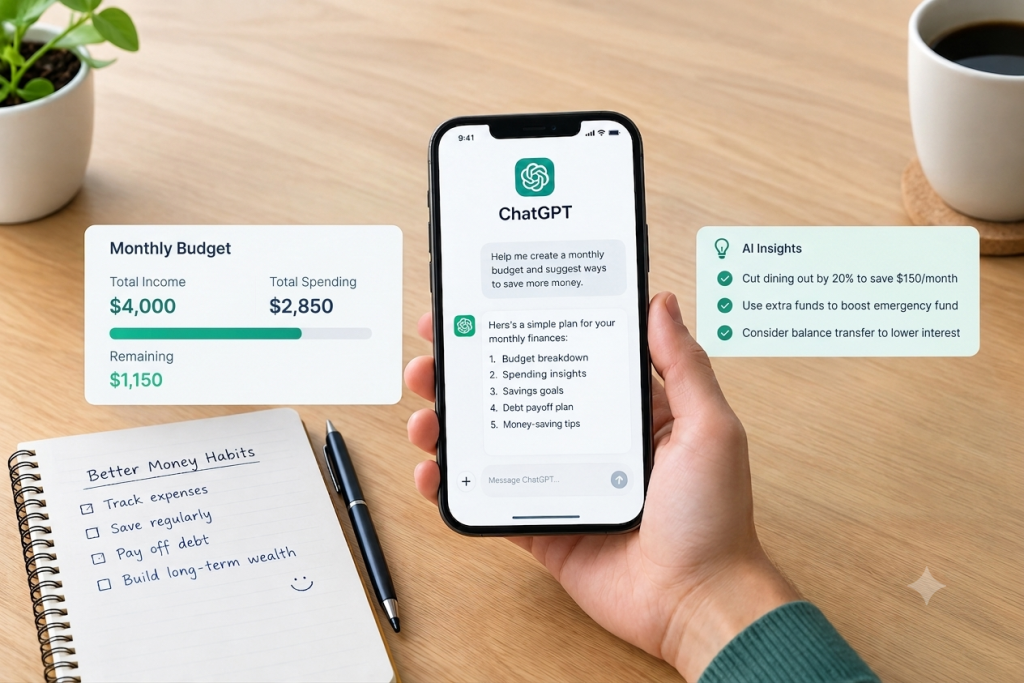
ChatGPT can help users organize, analyze, and plan financial information by serving as an AI financial assistant when you provide the details. When given accurate numbers and context, ChatGPT can organize your income and expenses into budgets, categorize spending from transaction lists, compare financial scenarios, create savings plans, structure debt payoff strategies, track net worth changes, explain investment terminology, and prepare financial information for professional review. ChatGPT can help with financial analysis and planning, but the user remains responsible for financial decisions. It’s particularly useful for organizing information you already have, spotting patterns in spending, exploring different financial scenarios, and understanding financial concepts. It should never be treated as a replacement for a qualified financial adviser, tax professional, or bank.
Quick Summary: 10 Ways to Use ChatGPT for Finance
| Use Case | What ChatGPT Can Help With | Best For |
| Budgeting | Organizing income and expenses | Beginners and monthly planning |
| Spending analysis | Categorizing transactions | Anyone reducing expenses |
| Subscriptions | Finding recurring charges | Cost-conscious users |
| Cash flow | Planning upcoming bills | Monthly planning |
| Savings | Creating savings targets | Goal-oriented users |
| Debt | Comparing repayment strategies | Borrowers managing debt |
| Major purchases | Comparing scenarios | Buyers making decisions |
| Net worth | Organizing assets and liabilities | Long-term financial tracking |
| Investments | Explaining allocation and risk | Investors learning concepts |
| Financial organization | Preparing information for professionals | Everyone |
10 Practical Ways to Use ChatGPT for Finance
1. Create a Monthly Budget With ChatGPT
A budget is the foundation of personal money management. Instead of manually organizing your income and expenses, ChatGPT can structure this information into a workable plan. Provide your monthly take-home income, fixed expenses (rent, insurance, utilities), variable expenses (groceries, transportation, entertainment), debt payments, and any savings goals. ChatGPT will organize these into categories, show you where your money goes, and help identify areas for potential cuts.
Example prompt:
“My monthly take-home income is $4,500. My rent is $1,400, utilities are $200, groceries are $500, transportation is $300, subscriptions are $100, and debt payments are $400. Create a monthly budget that includes a $600 savings goal and identify areas where I could reduce discretionary spending.
What to check: Treat ChatGPT’s output as a starting point, not a final plan. Review the categories and percentages against your own spending patterns. Verify that fixed costs are accurate by checking recent bills. Adjust variable expenses based on your actual spending from the past three months.
2. Analyze Your Spending
ChatGPT excels at organizing unstructured financial data. If you have transaction history from your bank or credit card, ChatGPT can categorize spending into housing, food, transportation, shopping, entertainment, subscriptions, debt, and savings. This helps you spot patterns and understand where discretionary money goes.
Example prompt:
“Analyze these transactions by category. Identify my three largest spending categories, separate essential and discretionary expenses where possible, and highlight unusual spending patterns.”
Structured transaction data produces better results than vague descriptions. Export recent transactions from your bank’s app or download a CSV file from your credit card company, then share the relevant portion with ChatGPT. This approach gives you concrete insights rather than generalizations.
What to check: Verify that ChatGPT’s categorizations match your own understanding. Some transactions may be ambiguous (is a coffee shop purchase food or entertainment?). Adjust categories to reflect your personal priorities, then use the analysis to identify habits.
Read More: How to Use AI for Data Analysis (Without Being a Data Scientist)
3. Find Unnecessary Subscriptions and Recurring Charges
One of the easiest ways to free up money is identifying recurring charges you’ve forgotten about. ChatGPT can review your transaction history and flag every monthly, quarterly, or annual charge, showing you which services are active and what they cost over time.
Example prompt:
“Review these transactions and identify recurring charges. Group them by service, monthly cost, annual cost, and payment frequency. Note any subscriptions that might be duplicates or underutilized.”
What to check: Before canceling any service, verify the charge against your bank statement and the service’s website. Some recurring charges may be worth keeping. Others may justify the cost through usage. Create a spreadsheet of subscriptions you want to keep and those to cancel, with cancellation steps for each. Set reminders to check subscriptions quarterly.
4. Plan Upcoming Bills and Monthly Cash Flow
Budgeting tells you where money should go. Cash flow planning shows you when money enters and leaves your account. ChatGPT can organize your paydays, bills, and large upcoming expenses to ensure your cash balance doesn’t dip too low before the next deposit.
Example prompt:
“Here are my expected income and bills for the next 30 days. Create a simple cash-flow schedule showing when deposits arrive and when bills are due. Identify any dates where my available cash could become tight.”
Provide payday dates, bill due dates, and amounts. ChatGPT will create a timeline showing when cash stress might occur and highlight periods where you might need to adjust payment timing or prioritize bills.
What to check: Verify that all bill due dates and amounts are accurate. Note any upcoming irregular expenses (car insurance renewal, annual fees, holiday gifts). Adjust the timeline if payday dates change or bills shift. Use this planning tool to ensure you have enough cash before making large discretionary purchases.
5. Create a Savings Plan
A savings goal without a plan remains a wish. ChatGPT can help you break down a financial target into monthly increments, calculate how long savings will take, and explore different scenarios if your contribution amount changes.
Example prompt:
“I want to save $6,000 in 12 months for a vacation. I currently have $1,500 saved and can set aside $400 per month. Show me three savings scenarios and explain how long each would take if I adjust my monthly contribution.”
ChatGPT can model scenarios where you save $300, $400, or $500 monthly, showing the timeline and target-reach date for each. This helps you decide whether your goal is realistic or needs adjustment.
What to check: ChatGPT cannot guarantee investment returns or future financial outcomes. If you’re building an emergency fund, keep it in a high-yield savings account. If you’re saving for long-term goals, discuss investment options with a financial professional. Track actual progress monthly against your plan and adjust contributions if your financial situation changes.
6. Build a Debt Payoff Plan
People with multiple debts often struggle to decide which to pay first. The two most common strategies are the debt avalanche (pay highest interest rate first, saving money on interest) and the debt snowball (pay smallest balance first, building momentum). ChatGPT can compare both approaches with your specific debts.
Example prompt:
“I have three debts: Credit card with $3,500 at 18% APR and $105 minimum payment, car loan with $8,000 at 5% APR and $200 minimum payment, and student loan with $12,000 at 4% APR and $120 minimum payment. I can pay $800 total per month toward debt. Compare the avalanche and snowball methods, estimate payoff timelines, and show the interest difference.”
ChatGPT will show you each method side-by-side, how many months each takes, and total interest paid. This clarity helps you choose the strategy that aligns with both your finances and psychology.
What to check: Verify your APR, minimum payments, and current balances against your account statements. Confirm there are no prepayment penalties. Consider that the avalanche method saves more money while the snowball method provides faster early wins. Once you’ve committed to a strategy, automate your payments to stay on track.
7. Compare Major Financial Decisions
ChatGPT is particularly useful for scenario analysis. When facing a significant financial decision like buying a car, refinancing a loan, or choosing between rent and purchase, ChatGPT can organize your options side-by-side with all costs included.
Example prompt:
“Compare these two car options: Used 2020 Honda with $15,000 purchase price, 6% interest on $15,000 over 60 months, $120/month insurance, and estimated $500/year maintenance. New car with $28,000 purchase price, 5% interest over 60 months, $150/month insurance, and $300/year maintenance. Show total cost of ownership for each over five years.”
Provide specific numbers and ask ChatGPT to surface its assumptions so you can verify or adjust them. This prevents hidden costs from surprising you later.
What to check: Before making any major decision, independently verify the numbers you provided are accurate. Research realistic insurance quotes, maintenance costs, and interest rates for your location and situation. Get multiple quotes from lenders. Discuss tax implications with a tax professional if applicable. Sleep on the decision before committing.
8. Track and Understand Your Net Worth
Net worth equals everything you own minus everything you owe. Tracking it over time shows whether you’re building wealth or accumulating debt. ChatGPT can help you organize and categorize your assets and liabilities.
Example prompt:
“Here are my assets and liabilities. Calculate my current net worth, organize this information into categories, and suggest three metrics I could track monthly to measure progress.”
List your assets (cash, savings, investments, retirement accounts, property) and liabilities (credit cards, student loans, mortgages, car loans, personal loans). ChatGPT will calculate your net worth and suggest useful tracking metrics like debt-to-income ratio or liquid net worth.
What to check: Use current market values for investments and real estate, not purchase prices. Update your net worth quarterly or semi-annually as you get new investment statements and bank balances. Recognize that short-term market fluctuations don’t reflect actual progress. ChatGPT doesn’t independently verify asset values, so double-check your numbers.
9. Understand Your Investment Portfolio
If you have investments, ChatGPT can explain what you own, whether your allocation matches your risk tolerance, and where your portfolio might be concentrated. This doesn’t replace professional financial advice, but it helps you understand what to discuss with your adviser.
Example prompt:
“Here is my current portfolio: $8,000 in an S&P 500 index fund, $5,000 in a total market fund, $3,000 in individual tech stocks, $2,000 in a bond fund, and $1,000 in cash. Explain my allocation by asset class, identify concentration issues, and note what I should discuss with a financial professional.”
ChatGPT can help you understand asset allocation, diversification, sector concentration, and how your portfolio aligns with your time horizon. It can explain terms like expense ratios, correlation, and rebalancing.
What to check: ChatGPT should not be treated as a source for stock recommendations or guaranteed returns. Use it to understand concepts and ask better questions of a qualified financial adviser. Verify that your portfolio’s risk level matches your comfort and time horizon. Review fees and consider whether lower-cost index funds might serve your goals better.
10. Organize Financial Information for Better Decisions
This final use case extends beyond budgeting. ChatGPT can help you prepare for conversations with professionals, organize scattered financial documents, and think through financial checklists.
Example prompt:
“Organize this financial information into income, expenses, assets, liabilities, debt, savings, and investments categories. Then create a list of questions I should discuss with a financial professional to improve my plan.”
ChatGPT can help you identify gaps in your planning, generate questions for a financial adviser or tax professional, and create checklists for major financial life events. This positions ChatGPT as a preparation tool, not a decision-maker.
What to check: Use ChatGPT’s organization and questions as a starting point, but let your personal situation guide the priorities. Some suggestions may not apply to your circumstances. Bring the output to a professional for personalized advice.
How to Write Better ChatGPT Finance Prompts
Effective finance prompts follow a simple structure: provide context and numbers, state your goal, explain constraints, mention your timeframe, and specify how you want the output organized. A poor prompt like “Help me save money” gives ChatGPT no starting point. A better prompt gives specific numbers and goals.
Poor prompt: “Help me save money.”
Better prompt: “I earn $5,000 per month, spend about $4,200 on average, and want to save $10,000 within 12 months. I cannot reduce my rent or insurance costs. Show me three realistic approaches and calculate the monthly savings required for each approach.”
Follow these four rules: First, give ChatGPT actual numbers rather than estimates. Second, state your financial goal clearly and include your timeframe. Third, explain constraints like fixed costs you can’t reduce or income that won’t increase. Fourth, ask ChatGPT to show its assumptions and calculations so you can verify accuracy. These practices transform vague requests into actionable analysis.
How to Use ChatGPT Finance Features and Connected Financial Data
ChatGPT’s capabilities evolve regularly. Some users have access to features that let them connect bank accounts or financial data to ChatGPT for deeper analysis. When available and when you meet eligibility requirements, connecting financial data can provide more contextual spending analysis, automatic recurring expense detection, upcoming bill organization, and net worth tracking without manual data entry.
However, not all users have access to these features. Availability depends on your location, account type, and which financial institutions and banks are supported. Before relying on connected financial features, check your account’s current capabilities and the supported accounts in your region. Many of the practical workflows in this article don’t require connected data; they work well when you manually provide information to ChatGPT. Do not assume that every ChatGPT user can connect a bank account or that connected data is universally available.
What ChatGPT Should Not Do With Your Money
ChatGPT should not be treated as a replacement for a financial adviser, tax professional, lawyer, bank, brokerage, or accountant. It’s a tool for organizing information and exploring scenarios, not for making final financial decisions. Before making any significant decision involving investments, taxes, loans, retirement planning, insurance, or legal obligations, independently verify important information and consult a qualified professional. This distinction matters: ChatGPT can help educate you and organize your thinking, but it cannot provide personalized professional advice. OpenAI’s own positioning is clear that this is an analytical tool, not a financial services provider.
How to Protect Your Financial Information When Using ChatGPT
Do not share passwords, PINs, banking credentials, full credit card numbers, or security answers with ChatGPT. When sharing transaction files or bank statements, remove unnecessary sensitive information like full account numbers, Social Security numbers, or full names if possible. You can share transaction dates and amounts without personally identifying details. Understand the privacy settings for whatever ChatGPT features you use. Familiarize yourself with OpenAI’s current privacy and data-handling practices by reviewing their official help documentation, rather than relying on third-party claims. If you use connected financial features, review what data you’re explicitly sharing and what the platform’s data retention policies are.
Best Practices for Using ChatGPT for Personal Finance
Use these guidelines to get the most value from ChatGPT while avoiding common pitfalls:
- Use accurate numbers from recent statements rather than estimates
- State the date of the financial information you’re providing
- Separate facts (your actual income) from assumptions (expected income increases)
- Ask ChatGPT to show its calculations so you can verify them
- Ask what information is missing from your request
- Request multiple scenarios rather than a single recommendation
- Verify important numbers against your primary source (bank statements, investment statements, bills)
- Do not rely on AI alone for high-stakes financial decisions
- Keep your financial information organized so you can update and refine analysis regularly
- Recheck key calculations before acting on ChatGPT’s output
Common Mistakes to Avoid
Mistake 1: Asking vague questions. “Help me with my finances” gives ChatGPT no starting point. Include specific numbers and goals.
Mistake 2: Treating output as guaranteed advice. ChatGPT’s analysis is only as good as your input. Market conditions, personal circumstances, and laws change.
Mistake 3: Using outdated information. If you’re providing expense data from six months ago, conclusions may not reflect your current situation. Use recent information.
Mistake 4: Forgetting to mention constraints. ChatGPT might suggest cutting your rent to save money, which isn’t realistic. Tell it what can’t change.
Mistake 5: Trusting calculations without verification. Check the math yourself. ChatGPT makes arithmetic errors and can misunderstand context.
Mistake 6: Sharing unnecessary sensitive information. You don’t need to share full account numbers or SSNs to get useful analysis.
Mistake 7: Assuming every feature is available. Connected financial data, advanced analysis features, and other capabilities may not be available to all users. Check your specific account’s capabilities.
ChatGPT for Finance vs. Traditional Financial Tools
| Task | ChatGPT | Banking App | Spreadsheet | Financial Professional |
| Budget organization | Strong | Strong | Strong | Strong |
| Spending categorization | Strong | Strong | Moderate | Strong |
| Scenario analysis | Strong | Limited | Strong | Strong |
| Financial education | Strong | Limited | Limited | Strong |
| Investment explanation | Strong | Moderate | Moderate | Strong |
| Personalized advice | Limited | Limited | No | Strong |
| Automated account actions | Limited | Strong | No | Depends |
ChatGPT complements these tools rather than replacing them. Your bank app connects to your actual accounts. Spreadsheets let you build custom models. Financial professionals provide personalized guidance. ChatGPT excels at organizing information, explaining concepts, and exploring scenarios. Use each tool for what it does best.
Final Verdict
ChatGPT is most valuable in personal finance when used as a tool for organizing, analyzing, comparing, planning, and verifying. It excels at taking scattered financial information and making sense of it. It helps you explore different financial scenarios before committing to a decision. It can organize your thinking and prepare you for conversations with professionals. It does not, however, replace the judgment of a qualified financial adviser, the security of a bank, or the expertise of a tax professional.
The best starting point is straightforward: choose one area of your finances that feels most overwhelming. If it’s monthly spending, give ChatGPT a clean summary of your income and expenses from the past month. Ask it to categorize the information, identify your three largest spending categories, separate essential from discretionary spending, and suggest one area worth reviewing. Review the output, verify the numbers make sense, and decide whether the insights match your own observations. Then move to the next area: subscriptions, debt, savings, or investments. This incremental approach builds confidence and shows you where ChatGPT adds genuine value to your financial decision-making.
Frequently Asked Questions
Can I use ChatGPT for personal finance?
Yes. ChatGPT can organize financial information, create budgets, analyze spending, compare financial scenarios, and help you understand financial concepts. It works best when you provide accurate numbers and clear goals. Don’t treat it as a financial adviser.
Can ChatGPT create a budget?
Yes. Provide your monthly income and expenses, and ChatGPT will organize them into a structured budget showing where your money goes. Ask it to identify areas for potential savings and to show spending as a percentage of income.
How can I use ChatGPT to manage my money?
Use ChatGPT to organize financial information, analyze spending patterns, compare financial scenarios, plan savings and debt payoff, track net worth, and prepare for conversations with financial professionals. Give it accurate data and clear goals for best results.
Can ChatGPT analyze my spending?
Yes. Share your transactions or a summary of spending by category, and ChatGPT can identify patterns, highlight unusual expenses, find your largest spending categories, and separate essential from discretionary spending.
Can ChatGPT help me pay off debt?
Yes. ChatGPT can compare the debt avalanche and snowball methods, calculate payoff timelines for each, show interest savings, and suggest payment strategies. It can’t make the payments for you, but it helps you decide how to approach them strategically.
Can ChatGPT analyze my investment portfolio?
Yes. ChatGPT can explain your asset allocation, identify concentration in specific sectors or stocks, discuss diversification, and explain investment terminology. It cannot select specific stocks or guarantee returns. Use it to understand your portfolio before discussing it with a financial professional.
Is ChatGPT a financial adviser?
No. ChatGPT can organize information and help you understand financial concepts, but it cannot provide personalized financial advice. Always verify important information independently and consult a qualified financial professional for major decisions.
Is it safe to give ChatGPT financial information?
It’s generally safe to share transaction data, amounts, and financial information needed for analysis. Don’t share passwords, PINs, full credit card numbers, or security answers. Understand your privacy settings and OpenAI’s data-handling practices.