
OpenAI has introduced ChatGPT for Teens, a purpose-built AI experience designed specifically for teenagers aged 13 to 17. Rather than simply filtering adult content, this new version combines learning-focused tools, stronger safety protections, and parental oversight to create a fundamentally different experience. The move represents OpenAI’s most significant effort to date to make AI accessible to younger users while addressing concerns about safety, healthy use, and educational value. This article explains what ChatGPT for Teens actually offers, how it differs from standard ChatGPT, and what parents, teens, and educators should know about the launch.
What Is ChatGPT for Teens?
ChatGPT for Teens is OpenAI’s age-specific experience for users aged 13 to 17, combining educational features like Study Mode and Responsible Homework Reminders with stronger default safety protections and optional parental controls. It applies automatically when OpenAI estimates a user is under 18 or when someone states their age falls between 13 and 17. Unlike a simple content filter, the experience integrates learning science research, behavioral guardrails to prevent emotional dependency, and tools designed to foster healthy, balanced AI use for developing minds.
Key Takeaways
- Designed for users aged 13 to 17; automatically applied when OpenAI estimates someone is under 18
- Combines learning features (Study Mode, homework reminders, quizzes) with stronger safety protections
- Applies age-appropriate safeguards across areas including self-harm, violence, eating disorders, and explicit content
- Parents with linked accounts can set Quiet Hours, adjust selected settings, and receive limited safety notifications
- Includes healthy-use interventions like break reminders and prevents ChatGPT from using romantic language or implying it has consciousness
What’s New in ChatGPT for Teens?
Study Mode and Step-by-Step Learning
Study Mode represents one of the largest changes in how ChatGPT functions for teens. Rather than providing direct answers to homework questions, Study Mode guides students through problems using scaffolded learning techniques. When a student asks for help with an algebra problem, for example, ChatGPT uses guiding questions and step-by-step support to help them work through it themselves. This approach draws on established learning science research showing that active retrieval and self-explanation produce better comprehension and retention than passive reading.
The feature uses several structured teaching methods: guiding questions that prompt students to think through problems, metacognitive prompts that encourage reflection on their own thinking, and knowledge checks that confirm understanding before moving forward. A student studying for a test can ask ChatGPT to explain an unfamiliar concept, work through a practice problem, and test their understanding. The experience is intentionally designed to keep teens actively engaged in learning rather than allowing them to bypass critical thinking.
Responsible Homework Reminders
This new capability recognizes when a student may be trying to shortcut an assignment. If someone asks ChatGPT to “just give me the answer,” the system can redirect them toward Study Mode and explain why step-by-step problem solving will actually help them learn better. This distinction matters significantly. The system is designed to distinguish between “Help me understand how to solve this” and “Give me the answer so I can turn it in,” then guide students toward approaches that support genuine learning. OpenAI does not claim this system perfectly detects cheating, but rather that it can recognize certain patterns and offer better alternatives.
Quizzes and Learning Visualizations
These features give students practical tools for self-assessment and concept visualization. Quizzes allow teens to test their understanding of material they have studied, while Learning Visualizations help make difficult concepts in mathematics and science more concrete and easier to grasp. A student struggling with calculus concepts, for instance, can request visualizations that make abstract ideas tangible. These tools are built to reinforce learning through multiple approaches rather than serving as ways to avoid studying.
Study Hours
Study Hours let teens or parents designate specific times when Study Mode activates by default. A student might set Study Hours from 7 PM to 9 PM on weekdays, so that ChatGPT automatically uses its guided learning approach during that time. This feature helps transform study habits into routine and removes friction from engaging in deeper learning rather than quick shortcuts. Parents can adjust these settings, making it a point of collaborative decision-making between parent and teen rather than a restriction imposed from above.
ChatGPT Teen Safety: What’s Different?
For teen users, safety protections are enabled as defaults rather than optional add-ons. OpenAI applies age-appropriate safeguards designed to reduce exposure to harmful or developmentally inappropriate content while preserving the ability to learn, create, and explore. These protections are based on OpenAI’s Under-18 Model Spec, which incorporates guidance from developmental science and expert consultation.
In practical terms, ChatGPT for Teens applies stronger handling in several high-risk areas:
Self-harm and Eating Disorders. ChatGPT includes stronger safeguards around conversations that touch on self-harm, and OpenAI is adding additional safety notifications related to eating disorders. When patterns matching these areas emerge, the system responds with protective interventions designed to encourage offline support.
Violence and Dangerous Activities. Age-appropriate handling of violent content and activities that pose physical danger to teens is baked into the model’s default behavior.
Explicit or Graphic Content. Stronger restrictions prevent access to sexually explicit, graphic, or otherwise developmentally inappropriate material.
It is important to understand what these protections actually do. They are designed to reduce risk and limit exposure to certain content categories, not to make harm impossible. OpenAI tests these safeguards against teen-specific standards and publishes results in system cards, but the protections are engineering controls, not guarantees.
How ChatGPT Handles Emotional Dependency for Teens
Emotional dependency represents a distinct category of concern for younger users. OpenAI’s updated approach goes beyond content filtering by changing how ChatGPT communicates with teens.
Specifically, ChatGPT for Teens will not use romantic language toward users, encourage emotional dependence, or imply that it has feelings or consciousness. The system avoids language that could blur the line between AI tool and human relationship. Instead, ChatGPT consistently identifies itself as artificial intelligence and includes product cues that reinforce this distinction. This matters because teenagers are still developing their understanding of authentic relationships, and AI systems that simulate emotional connection could potentially interfere with that development.
These protections are reinforced through other design choices. Customization options like accent colors and voice variations let teens personalize the experience without suggesting that ChatGPT is a friend or confidant. Break reminders encourage stepping away from the application, and the overall design prioritizes real-world relationships over extended time in conversation with an AI system.
How Do ChatGPT Parental Controls Work?
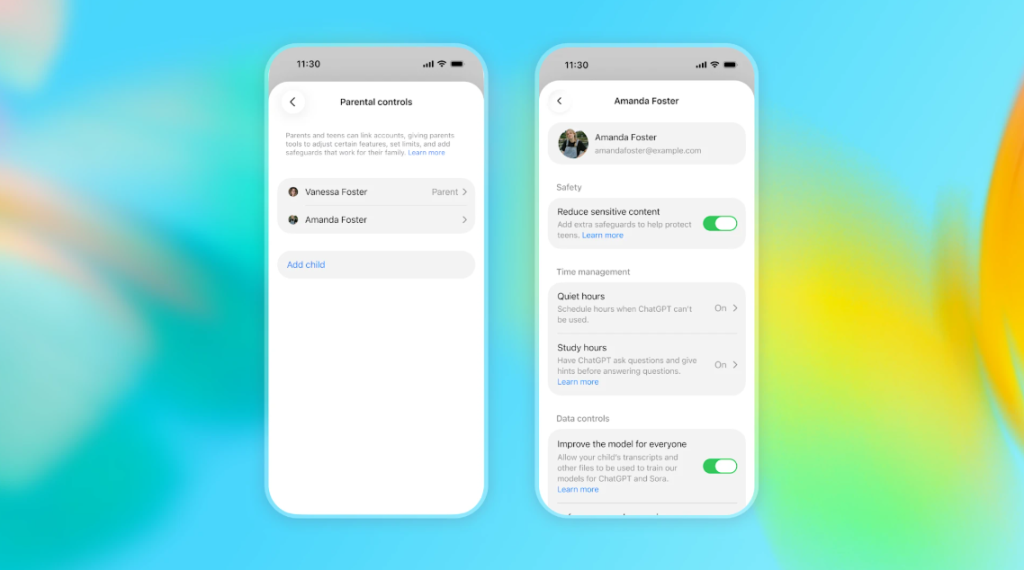
Parents who want oversight of their teen’s ChatGPT use can link accounts. This creates a parent-teen relationship within ChatGPT that enables specific controls and notifications.
What parents can do:
- Set Quiet Hours during which ChatGPT is not available (useful for bedtime, school hours, or family time)
- Manage selected account settings including data control preferences
- Receive safety notifications in limited high-risk situations, including new notifications related to eating disorders
- Monitor basic usage patterns and account activity
What parents cannot do:
- Read or access their teen’s private conversations
- See the full history of what their teen asked ChatGPT
- Monitor in real time or receive detailed transcripts
This design reflects a deliberate balance. OpenAI wants parents to have meaningful oversight without making ChatGPT feel like comprehensive surveillance. Parents receive notifications only when serious safety concerns emerge, focusing on moments when offline support may genuinely matter.
Parent Checkpoint
Before linking accounts, parents should understand that parental controls provide selected oversight, not comprehensive monitoring. You will receive notifications about safety concerns but cannot read conversations. Teens will know that parental controls are active. This is a tool for partnership and safety, not secret surveillance.
How Does ChatGPT Know If Someone Is Under 18?
OpenAI uses age prediction to determine whether a ChatGPT account may belong to someone under 18. The system looks at signals from how an account is used, such as how long the account has existed, typical times of activity, usage patterns over time, and the age a user has stated.
If OpenAI’s system predicts that an account belongs to someone under 18, additional teen protections are applied automatically. Users aged 13 to 17 can also indicate their age directly, which can result in the teen experience being applied.
Age prediction is not the same as age verification. It is an estimation system rather than a definitive way of proving someone’s age, so mistakes are possible. An adult could be incorrectly placed into the teen experience, while a younger user could potentially be missed by the system.
For adults who are incorrectly placed into the under-18 experience, OpenAI provides an age-verification process that can be used to confirm adulthood and restore the appropriate experience. This approach allows OpenAI to apply stronger protections to likely teen accounts without requiring every user to submit government identification simply to use ChatGPT.
ChatGPT for Teens vs. Regular ChatGPT
| Dimension | Regular ChatGPT | ChatGPT for Teens |
| Target age | All users (13+) | Ages 13 to 17 |
| Safety protections | Standard safeguards | Stronger, teen-specific protections |
| Study Mode | Available | Available; can be enabled by default for linked teen accounts |
| Homework reminders | Not available | Recognizes shortcuts, redirects to Study Mode |
| Quizzes and visualizations | Limited | Full suite for active learning |
| Study Hours | Not available | Can set designated study times |
| Break reminders | General features | Teen-specific healthy-use prompts |
| Parental controls | Not available | Quiet Hours, settings, safety notifications |
| Emotional-dependency safeguards | Standard | Reinforced: no romantic language, no false consciousness claims |
| Sensitive-image reminders | Basic | Enhanced teen-focused warnings |
This comparison shows that ChatGPT for Teens is not simply regular ChatGPT with stricter content filters. It is a distinctly different product focused on learning, safety, and healthy use.
What Can Teens Actually Use ChatGPT For?
For Learning and Academic Work
Teens can use ChatGPT for Teens to understand difficult concepts, practice problems, prepare for exams, create study plans, and review notes. Study Mode is specifically designed to support these activities without enabling shortcuts. A student struggling with essay structure can ask ChatGPT to guide them through the writing process. Another student can ask for help learning a programming language by working through problems collaboratively.
Read More: Best AI Tools for Students in 2026
For Creative and Technical Projects
ChatGPT can assist with brainstorming, coding projects, research assistance, and writing practice. Teens have built real projects with ChatGPT, including AI-powered tools for specific problems. Rushil Kukreja, Arhan Menta, and Nayel Rehman in Virginia developed WiFind, a search-and-rescue system using AI to analyze Wi-Fi signals and locate survivors after disasters. Crystal Yang in Texas used ChatGPT to develop and scale Audemy, an audio-based educational platform for blind students that grew to 200,000 users.
What to Verify
Teens should verify important facts independently, especially for academic work, health questions, or anything that might influence real-world decisions. ChatGPT can make mistakes. Asking a trusted adult for input on complex topics remains essential. ChatGPT is most useful as a learning partner, not an unquestionable authority.
What Are the Limitations of ChatGPT for Teens?
Several important limitations deserve explicit mention.
AI remains imperfect. ChatGPT can generate confidently incorrect information, especially on specialized topics. Teens should verify important claims.
Age prediction has accuracy limits. The system may misclassify some users. Adults might incorrectly receive the teen experience, and some younger users might access regular ChatGPT.
Safety protections are not guarantees. Safeguards are designed to reduce harmful content exposure, not eliminate all risk. Sophisticated attempts to circumvent restrictions may sometimes succeed.
Parental controls provide selected oversight, not comprehensive monitoring. Parents cannot read conversations and receive notifications only in limited high-risk areas.
ChatGPT should not replace professional support. Teachers, parents, counselors, therapists, and other real-world relationships cannot be replaced by AI. For serious concerns, teens should seek help from trusted adults.
Teens may attempt to bypass restrictions. Some users might create separate accounts, use VPNs, or develop other workarounds. The system is not designed as impenetrable.
Privacy questions remain unanswered. The exact signals OpenAI uses for age prediction are not public. Questions about data retention and privacy implications deserve ongoing scrutiny.
What Are People Saying About OpenAI’s Teen Mode?
Community reaction to ChatGPT for Teens has been mixed.
Supporters highlight several benefits. Many parents and educators welcome teen-specific safeguards as preferable to a one-size-fits-all AI experience. The learning-focused features resonate with those who want AI to support education rather than enable shortcuts. Parent controls without full surveillance are appreciated by those seeking a middle ground between unrestricted access and total monitoring.
Critics raise important questions. Skepticism about age prediction accuracy is common. Some worry that the learning restrictions are too aggressive, preventing legitimate educational use. Privacy implications of age prediction systems generate concern, particularly around what data OpenAI collects and retains. Questions about whether teens will attempt to bypass restrictions through secondary accounts are frequently discussed. Some argue that a separate teen experience, rather than simply building safety into ChatGPT for all users, creates unnecessary complexity.
These are legitimate discussion points. The real-world effectiveness of ChatGPT for Teens will depend on how well the features actually work in practice, how accurate age classification proves to be, and whether parents and teens find the balance between capability and protection appropriate for their needs.
Best Practices for Teens Using ChatGPT
If you are a teen using ChatGPT for Teens, these practices can help you get the most from the experience.
- Use Study Mode for genuine learning rather than bypassing assignments. The step-by-step approach actually helps understanding stick longer.
- Verify important facts independently, especially for academic work or decisions that affect your life.
- Do not share private or sensitive images. The system will remind you, but the choice is yours.
- Remember that ChatGPT is a tool, not a friend. Real relationships with people matter more than time spent in chat.
- Ask a trusted adult for help with serious concerns, health questions, or anything causing real distress.
- Take breaks during long sessions. Step away, move around, and engage with people in your life.
- Think critically about what ChatGPT tells you. Question it, check its work, and know when to stop trusting it and ask a human expert instead.
Is ChatGPT for Teens Worth Using?
The answer depends on what you are trying to accomplish.
For students: ChatGPT for Teens makes sense if you want help understanding concepts, practicing skills, and preparing for exams. Study Mode is specifically built for this. If your goal is to minimize your own thinking and get quick answers, the system is intentionally designed to make that harder.
For parents: This is worth considering if you want selected oversight and safety notifications without full surveillance of your teen’s conversations. Linking accounts makes sense if you value knowing that additional protections are active and that you will receive alerts in serious situations. If you need to read every conversation your teen has, you will be disappointed.
For educators: ChatGPT for Teens provides useful context for teaching students about AI. The learning-focused design demonstrates how AI can support education. Using this as a teaching tool about both AI capabilities and limitations is valuable. Educators maintain authority over whether and how AI is used in actual classroom instruction.
The product represents OpenAI’s most comprehensive attempt to build an AI system specifically for younger users. Whether it delivers on that promise will become clearer as more teens use it and real-world feedback accumulates.
Conclusion
ChatGPT for Teens is not simply a stricter version of ChatGPT with better content filters. It is a purpose-built experience combining learning-focused tools, stronger age-appropriate safety protections, healthy-use features, and parental controls. The real-world effectiveness of this approach will ultimately depend on how well the system performs in practice. Age prediction will need to work accurately enough to properly classify users. Safety protections will need to balance security with the ability to learn and explore. Parental controls will need to provide meaningful oversight without turning ChatGPT into comprehensive surveillance. The feedback from teens, parents, and educators using the product will inform how OpenAI refines these systems. For now, the launch represents a significant attempt to make AI accessible to younger users while taking seriously the distinct developmental needs and risks that younger users face. Parents and teens considering this experience should approach it as a learning tool with clear benefits and limitations, neither assuming it solves all concerns nor dismissing its potential value.
Frequently Asked Questions
What is ChatGPT for Teens?
ChatGPT for Teens is OpenAI’s experience designed for ages 13 to 17, combining learning-focused tools like Study Mode with stronger safety protections and optional parental controls. It differs fundamentally from standard ChatGPT by integrating features that support active learning and prevent emotional dependency.
What age is ChatGPT for Teens for?
ChatGPT for Teens is designed for users aged 13 to 17. Anyone aged 13 to 17, or whom OpenAI estimates is under 18, is automatically placed into this experience.
What is OpenAI’s teen mode?
Teen mode is a common term for ChatGPT for Teens. It is OpenAI’s official name for the age-specific experience combining learning features, safety protections, and parental controls.
How does ChatGPT know if you are under 18?
OpenAI uses age prediction, a system that analyzes behavioral and account signals to estimate whether someone is under 18. Users can also explicitly state their age. If classified as under 18, you automatically receive the teen experience.
What features are included in ChatGPT for Teens?
Key features include Study Mode for step-by-step guidance, Responsible Homework Reminders that redirect shortcuts toward learning, Quizzes and Learning Visualizations for practice and concept visualization, and Study Hours for scheduling dedicated study time.
Can parents see their teen’s ChatGPT conversations?
No. Parents with linked accounts can set Quiet Hours, manage selected settings, and receive safety notifications in limited high-risk situations, but they cannot read private conversations.
What safety restrictions does ChatGPT have for teens?
ChatGPT for Teens applies stronger protections around self-harm, violence, eating disorders, dangerous activities, and explicit sexual or graphic content. The system also avoids romantic language and does not imply feelings or consciousness.
Does ChatGPT for Teens have Study Mode?
Yes. Study Mode is a core feature that uses guiding questions and step-by-step support to help teens understand material rather than simply receiving answers.
What are Study Hours in ChatGPT?
Study Hours are designated times when Study Mode is enabled by default. Teens or parents can set specific study periods, helping establish study routines and making it easier to engage in deeper learning.
Can adults accidentally be placed in the teen experience?
Yes, it is possible. Age prediction may misclassify some adults as under 18, placing them into ChatGPT for Teens. If this happens, you can contact OpenAI support to request manual review of your age classification.